Back
BackIonic and Molecular Compounds: Structure, Naming, and Examples
Study Guide - Smart Notes
 Tailored notes based on your materials, expanded with key definitions, examples, and context.
Ch.6 Ionic and Molecular Compounds
Overview of Chemical Bonds
Chemical bonds are the forces that hold atoms together in compounds. The two primary types of chemical bonds are ionic bonds and covalent bonds, each with distinct characteristics and formation processes.
Ionic Bonds: Formed by the transfer of electrons from one atom to another, typically between a metal and a non-metal. The resulting ions are held together by electrostatic attraction.
Covalent Bonds: Formed by the sharing of electrons between atoms, usually between two non-metals. The shared electrons create a stable molecule.
Ions and Ionic Compounds
Ions are atoms or groups of atoms that have gained or lost electrons, resulting in a net charge. Ionic compounds are formed when positive and negative ions combine to balance their charges.
Cations: Positively charged ions (e.g., Mg2+, Na+).
Anions: Negatively charged ions (e.g., Cl-, S2-).
Charge Balance: The total positive charge must equal the total negative charge in an ionic compound.
Predicting Ionic Compound Formulas
To predict the formula of an ionic compound, determine the charges of the ions and combine them in ratios that balance the charges.
Example 1: Magnesium and chlorine combine to form MgCl2 (), as Mg2+ and two Cl- ions balance the charges.
Example 2: Magnesium and phosphorus combine to form Mg3P2 (), as three Mg2+ and two P3- ions balance the charges.
Example 3: Lithium and sulfur combine to form Li2S (), as two Li+ and one S2- ion balance the charges.
Examples of Ionic Compound Formation
Boron and fluorine: B3+ and F- combine to form BF3 ().
Potassium and sulfur: K+ and S2- combine to form K2S ().
Magnesium and nitrogen: Mg2+ and N3- combine to form Mg3N2 ().
Naming Ionic Compounds
The naming of ionic compounds follows a systematic approach:
Identify the cation and anion.
Name the cation first using the element's name.
Name the anion second, modifying the element's name to end with '-ide'.
Example: Na2S () is named sodium sulfide.
Example: MgO () is named magnesium oxide.
Molecular (Covalent) Compounds
Molecular compounds are formed by covalent bonds, which involve the sharing of electrons between two non-metal atoms. These compounds are also known as molecules.
Diatomic Elements: H2, N2, O2, F2, Cl2
Common Covalent Molecules: NH3 (ammonia), CO2 (carbon dioxide), H2O (water), CH4 (methane)
Lewis Structures for Molecules
Lewis structures visually represent the arrangement of electrons in molecules, showing shared pairs (covalent bonds) and lone pairs.
Naming Covalent Compounds
The naming of covalent compounds uses prefixes to indicate the number of each atom present:
Name the first element.
Name the second element, changing the ending to '-ide'.
Add prefixes to indicate the number of each atom (mono-, di-, tri-, tetra-, etc.).
Example: CO2 () is named carbon dioxide.
Example: S2Br2 () is named disulfur dibromide.
Example: N2O5 () is named dinitrogen pentoxide.
Prefixes Used in Covalent Compound Naming
1: mono-
2: di-
3: tri-
4: tetra-
5: penta-
6: hexa-
7: hepta-
8: octa-
9: nona-
10: deca-
Common Names of Covalent Compounds
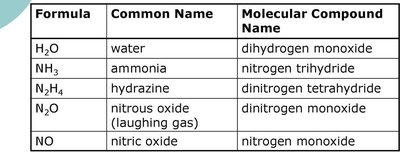
Some covalent compounds have common names that differ from their systematic molecular names. The following table compares these names:
Formula | Common Name | Molecular Compound Name |
|---|---|---|
H2O | water | dihydrogen monoxide |
NH3 | ammonia | nitrogen trihydride |
N2H4 | hydrazine | dinitrogen tetrahydride |
N2O | nitrous oxide (laughing gas) | dinitrogen monoxide |
NO | nitric oxide | nitrogen monoxide |
Summary Table: Ionic vs. Covalent Compounds
Type | Formation | Example |
|---|---|---|
Ionic | Transfer of electrons (metal + non-metal) | NaCl, MgO |
Covalent | Sharing of electrons (non-metal + non-metal) | H2O, CO2 |
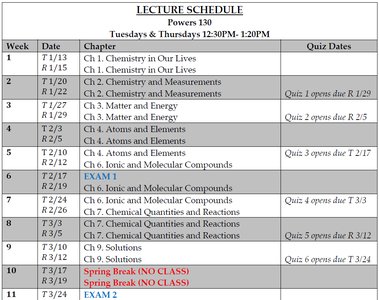
Lecture Schedule Context
The lecture schedule confirms that Ch.6 "Ionic and Molecular Compounds" is a core topic in the course, with quizzes and exams covering this material.