 Back
BackIonic and Molecular Compounds: Structure, Naming, and Formulas
Study Guide - Smart Notes
 Tailored notes based on your materials, expanded with key definitions, examples, and context.
Ch. 6: Ionic and Molecular Compounds
Introduction to Chemical Bonds
Chemical bonds are the forces that hold atoms together in compounds. There are two main types of chemical bonds: ionic bonds and covalent bonds. Understanding these bonds is essential for predicting compound formation, properties, and nomenclature.
Ionic bonds: Involve the transfer of electrons from one atom to another, typically between a metal and a non-metal, resulting in the formation of ions.
Covalent bonds: Involve the sharing of electrons between two non-metal atoms, resulting in the formation of molecules.
Ions and Ionic Compounds
Ions are charged particles formed when atoms gain or lose electrons. Ionic compounds are formed by the electrostatic attraction between positively charged cations and negatively charged anions.
Cation: A positively charged ion (e.g., Na+, Mg2+).
Anion: A negatively charged ion (e.g., Cl-, O2-).
Formation: Metals lose electrons to form cations; non-metals gain electrons to form anions.
Predicting Ionic Compound Formulas
To write the formula for an ionic compound, balance the total positive and negative charges so the compound is electrically neutral.
Example 1: Magnesium and chlorine combine to form MgCl2 because Mg forms Mg2+ and Cl forms Cl-. Two Cl- ions are needed to balance one Mg2+ ion.
Example 2: Magnesium and phosphorus combine to form Mg3P2 (Mg2+ and P3-).
Example 3: Lithium and sulfur combine to form Li2S (Li+ and S2-).
General Rule: The total positive charge must equal the total negative charge in the formula.
Examples of Ionic Compound Formation
Boron (B3+) and Fluorine (F-): BF3
Potassium (K+) and Sulfur (S2-): K2S
Magnesium (Mg2+) and Nitrogen (N3-): Mg3N2
Naming Ionic Compounds
The name of an ionic compound is derived from the names of its constituent ions.
Name the cation first using the element's name.
Name the anion second, modifying the element's name to end with -ide.
Example: Na2S is named sodium sulfide.
Example: MgO is named magnesium oxide.
Covalent (Molecular) Compounds
Covalent compounds are formed when two non-metals share electrons. Each shared pair of electrons constitutes a covalent bond, represented by a single line in structural formulas.
Example: Two fluorine atoms share electrons to form F2.
Common covalent molecules: NH3, CO2, H2O, CH4, H2, N2, O2, F2, Cl2
Naming Covalent Compounds
The names of covalent compounds use prefixes to indicate the number of each type of atom present. The first element is named in full; the second element's name ends with -ide.
Prefixes: mono- (1), di- (2), tri- (3), tetra- (4), penta- (5), hexa- (6), hepta- (7), octa- (8), nona- (9), deca- (10)
Note: The prefix 'mono-' is usually omitted for the first element.
Example: CO2 is carbon dioxide ("di-" for two oxygen atoms).
Example: S2Br2 is disulfur dibromide.
Other examples:
NO2: nitrogen dioxide
CO: carbon monoxide
N2O5: dinitrogen pentoxide
CCl4: carbon tetrachloride
IF7: iodine heptafluoride
Common Names of Covalent Compounds
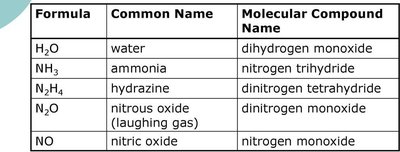
Some covalent compounds have common names that differ from their systematic names. The table below summarizes several examples:
Formula | Common Name | Molecular Compound Name |
|---|---|---|
H2O | water | dihydrogen monoxide |
NH3 | ammonia | nitrogen trihydride |
N2H4 | hydrazine | dinitrogen tetrahydride |
N2O | nitrous oxide (laughing gas) | dinitrogen monoxide |
NO | nitric oxide | nitrogen monoxide |
Summary Table: Types of Chemical Bonds
Bond Type | Formation | Example |
|---|---|---|
Ionic | Transfer of electrons (metal + non-metal) | NaCl, MgO |
Covalent | Sharing of electrons (non-metal + non-metal) | H2O, CO2 |
Additional info:
Polyatomic ions (e.g., SO42-, NO3-) are also important in ionic compounds but were not detailed in the provided material.
Lewis structures are used to represent the arrangement of electrons in molecules, especially for covalent compounds.
