 Back
BackMatter, Mixtures, and Energy: Foundations of Chemistry
Study Guide - Smart Notes
 Tailored notes based on your materials, expanded with key definitions, examples, and context.
Matter and Its Classification
Definition of Matter
Matter is anything that has mass and occupies space. All substances and materials in the universe are forms of matter, which can be classified based on their physical and chemical properties.
Classification of Matter
Pure Substances: Matter with a fixed or definite composition. Pure substances can be further divided into elements and compounds.
Mixtures: Matter that consists of two or more substances physically mixed together, but not chemically combined. Mixtures can be homogeneous or heterogeneous.


Pure Substances
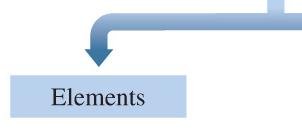
Elements: The simplest type of pure substance, consisting of only one kind of atom. Elements cannot be broken down into simpler substances by chemical means.
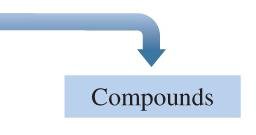
Compounds: Pure substances composed of two or more elements chemically combined in a fixed ratio. Compounds can be broken down into their elements by chemical reactions.
Mixtures
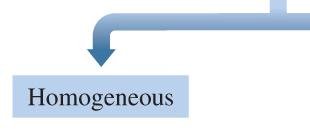
Homogeneous Mixtures (Solutions): Mixtures with a uniform composition throughout. The individual components are not distinguishable.
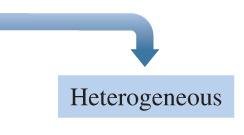
Heterogeneous Mixtures: Mixtures in which the composition is not uniform and the different components are visible.
Examples of Matter Types
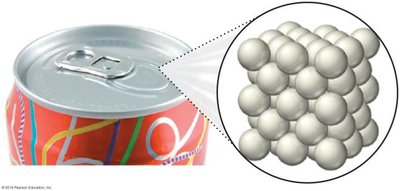
Element Example: Aluminum in a soda can is a pure element, consisting of only aluminum atoms.
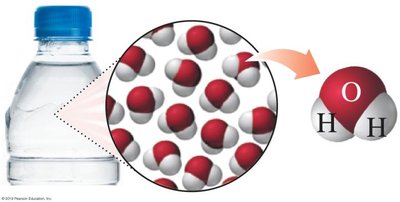
Compound Example: Water in a bottle is a compound, made of hydrogen and oxygen atoms chemically bonded in a 2:1 ratio.
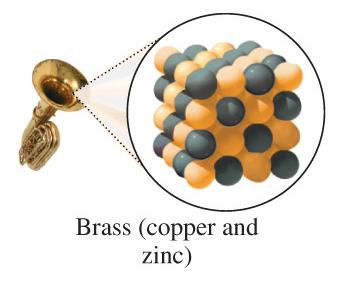
Homogeneous Mixture Example: Brass (an alloy of copper and zinc) is a homogeneous mixture because its composition is uniform throughout.
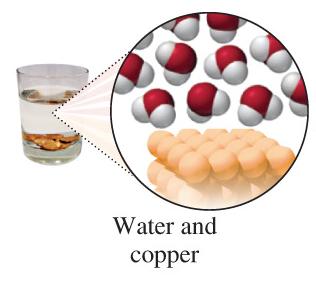
Heterogeneous Mixture Example: A mixture of water and copper metal, where the two substances remain distinct and separate.
Separation of Mixtures
Physical Methods of Separation
Mixtures can be separated into their components by physical methods, which do not change the identities of the substances involved.
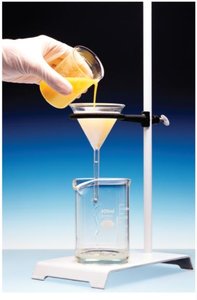
Filtration: Used to separate a solid from a liquid in a heterogeneous mixture (e.g., sand from water).
Decantation: Pouring off a liquid to separate it from a solid or another liquid of different density.

States of Matter and Changes of State
States of Matter
Matter exists in three primary states: solid, liquid, and gas. Each state is characterized by the arrangement and movement of its particles.
Solid: Particles are closely packed in a fixed position and vibrate in place.
Liquid: Particles are close together but can move past one another, allowing liquids to flow.
Gas: Particles are far apart and move freely, filling the volume of their container.
Changes of State
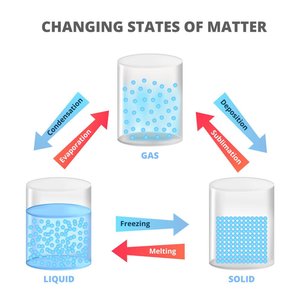
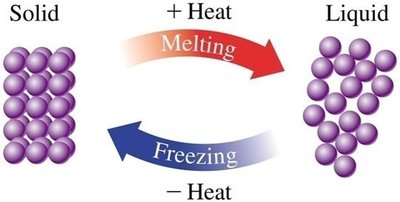
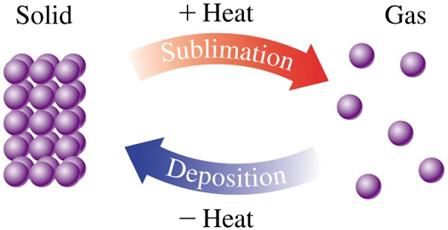
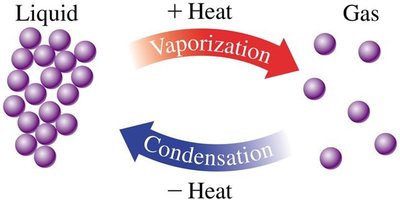
Physical changes that involve the conversion of a substance from one state to another are called changes of state. These include melting, freezing, vaporization, condensation, sublimation, and deposition.
Melting: Solid to liquid
Freezing: Liquid to solid
Vaporization (Boiling/Evaporation): Liquid to gas
Condensation: Gas to liquid
Sublimation: Solid to gas
Deposition: Gas to solid
Energy and Temperature
Temperature Scales
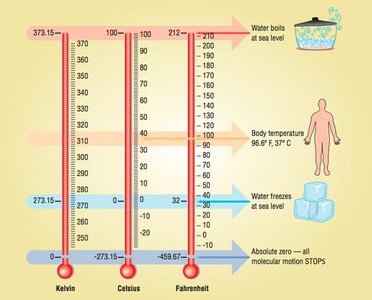
Temperature is a measure of the average kinetic energy of the particles in a substance. The three main temperature scales are Celsius (°C), Fahrenheit (°F), and Kelvin (K).
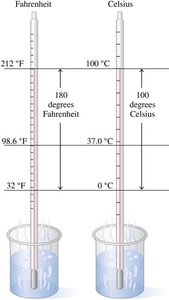
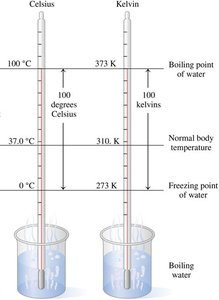
Celsius: Water freezes at 0°C and boils at 100°C.
Fahrenheit: Water freezes at 32°F and boils at 212°F.
Kelvin: The absolute temperature scale; water freezes at 273 K and boils at 373 K. 0 K is absolute zero, where all molecular motion stops.
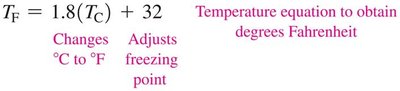
Temperature Conversion Equations
Celsius to Fahrenheit:
Celsius to Kelvin:
Specific Heat and Energy Transfer
Specific Heat
Specific heat is the amount of heat required to raise the temperature of 1 gram of a substance by 1°C (or 1 K). Different substances have different specific heats, which affects how quickly they heat up or cool down.
Water: High specific heat (4.18 J/g·°C), meaning it heats up and cools down slowly.
Sand and Asphalt: Lower specific heats, so they heat up and cool down more quickly than water.
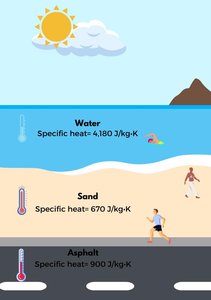
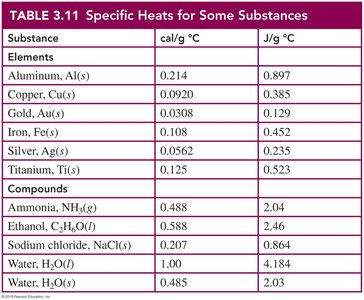
Table: Specific Heats for Some Substances
Substance | cal/g °C | J/g °C |
|---|---|---|
Aluminum, Al(s) | 0.214 | 0.897 |
Copper, Cu(s) | 0.0920 | 0.385 |
Gold, Au(s) | 0.0308 | 0.129 |
Iron, Fe(s) | 0.108 | 0.452 |
Silver, Ag(s) | 0.0562 | 0.235 |
Titanium, Ti(s) | 0.125 | 0.523 |
Ammonia, NH3(g) | 0.488 | 2.04 |
Ethanol, C2H5OH(l) | 0.588 | 2.46 |
Sodium chloride, NaCl(s) | 0.207 | 0.864 |
Water, H2O(l) | 1.00 | 4.184 |
Water, H2O(s) | 0.485 | 2.03 |
Phase Changes and Energy Diagrams
Heating and Cooling Curves
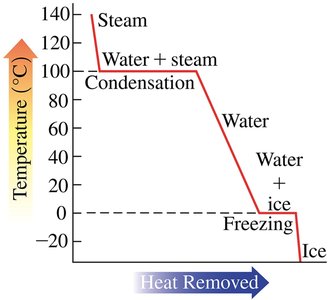
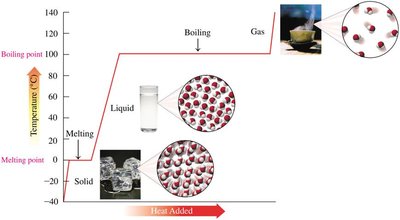
Heating and cooling curves show how the temperature of a substance changes as heat is added or removed. Plateaus on the curve represent phase changes, where temperature remains constant as the substance changes state.
Melting Point: The temperature at which a solid turns into a liquid.
Boiling Point: The temperature at which a liquid turns into a gas.
Summary Table: Classification of Matter
Type | Description | Example |
|---|---|---|
Element | Pure substance, one type of atom | Aluminum (Al) |
Compound | Pure substance, two or more elements chemically combined | Water (H2O) |
Homogeneous Mixture | Uniform composition throughout | Brass (Cu and Zn) |
Heterogeneous Mixture | Non-uniform composition, visible components | Water and copper |
Additional info: The images and tables provided reinforce the classification of matter, physical separation techniques, temperature scales, specific heat, and phase changes, which are foundational concepts in introductory chemistry courses.
