 Back
BackStep-by-Step Guidance for GOB Chemistry Study Questions
Study Guide - Smart Notes
 Tailored notes based on your materials, expanded with key definitions, examples, and context.
Q1. Identify each of the following as an observation, a hypothesis, an experiment, or a conclusion:
a. Drinking coffee at night keeps me awake.
b. I will try drinking coffee only in the morning.
c. If I stop drinking coffee in the afternoon, I will be able to sleep at night.
Background
Topic: Scientific Method
This question tests your understanding of the steps in the scientific method, including observation, hypothesis, experiment, and conclusion. Recognizing these steps is fundamental in scientific inquiry and problem-solving.

Key Terms:
Observation: Noting or recording a fact or occurrence.
Hypothesis: A proposed explanation or prediction based on limited evidence.
Experiment: A test or trial to investigate a hypothesis.
Conclusion: A judgment or decision reached after considering the results of an experiment.
Step-by-Step Guidance
Read each statement carefully and determine whether it describes a fact, a prediction, a test, or a result.
Recall that an observation is something you notice or record, a hypothesis is a prediction or explanation, an experiment is an action to test the hypothesis, and a conclusion is what you decide after the experiment.
Match each statement to the correct step of the scientific method based on its description.
Try solving on your own before revealing the answer!
Final Answer:
a. observation
b. experiment
c. hypothesis
Each statement fits a specific step in the scientific method, helping you understand how scientific inquiry is structured.
Q2. What is another way that student b in Sample Problem 1.2 could improve his or her retrieval of information?
Background
Topic: Strategies for Learning Chemistry
This question is about effective study techniques, specifically how to improve memory and retrieval of information for exams.
Key Terms:
Retrieval practice: Actively recalling information to strengthen memory.
Retesting: Practicing problems again after a delay to reinforce learning.
Step-by-Step Guidance
Think about methods that help reinforce learning, such as spaced repetition and self-testing.
Consider how practicing problems after a few days can help you remember information better.
Reflect on the benefits of reviewing material multiple times and testing yourself to check your understanding.
Try solving on your own before revealing the answer!
Final Answer:
Student b could wait two or three days and practice working the problems in each Section again. Retesting strengthens connections between new and previously learned information for longer lasting memory and more efficient retrieval.
Q3. Which of the following activities should you include in your study plan for learning chemistry successfully?
a. reading the chapter over and over until you think you understand it
b. going to the professor’s office hours
c. self-testing during and after reading each Section
d. waiting to study until the night before the exam
e. trying to work the Sample Problem before looking at the Solution
f. retesting on new information a few days later
Background
Topic: Study Skills and Planning
This question tests your ability to identify effective study strategies for learning chemistry.
Key Terms:
Self-testing: Practicing retrieval by testing yourself on material.
Retesting: Reviewing material after a delay to reinforce learning.
Office hours: Seeking help from your professor to clarify concepts.
Step-by-Step Guidance
Review each activity and consider whether it promotes active learning or passive review.
Identify which activities involve engaging with the material, practicing retrieval, or seeking help.
Exclude activities that are less effective, such as cramming or only reading without practice.
Try solving on your own before revealing the answer!
Final Answer:
b. going to the professor’s office hours
c. self-testing during and after reading each Section
e. trying to work the Sample Problem before looking at the Solution
f. retesting on new information a few days later
These activities are proven to enhance learning and retention in chemistry.
Q4. Which of the following will help you learn chemistry?
a. skipping review sessions
b. working problems as you read a Section
c. staying up all night before an exam
d. reading the assignment before class
Background
Topic: Study Habits
This question asks you to identify which habits are most effective for learning chemistry.
Key Terms:
Active learning: Engaging with material through practice and review.
Preparation: Reading assignments before class to be ready for new material.
Step-by-Step Guidance
Evaluate each option for its effectiveness in promoting understanding and retention.
Recognize that working problems and preparing before class are active learning strategies.
Identify which options are less effective or even detrimental to learning.
Try solving on your own before revealing the answer!
Final Answer:
b. working problems as you read a Section
d. reading the assignment before class
These strategies help you actively engage with the material and prepare for class discussions.
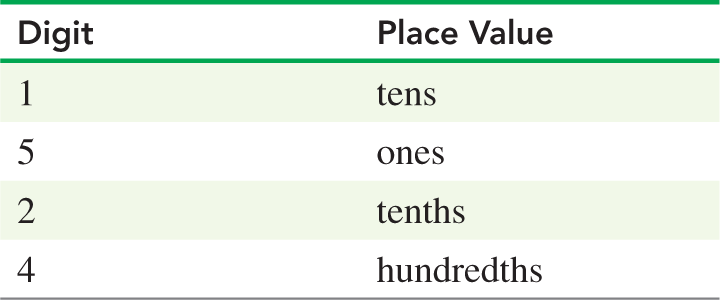
Q5. A bullet found at a crime scene has a mass of 15.24 g. What are the place values for each of the digits in the mass of the bullet?
Background
Topic: Place Value in Chemistry Measurements
This question tests your understanding of how each digit in a measured value represents a specific place value, which is important for reporting and interpreting data in chemistry.
Key Terms:
Place value: The value of a digit based on its position in a number.
Significant figures: Digits in a measurement that are meaningful in terms of precision.
Step-by-Step Guidance
Write out the number and identify the position of each digit (tens, ones, tenths, hundredths).
Match each digit to its corresponding place value using a place value chart.
Understand how place value relates to the precision of the measurement.
Try solving on your own before revealing the answer!
Final Answer:
1: tens
5: ones
2: tenths
4: hundredths
Each digit's place value helps you understand the precision of the measurement.
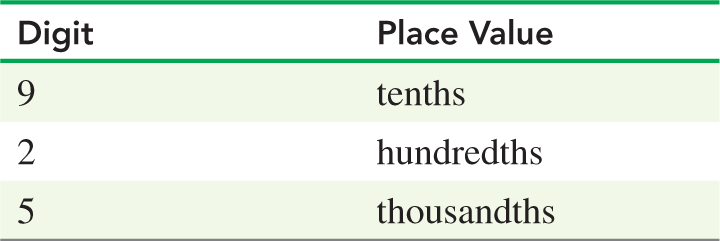
Q6. A bullet found at a crime scene contains 0.925 g of lead. What are the place values for each of the digits in the mass of the lead?
Background
Topic: Place Value in Chemistry Measurements
This question is similar to the previous one, focusing on the place value of digits in a decimal measurement.
Key Terms:
Place value: The value of a digit based on its position in a number.
Step-by-Step Guidance
Write out the number and identify the position of each digit after the decimal point (tenths, hundredths, thousandths).
Use a place value chart to match each digit to its place value.
Consider how the place value affects the precision of the measurement.
Try solving on your own before revealing the answer!
Final Answer:
9: tenths
2: hundredths
5: thousandths
Understanding place value is essential for accurate reporting of measurements.
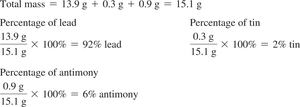
Q7. A bullet found at a crime scene contains 13.9 g of lead, 0.3 g of tin, and 0.9 g of antimony. What is the percentage of each metal in the bullet? Express your answers to the ones place.
Background
Topic: Calculating Percent Composition
This question tests your ability to calculate the percentage of each component in a mixture, a common task in chemistry for analyzing samples.

Key Formula:
Step-by-Step Guidance
Calculate the total mass of the bullet by adding the masses of lead, tin, and antimony.
Set up the percentage calculation for each metal using the formula above.
Plug in the values for each metal and multiply by 100% to get the percentage.
Express your answers to the ones place as requested.
Try solving on your own before revealing the answer!
Final Answer:
Lead: 92%
Tin: 2%
Antimony: 6%
Percent composition helps identify the makeup of a sample, which is important in forensic chemistry.
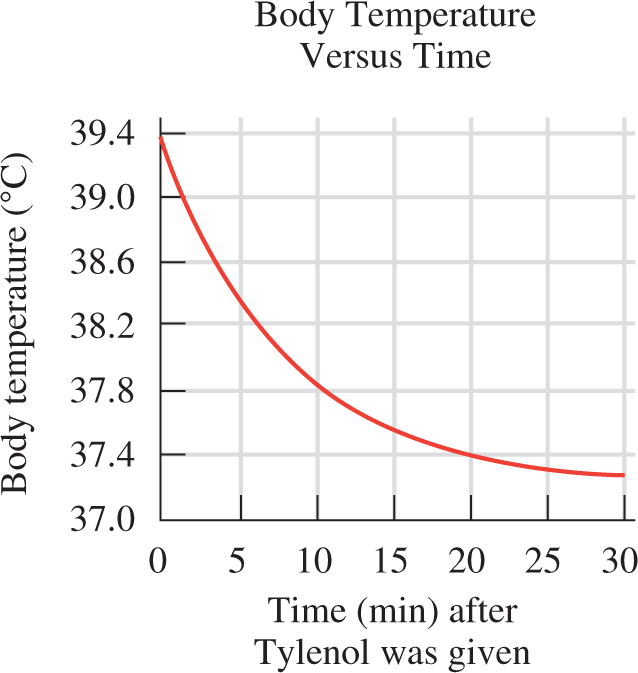
Q8. A nurse administers Tylenol to lower a child’s fever. The graph shows the body temperature of the child plotted against time. What is measured on the vertical axis? What is the range of values on the vertical axis? What is measured on the horizontal axis? What is the range of values on the horizontal axis?
Background
Topic: Interpreting Graphs in Chemistry and Health Sciences
This question tests your ability to read and interpret data from a graph, a key skill in both chemistry and health sciences.
Key Terms:
Vertical axis (y-axis): The axis that runs up and down, usually representing the dependent variable.
Horizontal axis (x-axis): The axis that runs left to right, usually representing the independent variable.
Step-by-Step Guidance
Examine the graph and identify what is labeled on each axis.
Determine the range of values for each axis by looking at the minimum and maximum values.
Understand how the data is plotted and what it represents in the context of the experiment.
Try solving on your own before revealing the answer!
Final Answer:
Vertical axis: body temperature (°C), range 37.0°C to 39.4°C
Horizontal axis: time (min) after Tylenol was given, range 0 min to 30 min
Interpreting graphs is essential for understanding experimental results and trends.
Q9. Write each of the following in scientific notation: a. 3500 b. 0.000016
Background
Topic: Scientific Notation
This question tests your ability to convert standard numbers into scientific notation, which is important for expressing very large or very small values in chemistry.

Key Terms and Formula:
Scientific notation: A way to express numbers as a coefficient times a power of ten.
Coefficient: A number at least 1 but less than 10.
Power of ten: Indicates how many places the decimal point is moved.
Step-by-Step Guidance
For each number, move the decimal point to create a coefficient between 1 and 10.
Count the number of places the decimal point is moved; this becomes the exponent for the power of ten.
For numbers greater than 1, the exponent is positive; for numbers less than 1, the exponent is negative.
Write the number in the form .
Try solving on your own before revealing the answer!
Final Answer:
a.
b.
Scientific notation makes it easier to work with very large or very small numbers in chemistry.
