Pearson+ LogoPearson+ Logo
Ch.4 Atoms and Elements
Timberlake - Chemistry: An Introduction to General, Organic, and Biological Chemistry 14th Edition
Timberlake14thChemistry: An Introduction to General, Organic, and Biological ChemistryISBN: 9781292472249Not the one you use?Change textbook
Chapter 4, Problem 104a,b

Provide the following:
a. the atomic number and symbol of the lightest alkali metal
b. the atomic number and symbol of the heaviest noble gas

Verified step by step guidance
1
Step 1: Recall the definition of alkali metals. Alkali metals are elements in Group 1 of the periodic table, excluding hydrogen. They are highly reactive metals.
Step 2: Identify the lightest alkali metal. The lightest alkali metal is the one with the smallest atomic number in Group 1. Look at the periodic table to find this element.
Step 3: Note the atomic number and symbol of the lightest alkali metal. The atomic number represents the number of protons in the nucleus, and the symbol is the one- or two-letter abbreviation for the element.
Step 4: Recall the definition of noble gases. Noble gases are elements in Group 18 of the periodic table. They are inert and have a full valence electron shell.
Step 5: Identify the heaviest noble gas. The heaviest noble gas is the one with the largest atomic number in Group 18. Look at the periodic table to find this element and note its atomic number and symbol.

Key Concepts

Here are the essential concepts you must grasp in order to answer the question correctly.

Alkali Metals

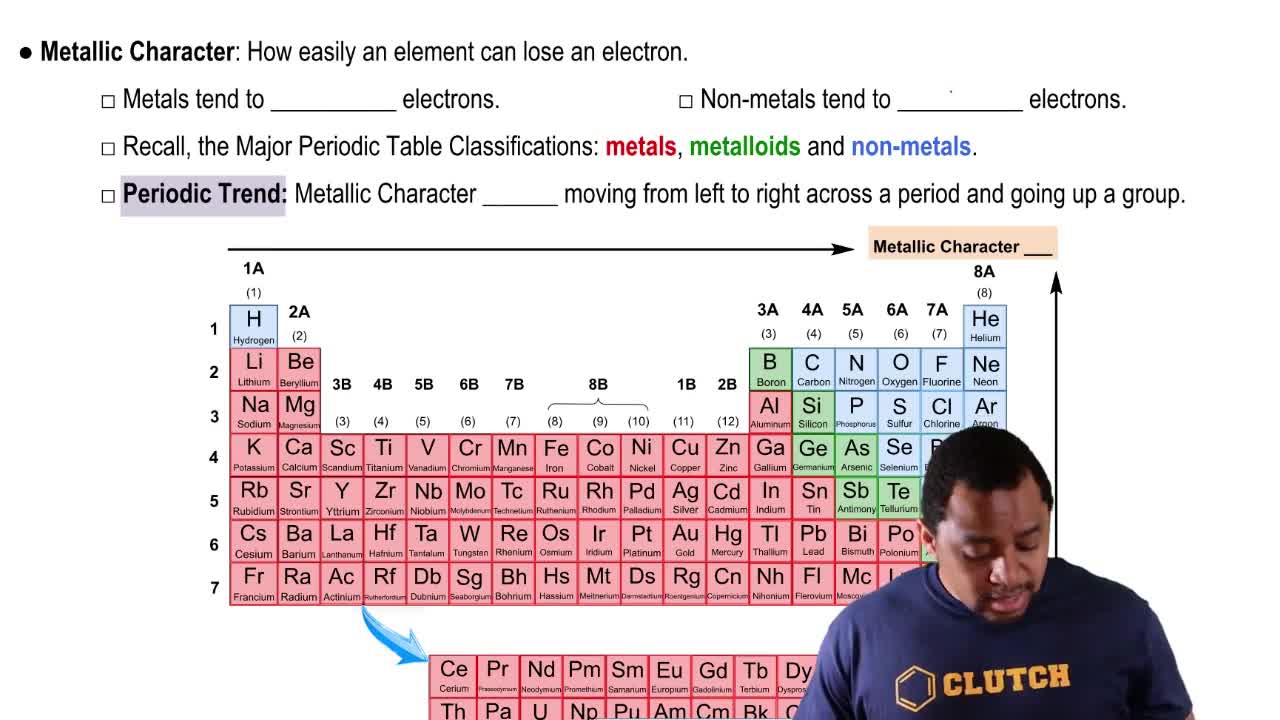
Alkali metals are a group of elements found in Group 1 of the periodic table, characterized by their single valence electron. This group includes lithium, sodium, potassium, rubidium, cesium, and francium. The lightest alkali metal is lithium, which has an atomic number of 3 and is known for its reactivity and use in batteries.
Recommended video:
Guided course
01:08
Periodic Trend: Metallic Character

Noble Gases

Noble gases are located in Group 18 of the periodic table and are known for their lack of reactivity due to having a full valence shell of electrons. This group includes helium, neon, argon, krypton, xenon, and radon. The heaviest noble gas is radon, which has an atomic number of 86 and is notable for its radioactivity and use in certain types of radiation therapy.
Recommended video:
Guided course
14:42
Test for Anions

Atomic Number and Symbol

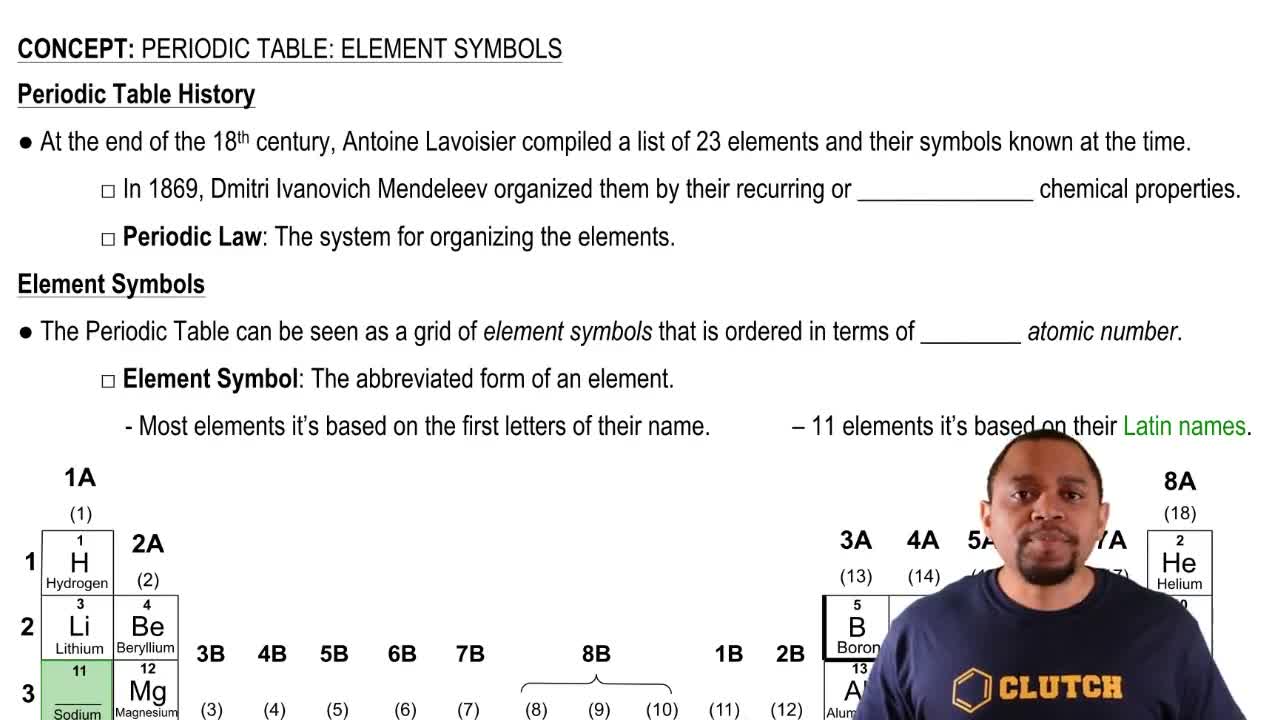
The atomic number of an element is the number of protons in its nucleus, which determines its position in the periodic table and its chemical properties. Each element is also represented by a unique chemical symbol, typically one or two letters derived from its name. For example, lithium is represented by 'Li' and radon by 'Rn'.
Recommended video:
Guided course
04:01
Periodic Table: Symbols Concept