Pearson+ LogoPearson+ Logo
Ch.4 Atoms and Elements
Timberlake - Chemistry: An Introduction to General, Organic, and Biological Chemistry 14th Edition
Timberlake14thChemistry: An Introduction to General, Organic, and Biological ChemistryISBN: 9781292472249Not the one you use?Change textbook
Chapter 4, Problem 104c,d

Provide the following:
c. the atomic mass and symbol of the alkaline earth metal in Period 3
d. the atomic mass and symbol of the halogen with the fewest electrons

Verified step by step guidance
1
Step 1: Identify the alkaline earth metals in the periodic table. Alkaline earth metals are located in Group 2 of the periodic table.
Step 2: Locate Period 3 in the periodic table. Periods are horizontal rows, and Period 3 contains elements with atomic numbers 11 through 18.
Step 3: Find the alkaline earth metal in Period 3. This element will be in Group 2 and Period 3. Note its atomic symbol and atomic mass.
Step 4: Identify the halogens in the periodic table. Halogens are located in Group 17 of the periodic table.
Step 5: Determine the halogen with the fewest electrons. This will be the halogen with the smallest atomic number in Group 17. Note its atomic symbol and atomic mass.

Key Concepts

Here are the essential concepts you must grasp in order to answer the question correctly.

Alkaline Earth Metals

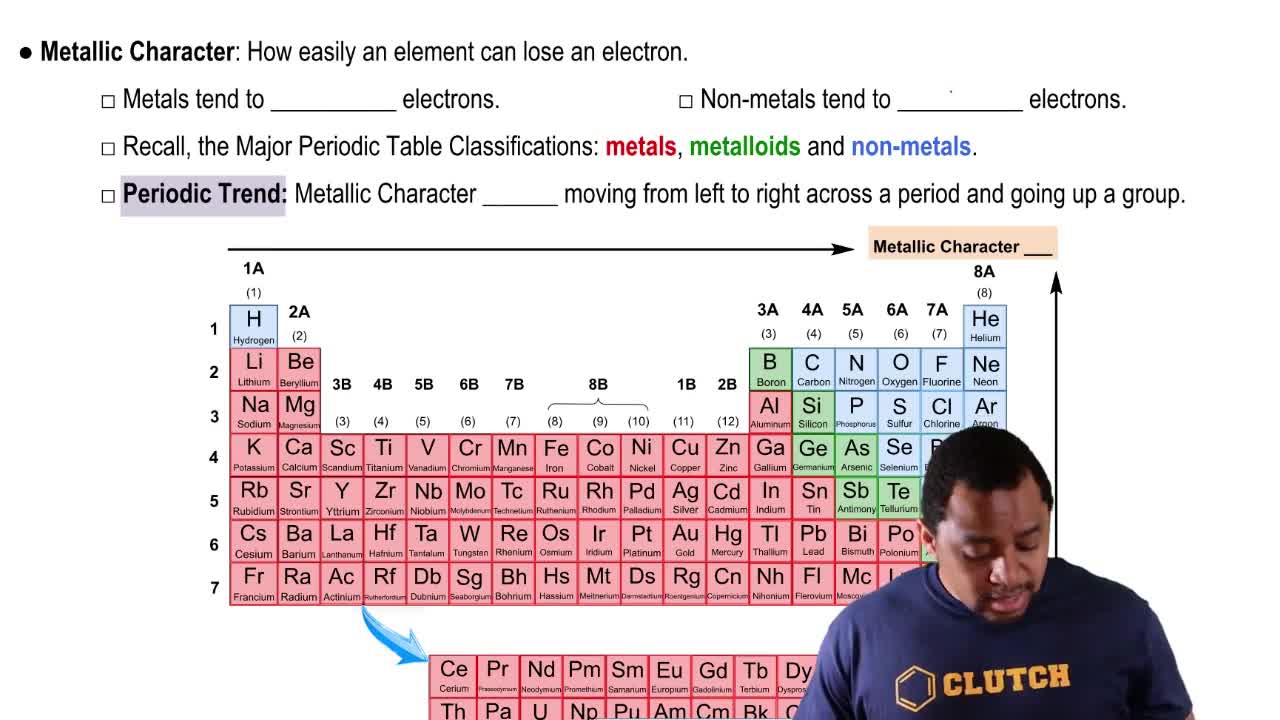
Alkaline earth metals are a group of elements found in Group 2 of the periodic table. They are characterized by having two electrons in their outermost shell, which makes them highly reactive, though less so than alkali metals. In Period 3, the alkaline earth metal is magnesium (Mg), which has an atomic mass of approximately 24.31 u.
Recommended video:
Guided course
01:08
Periodic Trend: Metallic Character

Halogens

Halogens are elements located in Group 17 of the periodic table, known for their high reactivity due to having seven electrons in their outer shell. The halogen with the fewest electrons is astatine (At), which has an atomic number of 85 and an atomic mass of about 210 u. Halogens typically form salts when they react with metals.
Recommended video:
Guided course
1:11
Halogenation Reactions Concept 1

Periodic Table

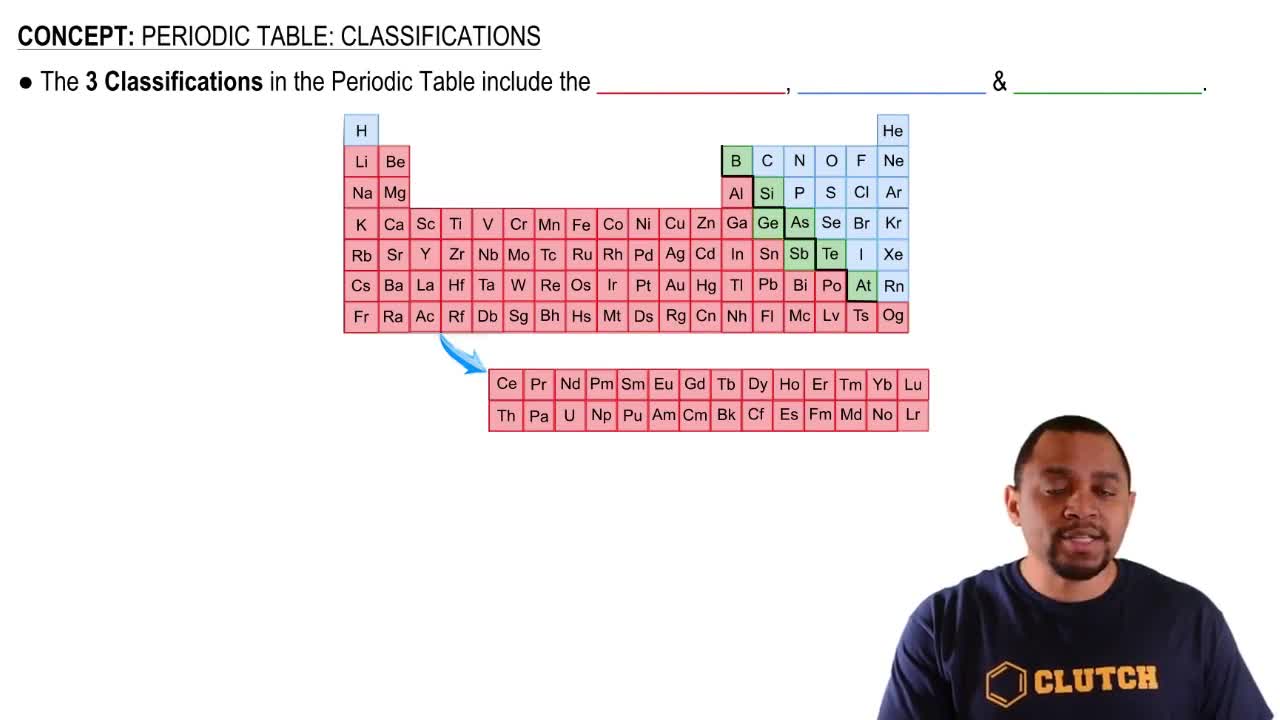
The periodic table is a systematic arrangement of elements based on their atomic number, electron configuration, and recurring chemical properties. It is organized into periods (rows) and groups (columns), which helps predict the behavior of elements. Understanding the layout of the periodic table is essential for identifying elements and their properties, such as atomic mass and reactivity.
Recommended video:
Guided course
02:40
Periodic Table: Classifications