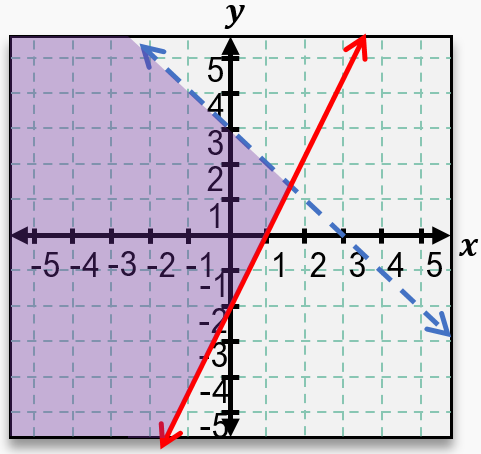
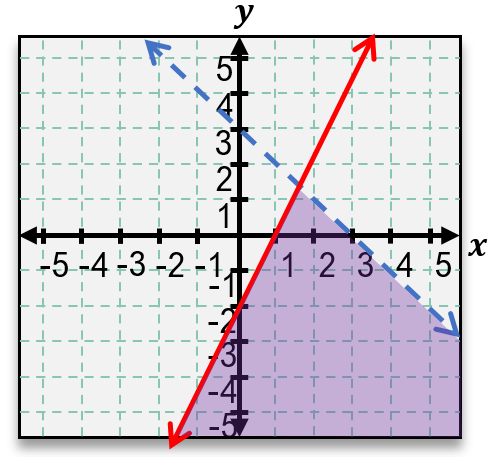
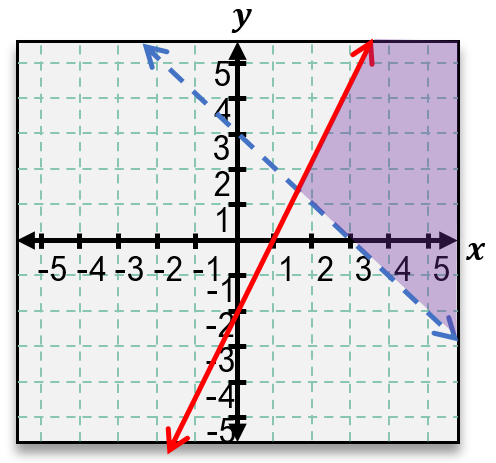
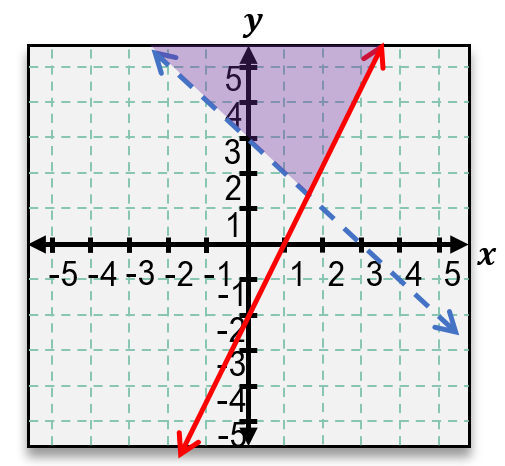
Graphing a system of inequalities involves combining the concepts of graphing individual linear inequalities and identifying their overlapping solution regions. Unlike systems of linear equations, which can be solved algebraically, systems of inequalities are typically solved by graphing each inequality and shading the appropriate regions to find where all conditions are simultaneously satisfied.
To graph each inequality, start by converting the inequality into an equation by replacing the inequality symbol with an equal sign. This allows you to graph the boundary line. For example, the inequality \(y \leq -x + 4\) corresponds to the line \(y = -x + 4\), which has a y-intercept of 4 and a slope of -1. The line is drawn solid if the inequality includes equality (≤ or ≥), and dashed if it does not (< or >).
Next, determine which side of the boundary line to shade. This is done by selecting a test point not on the line, commonly the origin \((0,0)\) if it is not on the line, and substituting its coordinates into the inequality. If the inequality holds true for the test point, shade the side of the line containing that point; if false, shade the opposite side. For instance, testing \((0,0)\) in \(y \leq -x + 4\) yields \(0 \leq 4\), which is true, so shade the side including \((0,0)\).
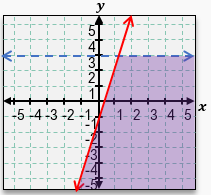
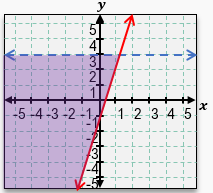
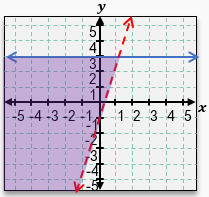
Repeat this process for each inequality in the system. For example, for \(y > 2x + 1\), graph the dashed line \(y = 2x + 1\) (since the inequality is strict), then test \((0,0)\): \(0 > 1\) is false, so shade the side opposite to \((0,0)\), which is above the line.
The solution to the system of inequalities is the region where the shaded areas overlap. This overlapping region represents all points that satisfy every inequality simultaneously. If no such region exists, the system has no solution.
By carefully graphing each boundary line and shading the correct regions, you can visually identify the solution set to any system of linear inequalities. This method reinforces understanding of linear functions, inequalities, and the geometric interpretation of their solutions.