 Back
BackIntermediate Algebra: Rational Expressions and Functions
Study Guide - Smart Notes
 Tailored notes based on your materials, expanded with key definitions, examples, and context.
Rational Expressions and Functions
Definition of Rational Expressions
A rational expression is a fraction in which the numerator and/or the denominator are polynomials. Rational expressions are also called fractional algebraic expressions.
Form: \( \frac{P(x)}{Q(x)} \), where \( Q(x) \neq 0 \)
Restriction: Any value of the variable that makes the denominator zero is excluded from the domain.
Example: \( \frac{2x-4}{x+5} \), with restriction \( x \neq -5 \)
Basic Rule of Fractions
For any polynomials \( a, b, c \), where \( b \neq 0 \) and \( c \neq 0 \):
\( \frac{a}{b} \cdot \frac{c}{d} = \frac{ac}{bd} \)
\( \frac{a}{b} \div \frac{c}{d} = \frac{ad}{bc} \)
Simplifying Rational Expressions
Factoring and Reducing
To simplify a rational expression, factor both the numerator and denominator completely, then divide out any common factors.
Example: \( \frac{5x+10}{2x+2} = \frac{5(x+2)}{2(x+1)} \)
Example: \( \frac{2x^2+9x+14}{4x+4} = \frac{(2x+7)(x+2)}{4(x+1)} \)
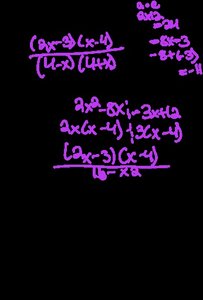
Special Cases: Factoring Out Negatives
When factoring a negative from a polynomial, the sign of each term changes.
Example: \( \frac{8-6x}{3-4x} = \frac{2(4-3x)}{-(4x-3)} = -2 \)
Multiplying and Dividing Rational Expressions
Multiplication
To multiply rational expressions, multiply the numerators together and the denominators together, then simplify.
Formula: \( \frac{a}{b} \cdot \frac{c}{d} = \frac{ac}{bd} \)
Example: \( \frac{x^2-49}{x^2-25} \cdot \frac{x+7}{x-5} = \frac{(x+7)(x-7)(x+7)}{(x+5)(x-5)(x-5)} \)
Division
To divide rational expressions, multiply by the reciprocal of the divisor.
Formula: \( \frac{a}{b} \div \frac{c}{d} = \frac{a}{b} \cdot \frac{d}{c} = \frac{ad}{bc} \)
Example: \( \frac{2x^2-8x}{4x^2+4x} \div \frac{x-4}{x+1} = \frac{2x(x-4)}{4x(x+1)} \cdot \frac{x+1}{x-4} = \frac{2x}{4x} = \frac{1}{2} \)
Adding and Subtracting Rational Expressions
Finding the Least Common Denominator (LCD)
To add or subtract rational expressions, first find the LCD of the denominators.
Factor each denominator completely.
List all different prime factors, each raised to the highest power that appears.
Multiply these factors to get the LCD.
Example: For denominators 16 and 56, \( 16 = 2^4 \), \( 56 = 2^3 \times 7 \). LCD = \( 2^4 \times 7 = 112 \).
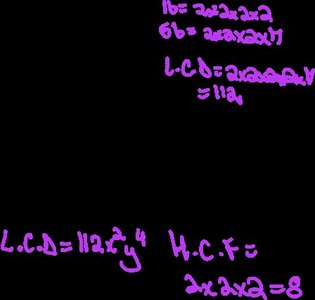
Addition and Subtraction Process
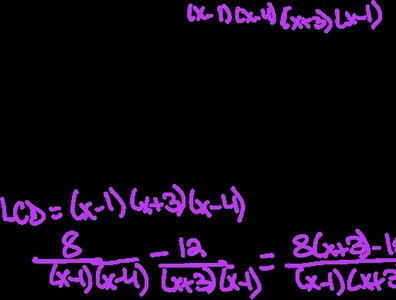
Once the LCD is found, rewrite each fraction with the LCD as the denominator, then add or subtract the numerators.
Formula: \( \frac{a}{b} + \frac{c}{b} = \frac{a+c}{b} \)
Formula: \( \frac{a}{b} - \frac{c}{b} = \frac{a-c}{b} \)
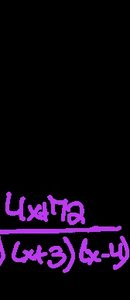
Example: \( \frac{8}{(x-1)(x+3)} - \frac{12}{(x+3)(x-4)} = \frac{8(x-4)-12(x-1)}{(x-1)(x+3)(x-4)} \)
Complex Rational Expressions
Definition and Simplification Methods
A complex rational expression (complex fraction) contains a fraction in its numerator, denominator, or both. There are two main methods for simplifying:
Method 1: Combine the fractions in the numerator and denominator into single fractions, then divide (multiply by the reciprocal).
Method 2: Multiply the numerator and denominator by the LCD of all the fractions to clear denominators, then simplify.
Example: \( \frac{\frac{2}{c} + \frac{4}{c^2}}{\frac{7}{2c}} \) can be simplified by combining and/or multiplying by the LCD.
Rational Equations
Solving Rational Equations
To solve equations involving rational expressions:
Find the LCD of all denominators.
Multiply both sides of the equation by the LCD to clear denominators.
Solve the resulting equation.
Check for extraneous solutions (values that make any denominator zero).
Example: \( \frac{1}{x} + \frac{5}{6} = \frac{2}{3} \) → Multiply both sides by 6x, solve for x, and check the solution.
Applications: Formulas and Advanced Ratio Exercises
Solving for a Variable in a Formula
Rational equations often appear in formulas. To solve for a variable, clear denominators and isolate the desired variable.
Example: \( \frac{1}{f} = \frac{1}{a} + \frac{1}{b} \) → Solve for a.
Proportions and Similar Triangles
Proportions are equations stating that two ratios are equal. In geometry, similar triangles have proportional sides.
Example: If \( \frac{17}{14} = \frac{23}{y} \), cross-multiply to solve for y.
Distance, Rate, and Time Problems
Distance problems use the formula \( d = rt \) (distance = rate × time). When two objects travel the same time or distance, set up equations accordingly.
Example: If Terry drives 360 km at r+20 km/h and Kathy drives 280 km at r km/h in the same time, \( \frac{360}{r+20} = \frac{280}{r} \).
Work Problems
Work problems involve rates of work. If two people work together, their combined rate is the sum of their individual rates.
Example: Janice can do a job in 4 hours, Marie in 3 hours. Together: \( \frac{1}{4}x + \frac{1}{3}x = 1 \), solve for x.
