 Back
BackSolving Linear Equations with Fractions: Step-by-Step Guide
Study Guide - Smart Notes
 Tailored notes based on your materials, expanded with key definitions, examples, and context.
Equations, Inequalities, and Problem Solving
Solving Linear Equations Involving Fractions
Linear equations with fractions are common in intermediate algebra. The process involves clearing fractions, combining like terms, and isolating the variable. This example demonstrates a systematic approach to solving such equations and checking the solution.
Step 1: Clear Fractions Multiply both sides of the equation by the Least Common Denominator (LCD) of all fractions to eliminate denominators. Example: For the equation , the LCD is 90.
Step 2: Apply the Distributive Property Distribute the LCD to each term in the equation. Multiply:
Step 3: Combine Like Terms Add terms with the variable to simplify:
Step 4: Isolate the Variable Divide both sides by the coefficient of to solve for :
Step 5: Check the Solution Substitute the solution back into the original equation to verify correctness. Simplify and confirm both sides are equal.
Key Terms:
Least Common Denominator (LCD): The smallest number that is a common multiple of the denominators in the equation.
Distributive Property:
Multiplication Property of Equality: If , then for any .
Example:
Solve
LCD = 90
Multiply both sides by 90:
Distribute:
Combine:
Divide:
Check: Substitute back and confirm equality.
Applications: This method is used to solve equations in algebra, physics, and engineering where variables are distributed across fractions.
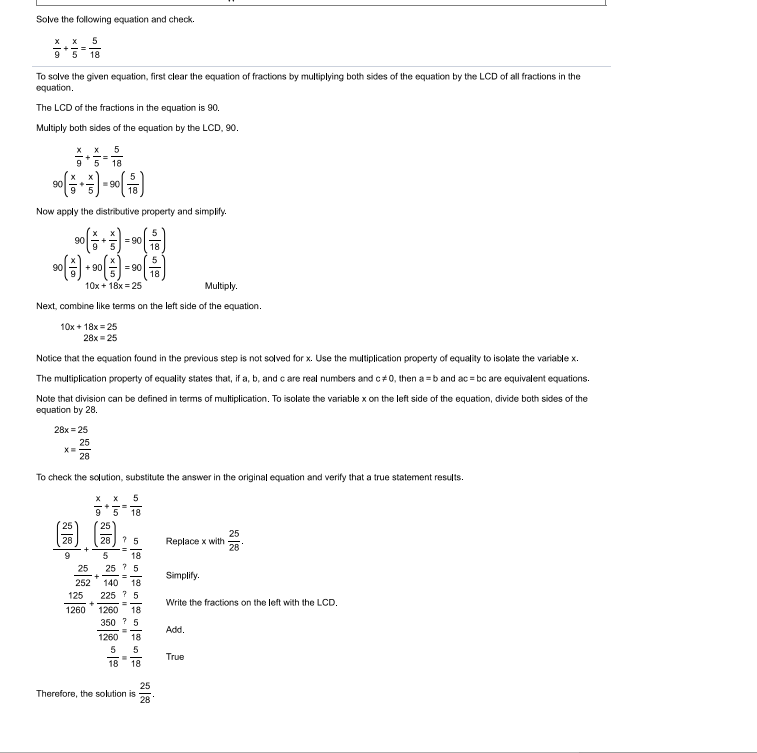
Additional info: The process shown is fundamental for solving equations in Ch. 2 - Equations, Inequalities, and Problem Solving. The example illustrates clearing fractions, combining like terms, and checking solutions, which are essential skills for intermediate algebra students.
