 Back
BackStudy Notes: Linear Equations in Two Variables and the Cartesian Plane
Study Guide - Smart Notes
 Tailored notes based on your materials, expanded with key definitions, examples, and context.
Linear Equations in Two Variables
Cartesian Plane
The Cartesian plane is a two-dimensional coordinate system defined by a horizontal axis (x-axis) and a vertical axis (y-axis). Each point on the plane is represented by an ordered pair (x, y), where x is the horizontal coordinate and y is the vertical coordinate.
Ordered Pair: A set of two numbers (x, y) that indicate the position of a point on the Cartesian plane.
Axes: The x-axis (horizontal) and y-axis (vertical) intersect at the origin (0, 0).
Quadrants: The plane is divided into four quadrants by the axes.
Example: Plotting the points A(3, 5), B(–4, –1), and C(0, 3) involves locating each ordered pair on the grid, moving x units horizontally and y units vertically from the origin.
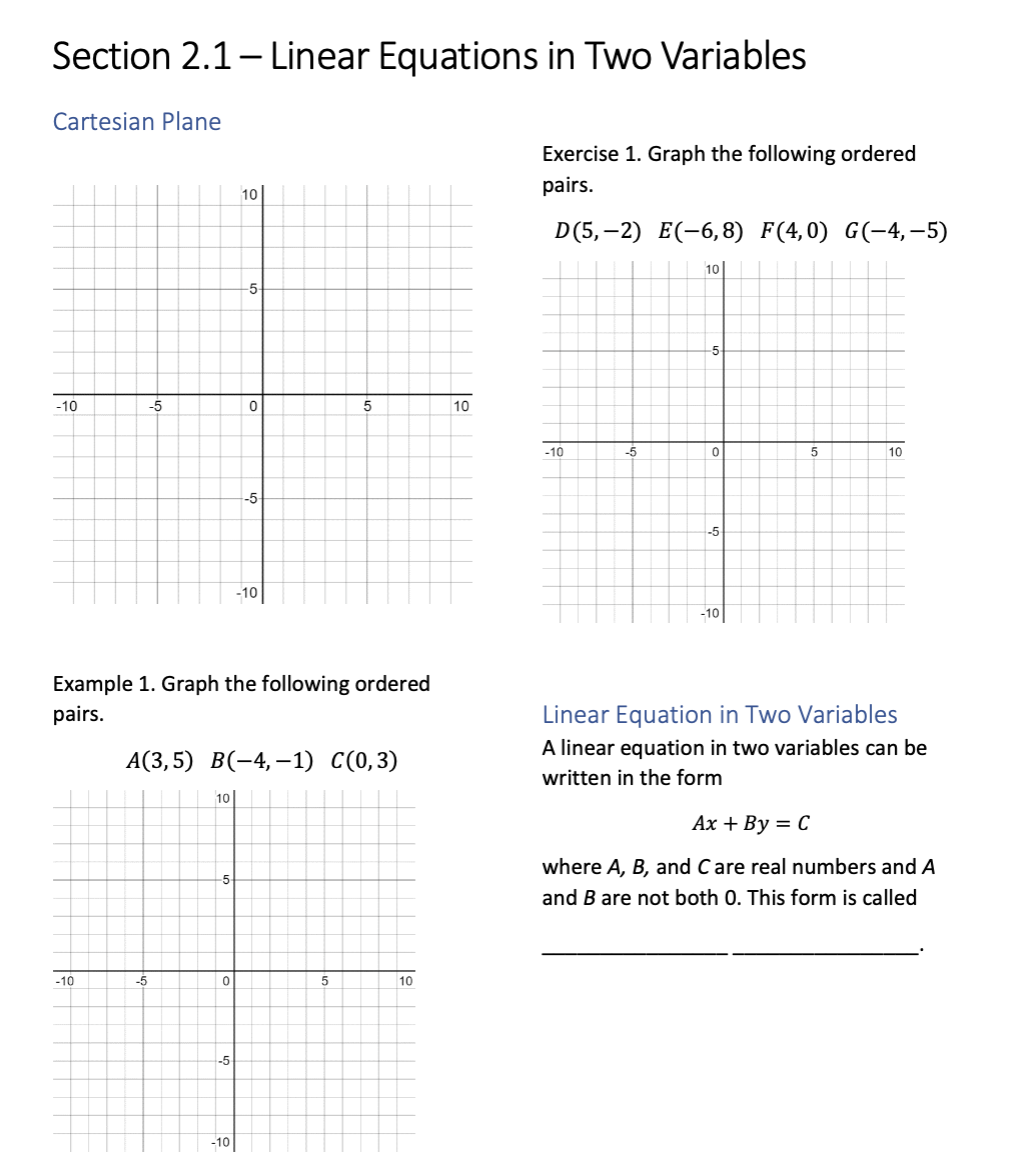
Exercise: Practice plotting D(5, –2), E(–6, 8), F(4, 0), and G(–4, –5) on the Cartesian plane.
Linear Equation in Two Variables
A linear equation in two variables is an equation that can be written in the form:
A, B, and C: Real numbers; A and B are not both zero.
This form is called the standard form of a linear equation.
The graph of a linear equation in two variables is always a straight line.
Example: The equation is a linear equation in two variables. Its graph is a straight line on the Cartesian plane.
Applications: Linear equations are used to model relationships between two quantities, such as cost and number of items, or distance and time.
Key Properties:
Every solution to the equation corresponds to a point on the line.
The coefficients A and B determine the slope and orientation of the line.
Additional info: The standard form is useful for analyzing and graphing linear equations, and for solving systems of equations.
