Of the elements F, Br, Cl, and I, which (4.7)d. requires the most energy to remove an electron?
Verified step by step guidance
1
Identify the concept involved: The problem is asking about ionization energy, which is the energy required to remove an electron from an atom.
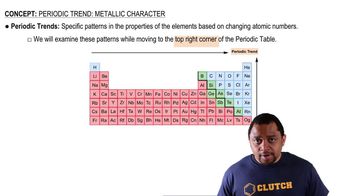
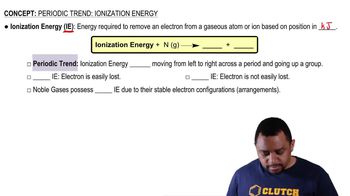
Recall the periodic trend: Ionization energy generally increases across a period (from left to right) and decreases down a group (from top to bottom) in the periodic table.
Locate the elements on the periodic table: Fluorine (F), Chlorine (Cl), Bromine (Br), and Iodine (I) are all halogens located in Group 17.
Compare their positions: Since all these elements are in the same group, the ionization energy decreases as you move down the group.
Determine which element is at the top of the group: Fluorine (F) is at the top of the group, so it requires the most energy to remove an electron.
Verified video answer for a similar problem:
This video solution was recommended by our tutors as helpful for the problem above
Video duration:
1m
Play a video:
0 Comments
Key Concepts
Here are the essential concepts you must grasp in order to answer the question correctly.
Ionization Energy
Ionization energy is the amount of energy required to remove an electron from an atom in its gaseous state. It is a key factor in determining how easily an element can lose an electron, with higher ionization energies indicating a stronger hold on electrons. This concept is crucial for comparing elements, as it helps predict their reactivity and stability.
Periodic Trend: Ionization Energy (Simplified) Concept 1
Trends in the Periodic Table
The periodic table exhibits specific trends in ionization energy, where it generally increases across a period and decreases down a group. This is due to the increasing nuclear charge and the effect of electron shielding. Understanding these trends allows for the prediction of which elements will require more or less energy to remove an electron.
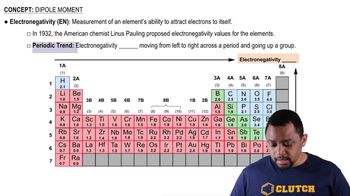
Electronegativity is a measure of an atom's ability to attract and hold onto electrons in a chemical bond. While it is not the same as ionization energy, there is a correlation between the two; elements with high electronegativity often have high ionization energies. This concept helps in understanding the behavior of halogens like F, Br, Cl, and I in terms of their electron affinity and reactivity.

 1:05 minutes
 Verified step by step guidance
 02:13
02:13