Fill in the following blanks using larger or smaller, higher orlower. Mg has a atomic size and a ionization energy than Cs.
Verified step by step guidance
1
Identify the position of Mg (Magnesium) and Cs (Cesium) on the periodic table. Mg is in Group 2, Period 3, and Cs is in Group 1, Period 6.
Recall that atomic size increases as you move down a group in the periodic table because additional electron shells are added.
Recall that ionization energy generally decreases as you move down a group because the outer electrons are farther from the nucleus and are more easily removed.
Compare the atomic size of Mg and Cs. Since Cs is further down the group than Mg, Cs has a larger atomic size than Mg.
Compare the ionization energy of Mg and Cs. Since Cs is further down the group than Mg, Cs has a lower ionization energy than Mg.
Verified video answer for a similar problem:
This video solution was recommended by our tutors as helpful for the problem above
Video duration:
1m
Play a video:
0 Comments
Key Concepts
Here are the essential concepts you must grasp in order to answer the question correctly.
Atomic Size
Atomic size refers to the distance from the nucleus of an atom to the outermost electron shell. Generally, atomic size increases down a group in the periodic table due to the addition of electron shells, making atoms larger. Conversely, atomic size decreases across a period from left to right as the increasing nuclear charge pulls electrons closer to the nucleus.
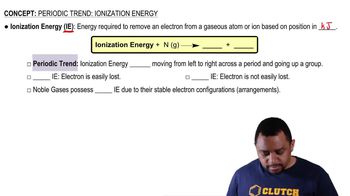
Ionization energy is the energy required to remove an electron from an atom in its gaseous state. This energy tends to decrease down a group because the outer electrons are farther from the nucleus and experience less attraction. In contrast, ionization energy increases across a period due to the increased nuclear charge, which holds the electrons more tightly.
Periodic Trend: Ionization Energy (Simplified) Concept 1
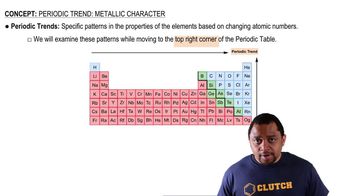
Periodic Trends
Periodic trends are patterns observed in the periodic table that describe how certain properties of elements change across periods and down groups. Key trends include atomic size, ionization energy, and electronegativity. Understanding these trends helps predict the behavior of elements, such as why magnesium (Mg) has a smaller atomic size and higher ionization energy compared to cesium (Cs).

 1:46 minutes
 Verified step by step guidance

 05:22
05:22