Use arrows to show electron pairing in the valence p subshell of a. Sulfurb. Brominec. Silicon
Verified step by step guidance
1
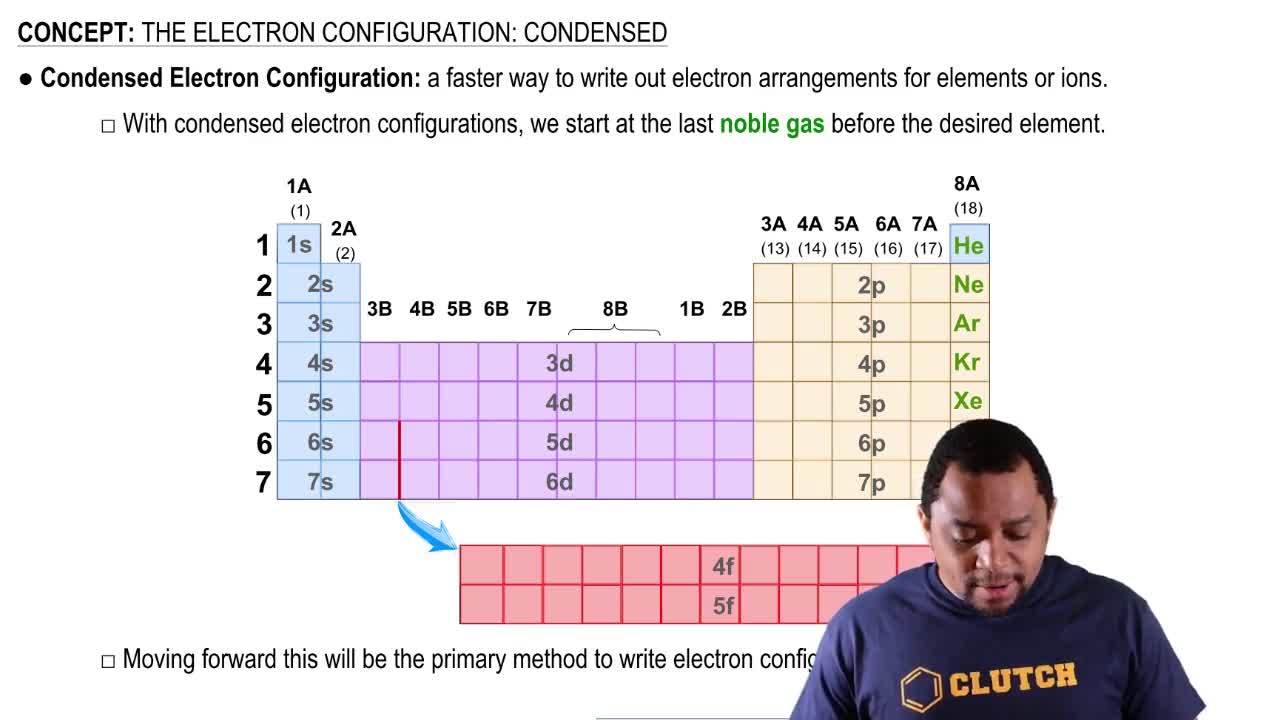
insert step 1: Identify the electron configuration for each element.
insert step 2: Determine the number of electrons in the valence p subshell for each element.
insert step 3: Use arrows to represent the electrons in the p subshell, following Hund's rule and the Pauli exclusion principle.
insert step 4: For sulfur (S), with an atomic number of 16, the electron configuration is [Ne] 3s^2 3p^4. The valence p subshell has 4 electrons.
insert step 5: For bromine (Br), with an atomic number of 35, the electron configuration is [Ar] 4s^2 3d^10 4p^5. The valence p subshell has 5 electrons. For silicon (Si), with an atomic number of 14, the electron configuration is [Ne] 3s^2 3p^2. The valence p subshell has 2 electrons.
Verified video answer for a similar problem:
This video solution was recommended by our tutors as helpful for the problem above
Video duration:
6m
Play a video:
0 Comments
Key Concepts
Here are the essential concepts you must grasp in order to answer the question correctly.
Valence Electrons
Valence electrons are the outermost electrons of an atom and are crucial for determining how an element will react chemically. They are involved in forming bonds with other atoms. The number of valence electrons can be determined from an element's position in the periodic table, which helps predict its chemical behavior.
Valence Electrons of Elements (Simplified) Concept 1
Electron Configuration
Electron configuration describes the distribution of electrons in an atom's orbitals. For elements in the p-block, such as sulfur, bromine, and silicon, the p subshell can hold a maximum of six electrons. Understanding the electron configuration allows us to visualize how electrons are arranged and paired in the valence shell, which is essential for drawing accurate representations.
Lewis structures are diagrams that represent the bonding between atoms and the lone pairs of electrons in a molecule. They use dots to represent valence electrons and lines for bonds. In the context of the question, Lewis structures will help illustrate the electron pairing in the p subshell for sulfur, bromine, and silicon, providing a clear visual representation of their valence electron arrangements.

 6:04 minutes
 Verified step by step guidance
 01:55
01:55