Identify each of the following changes of state as melting, freezing, sublimation, or deposition:c. Heat is removed from 125 g of liquid water at 0 °C.
Verified step by step guidance
1
Identify the initial state of the substance: The problem states that we have liquid water at 0 °C.
Determine the process involved when heat is removed from a liquid: Removing heat from a liquid typically results in the liquid changing to a solid state.
Recall the term for the change of state from liquid to solid: This process is known as 'freezing'.
Consider the temperature given: Since the temperature is at 0 °C, which is the freezing point of water, removing heat will cause the water to freeze.
Conclude the change of state: Therefore, the change of state when heat is removed from liquid water at 0 °C is 'freezing'.
Verified video answer for a similar problem:
This video solution was recommended by our tutors as helpful for the problem above
Video duration:
1m
Play a video:
0 Comments
Key Concepts
Here are the essential concepts you must grasp in order to answer the question correctly.
Phase Changes
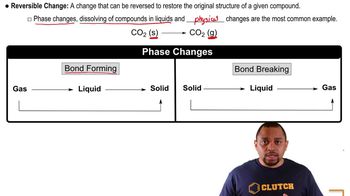
Phase changes refer to the transitions between different states of matter, such as solid, liquid, and gas. These changes occur due to the addition or removal of heat, which affects the energy and arrangement of particles. Understanding these transitions is crucial for identifying processes like melting, freezing, sublimation, and deposition.
Melting is the process where a solid turns into a liquid as heat is added, while freezing is the reverse process where a liquid becomes a solid as heat is removed. Both processes occur at specific temperatures known as melting and freezing points, which for water is 0 °C. Recognizing these processes helps in determining the state change when heat is either added or removed.
Sublimation is the transition of a substance from a solid directly to a gas without passing through the liquid state, while deposition is the reverse process where a gas turns directly into a solid. These processes also involve heat transfer, with sublimation requiring heat input and deposition releasing heat. Understanding these concepts is essential for identifying the nature of state changes in various substances.