Identify each of the following as characteristic of a solution, colloid, or suspension:a. a mixture that cannot be separated by a semipermeable membrane
Verified step by step guidance
1
Understand the definitions of solution, colloid, and suspension.
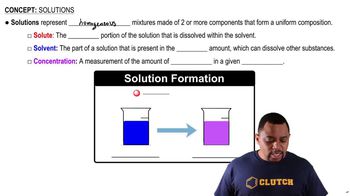
A solution is a homogeneous mixture where the solute is completely dissolved in the solvent, and it cannot be separated by a semipermeable membrane.
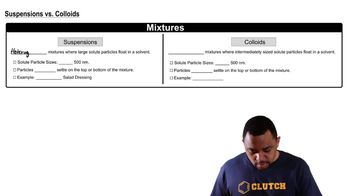
A colloid is a mixture where the particle size is intermediate between a solution and a suspension, and it can pass through a filter but not a semipermeable membrane.
A suspension is a heterogeneous mixture where the particles are large enough to settle out over time and can be separated by filtration.
Identify that a mixture that cannot be separated by a semipermeable membrane is characteristic of a solution.
Was this helpful?
Key Concepts
Here are the essential concepts you must grasp in order to answer the question correctly.
Solutions
A solution is a homogeneous mixture where one substance (the solute) is completely dissolved in another (the solvent). The particles in a solution are at the molecular or ionic level, making them too small to be seen and unable to settle out or be separated by filtration. Solutions can pass through semipermeable membranes, which allows for the movement of solvent molecules while retaining solute particles.
Colloids are mixtures where fine particles are dispersed within a continuous medium, but they do not settle out over time. The particle size in colloids is larger than that in solutions but smaller than in suspensions, typically ranging from 1 nanometer to 1 micrometer. Colloids can scatter light (Tyndall effect) and cannot be separated by ordinary filtration, but they can be separated by semipermeable membranes depending on the size of the particles.
Suspensions are heterogeneous mixtures where larger particles are dispersed in a liquid or gas but are not dissolved. These particles are typically larger than 1 micrometer and can settle out over time, leading to separation. Unlike solutions and colloids, suspensions can be separated by filtration and do not pass through semipermeable membranes, as the particles are too large to do so.