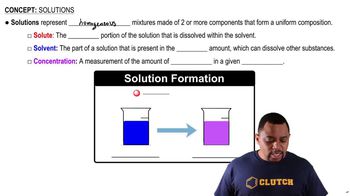
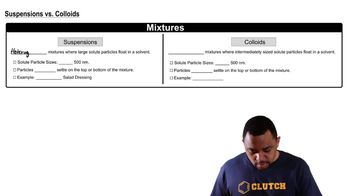
Understand the definitions: A solution is a homogeneous mixture where the solute is completely dissolved in the solvent, while a colloid is a mixture where the particle size is intermediate between a true solution and a suspension.
Observe the appearance: Solutions are typically clear and transparent, whereas colloids can appear cloudy or opaque due to the scattering of light by the larger particles.
Perform the Tyndall effect test: Shine a beam of light through the mixture. If the light scatters and the path of the light is visible, it indicates a colloid. In a true solution, the light will pass through without scattering.
Consider the particle size: In a solution, the particles are at the molecular or ionic level, typically less than 1 nanometer. In a colloid, the particles range from 1 to 1000 nanometers.
Check for sedimentation: Solutions do not settle out over time, while colloids may show some settling of particles if left undisturbed for a long period.
Was this helpful?
Key Concepts
Here are the essential concepts you must grasp in order to answer the question correctly.
Solutions
A solution is a homogeneous mixture where one substance (the solute) is completely dissolved in another (the solvent). The particles in a solution are at the molecular or ionic level, making them too small to be seen. Solutions do not scatter light and have a uniform composition throughout, which means they appear clear and transparent.
Colloids are mixtures where fine particles of one substance are dispersed within another, but not dissolved. These particles are larger than those in solutions, typically ranging from 1 nanometer to 1 micrometer. Colloids can scatter light, a phenomenon known as the Tyndall effect, and they often appear cloudy or opaque, distinguishing them from clear solutions.
To differentiate between a solution and a colloid, various separation techniques can be employed. For instance, filtration can separate colloidal particles from a liquid, as they are larger than the pores of the filter. Additionally, centrifugation can be used to separate colloids based on particle size and density, while solutions remain homogeneous and cannot be separated by these methods.