Consider an ion with the symbol Y³⁻ formed from a representative element. (6.1, 6.2, 6.3)c. If Y is in Period 3, what is the element?
Verified step by step guidance
1
Identify the charge of the ion Y³⁻, which indicates that the element Y has gained 3 electrons to form the ion.
Determine the number of electrons in the neutral atom of element Y by subtracting 3 from the total number of electrons in the ion.
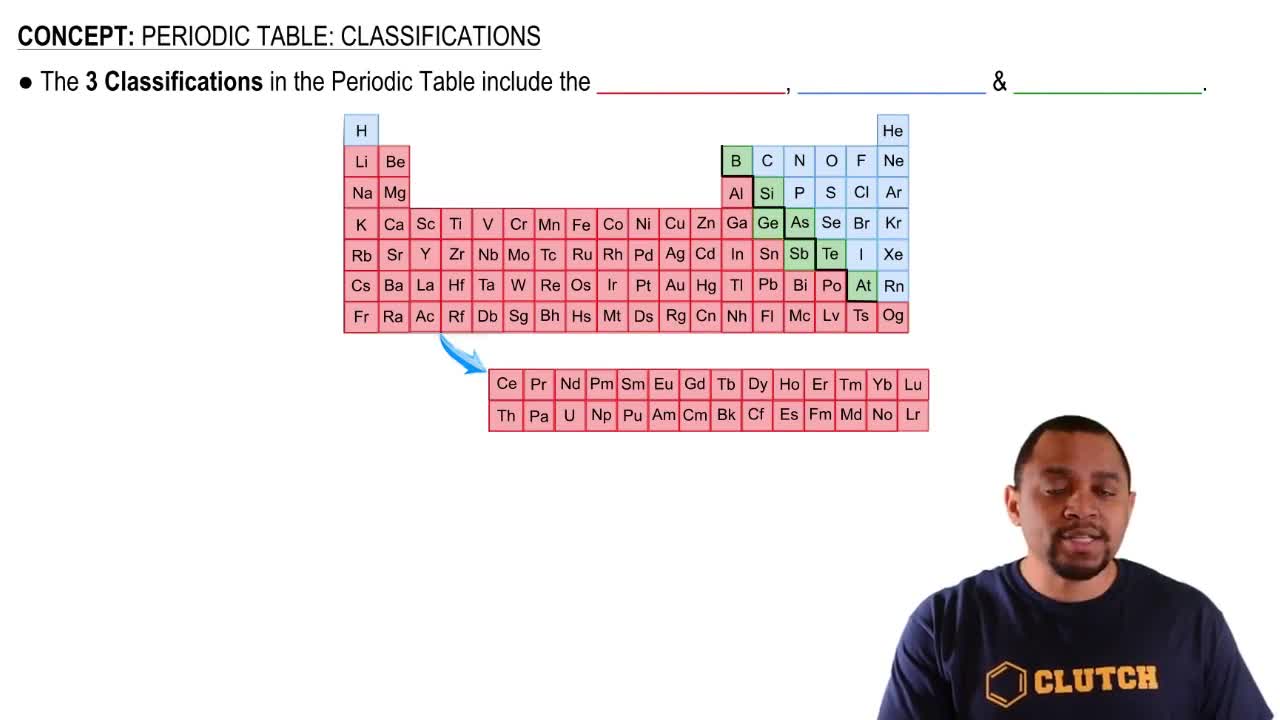
Recognize that the element is in Period 3 of the periodic table, which means it has three electron shells.
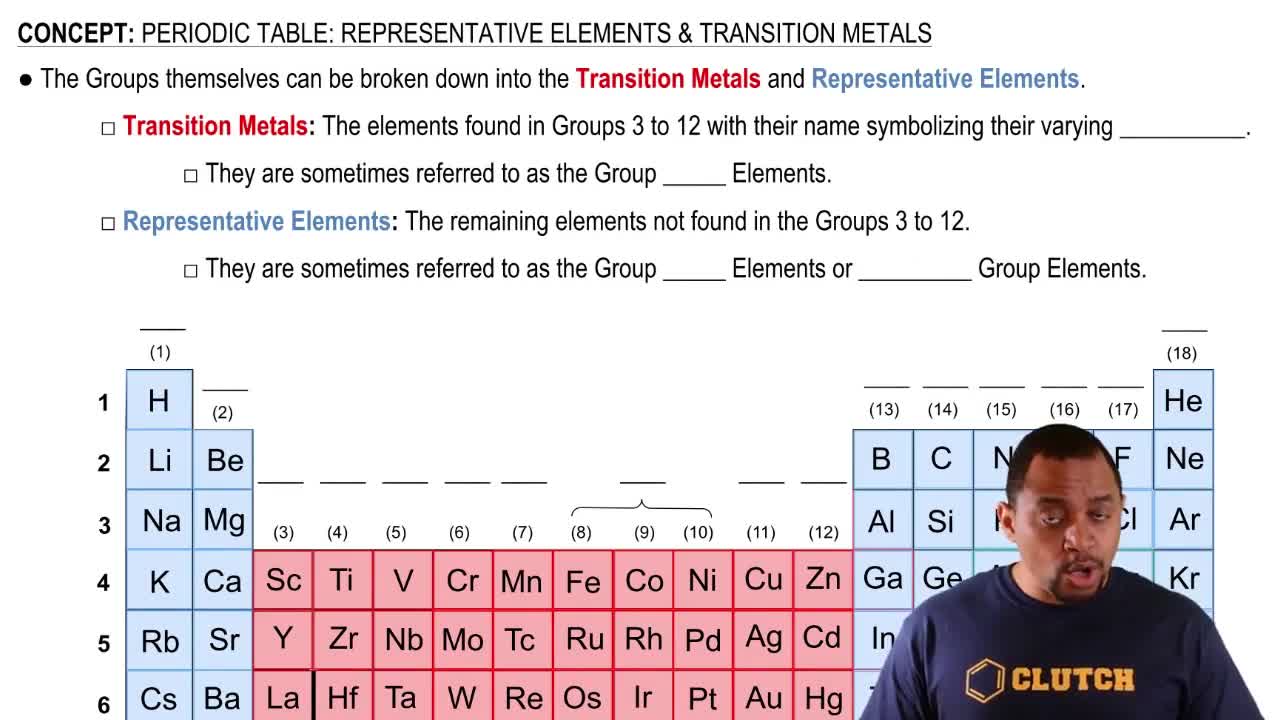
Use the periodic table to find the element in Period 3 that has the same number of electrons as the neutral atom of Y.
Conclude that the element is phosphorus (P), which is in Period 3 and forms a P³⁻ ion by gaining 3 electrons.
Verified video answer for a similar problem:
This video solution was recommended by our tutors as helpful for the problem above
Video duration:
3m
Play a video:
0 Comments
Key Concepts
Here are the essential concepts you must grasp in order to answer the question correctly.
Ionic Charge
Ionic charge refers to the electrical charge that an atom or molecule carries due to the loss or gain of electrons. In this case, Y³⁻ indicates that the element has gained three electrons, resulting in a negative charge. Understanding ionic charges is crucial for identifying elements and their behavior in chemical reactions.
The periodic table organizes elements based on their atomic number, electron configuration, and recurring chemical properties. Elements in the same period share the same number of electron shells. Knowing that Y is in Period 3 helps narrow down the possible elements to those with three electron shells, which include sodium, magnesium, aluminum, and others.
Representative elements, also known as main group elements, are found in groups 1, 2, and 13-18 of the periodic table. These elements typically exhibit a wide range of chemical and physical properties. Identifying Y as a representative element in Period 3 allows us to focus on elements like phosphorus or sulfur, which can form anions such as Y³⁻.