The equation for the formation of silicon tetrachloride from silicon and chlorine is (7.9)Si(s) + 2Cl₂(g) → SiCl₄(g) + 157 kcalb. Is the energy of the product higher or lower than the energy of the reactants?
Verified step by step guidance
1
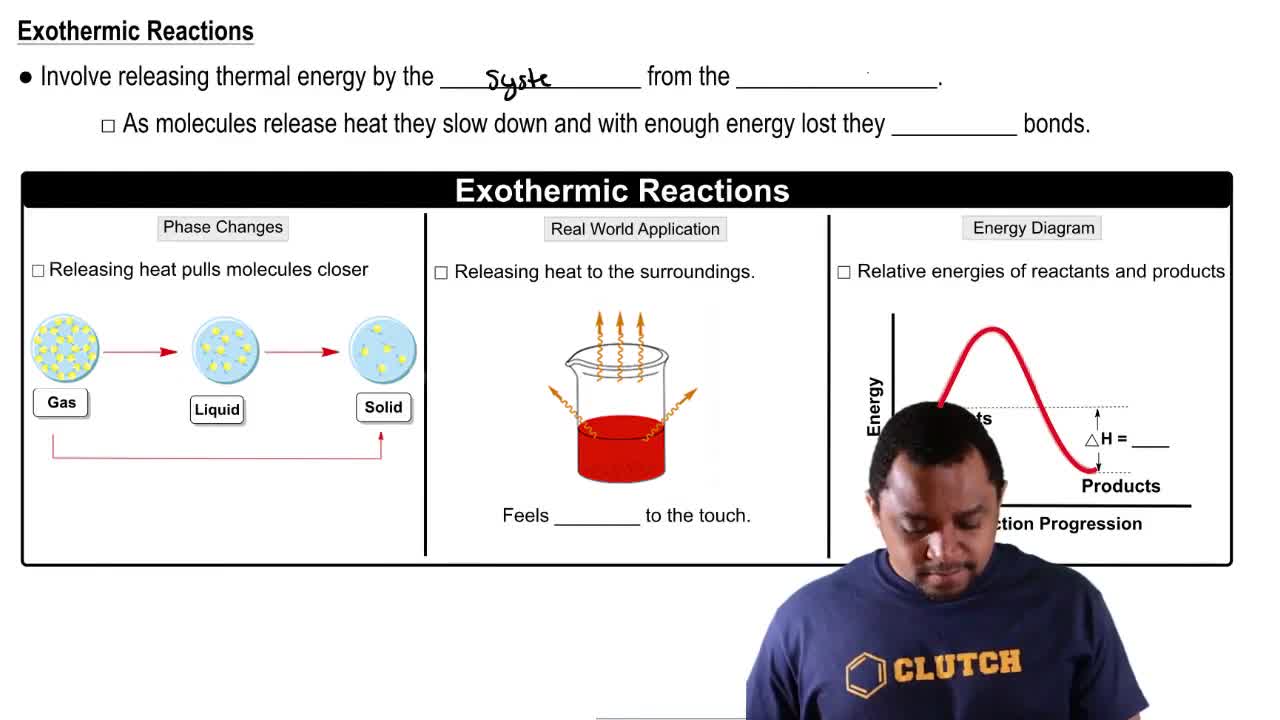
Identify the type of reaction: The given reaction is an exothermic reaction, as indicated by the release of 157 kcal of energy.
Understand exothermic reactions: In exothermic reactions, energy is released to the surroundings, meaning the products have lower energy than the reactants.
Analyze the energy change: Since 157 kcal is released, this implies that the energy of the products is lower than the energy of the reactants.
Relate energy release to stability: The release of energy suggests that the product, silicon tetrachloride (SiCl₄), is more stable than the reactants, silicon (Si) and chlorine (Cl₂).
Conclude the energy comparison: Therefore, the energy of the product (SiCl₄) is lower than the energy of the reactants (Si and Cl₂).
Verified video answer for a similar problem:
This video solution was recommended by our tutors as helpful for the problem above
Video duration:
2m
Play a video:
0 Comments
Key Concepts
Here are the essential concepts you must grasp in order to answer the question correctly.
Exothermic Reactions
The reaction given is exothermic, meaning it releases energy, specifically 157 kcal, as it proceeds from reactants to products. In exothermic reactions, the energy of the products is lower than that of the reactants because the excess energy is released into the surroundings, often in the form of heat.
Enthalpy change, represented as ΔH, quantifies the heat content of a system at constant pressure. In this reaction, the negative value of ΔH indicates that the products (SiCl₄) have a lower enthalpy than the reactants (Si and Cl₂), confirming that energy is released during the formation of silicon tetrachloride.
Thermodynamic stability refers to the relative energy levels of reactants and products in a chemical reaction. A product is considered thermodynamically stable if it has lower energy than the reactants, which is the case here, as the formation of SiCl₄ results in a more stable state due to the release of energy.