Magnetite, an iron ore with formula Fe3O4, can be reduced by treatment with hydrogen to yield iron metal and water vapor.Write the balanced equation.
Verified step by step guidance
1
Identify the reactants and products in the chemical reaction. The reactants are magnetite (Fe3O4) and hydrogen (H2), and the products are iron (Fe) and water vapor (H2O).
Write the unbalanced chemical equation: Fe3O4 + H2 -> Fe + H2O.
Balance the iron (Fe) atoms first. There are 3 Fe atoms in Fe3O4, so you need 3 Fe atoms on the product side: Fe3O4 + H2 -> 3Fe + H2O.
Next, balance the oxygen (O) atoms. There are 4 O atoms in Fe3O4, so you need 4 H2O molecules on the product side: Fe3O4 + H2 -> 3Fe + 4H2O.
Finally, balance the hydrogen (H) atoms. There are 8 H atoms needed for 4 H2O molecules, so you need 4 H2 molecules on the reactant side: Fe3O4 + 4H2 -> 3Fe + 4H2O.
Verified video answer for a similar problem:
This video solution was recommended by our tutors as helpful for the problem above
Video duration:
1m
Play a video:
0 Comments
Key Concepts
Here are the essential concepts you must grasp in order to answer the question correctly.
Balancing Chemical Equations
Balancing chemical equations involves ensuring that the number of atoms of each element is the same on both sides of the equation. This is based on the law of conservation of mass, which states that matter cannot be created or destroyed in a chemical reaction. To balance an equation, coefficients are adjusted in front of the chemical formulas to achieve equal atom counts.
Balancing Chemical Equations (Simplified) Concept 1
Reduction Reactions
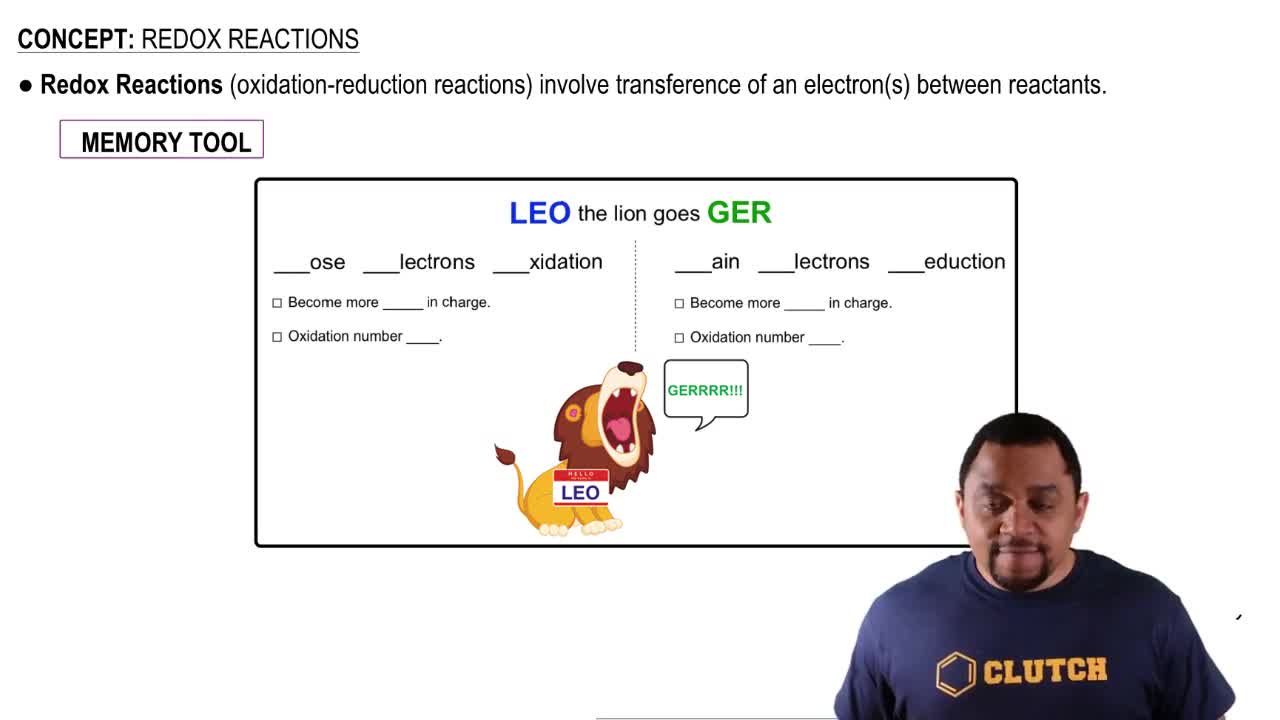
Reduction reactions involve the gain of electrons or a decrease in oxidation state by a substance. In the context of magnetite (Fe3O4) being reduced by hydrogen, iron ions in the ore gain electrons from hydrogen, which is oxidized to water. Understanding reduction is crucial for identifying how reactants transform into products in redox reactions.
Stoichiometry is the calculation of reactants and products in chemical reactions based on their molar ratios. It allows chemists to predict the amounts of substances consumed and produced in a reaction. In the case of reducing magnetite with hydrogen, stoichiometry helps determine the correct coefficients needed to balance the equation, ensuring that the quantities of iron and water produced are accurately represented.

 1:59 minutes
 Verified step by step guidance
 01:32
01:32