Match each of the formulas (a to c) with the correct diagram (1 to 3) of its shape, and name the shape; indicate if each molecule is polar or nonpolar. (6.6, 6.8, 6.9)1. 2. 3. a. PBr₃
Verified step by step guidance
1
Identify the molecular formula PBr₃ and determine the central atom, which is phosphorus (P).
Count the total number of valence electrons: Phosphorus has 5 valence electrons, and each bromine (Br) has 7 valence electrons. Therefore, the total is 5 + 3(7) = 26 valence electrons.
Draw the Lewis structure for PBr₃: Place phosphorus in the center and arrange the three bromine atoms around it, ensuring each Br is connected to P with a single bond. Distribute the remaining electrons to satisfy the octet rule for each atom.
Determine the molecular geometry using VSEPR theory: PBr₃ has three bonding pairs and one lone pair on the central phosphorus atom, resulting in a trigonal pyramidal shape.
Assess the polarity: Due to the asymmetrical shape and the difference in electronegativity between P and Br, PBr₃ is a polar molecule.
Verified video answer for a similar problem:
This video solution was recommended by our tutors as helpful for the problem above
Video duration:
10m
Play a video:
0 Comments
Key Concepts
Here are the essential concepts you must grasp in order to answer the question correctly.
Molecular Geometry
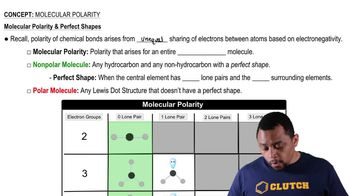
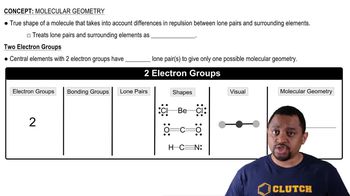
Molecular geometry refers to the three-dimensional arrangement of atoms within a molecule. It is determined by the number of bonding pairs and lone pairs of electrons around the central atom, which influences the shape of the molecule. Common geometries include linear, trigonal planar, tetrahedral, and octahedral, each with distinct bond angles.
Polarity in molecules arises from the distribution of electrical charge, which is influenced by the electronegativity of the atoms involved. A molecule is polar if it has a net dipole moment due to an uneven distribution of charge, often resulting from asymmetrical shapes or differences in electronegativity. Nonpolar molecules, on the other hand, have an even charge distribution.
Valence Shell Electron Pair Repulsion (VSEPR) theory is a model used to predict the shape of molecules based on the repulsion between electron pairs in the valence shell of the central atom. According to VSEPR, electron pairs will arrange themselves to minimize repulsion, leading to specific molecular shapes that can be correlated with the molecular formulas.

 10:44 minutes
 Verified step by step guidance
 01:30
01:30