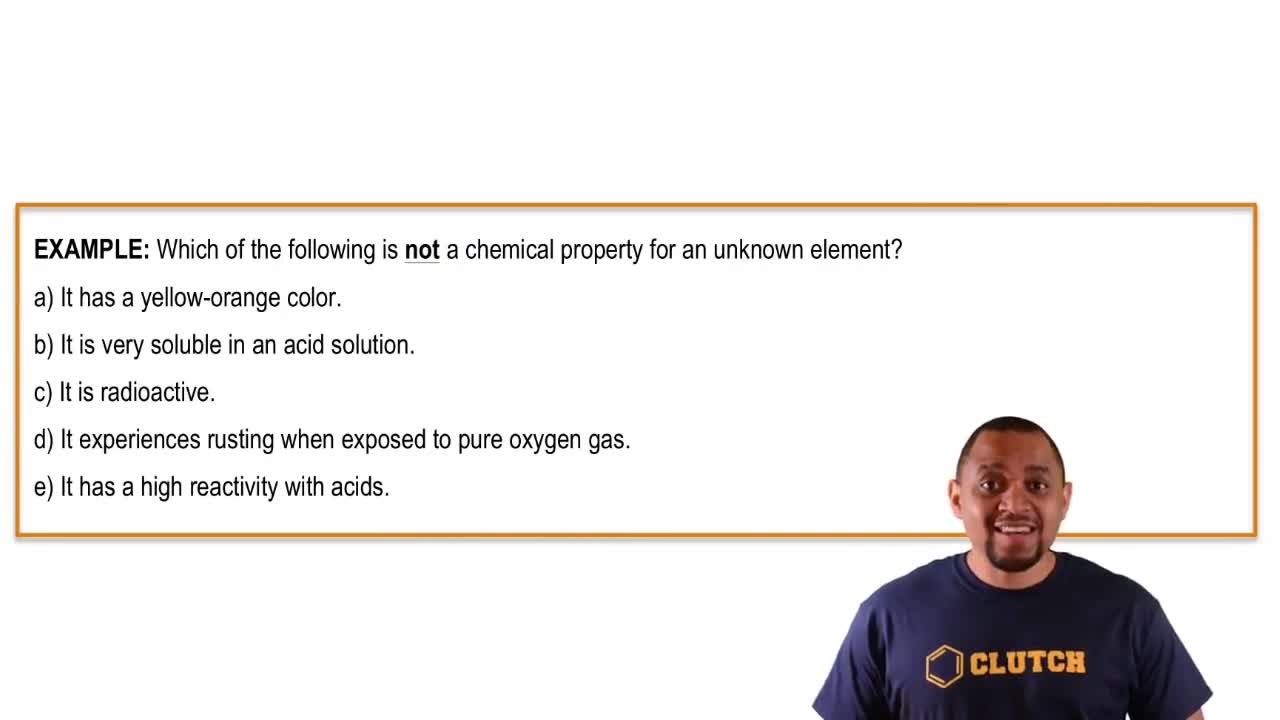
Describe each of the following as a physical or chemical property:a. Neon is a colorless gas at room temperature.
Verified step by step guidance
1
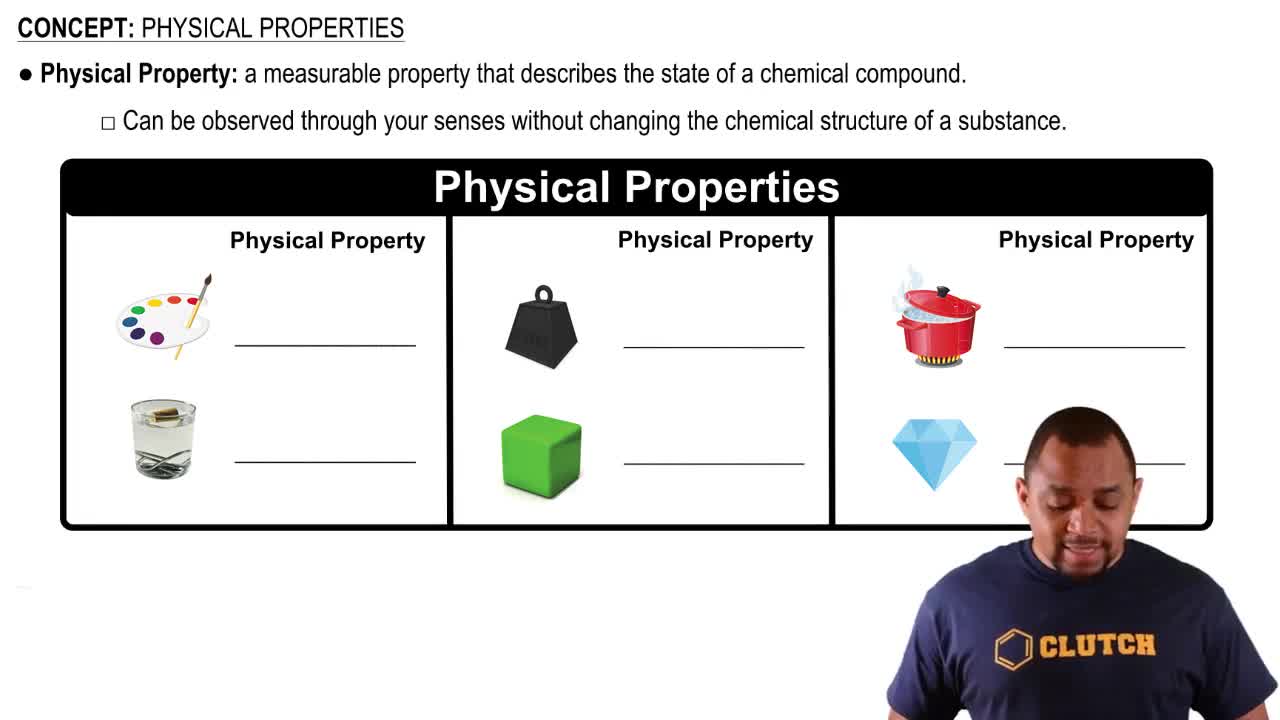
Understand the difference between physical and chemical properties: Physical properties can be observed or measured without changing the substance's identity, while chemical properties describe a substance's ability to undergo a chemical change.
Identify the property in question: The statement describes neon as a colorless gas at room temperature.
Determine if the property involves a change in the substance's identity: Since the description of neon being colorless and gaseous does not involve a change in its chemical identity, it is a physical property.
Consider the state of matter: The fact that neon is a gas at room temperature is a physical property because it describes its state of matter under specific conditions.
Conclude that the property is physical: Since the description involves observable characteristics without altering the chemical structure, it is a physical property.
Verified video answer for a similar problem:
This video solution was recommended by our tutors as helpful for the problem above
Video duration:
58s
Play a video:
0 Comments
Key Concepts
Here are the essential concepts you must grasp in order to answer the question correctly.
Physical Properties
Physical properties are characteristics of a substance that can be observed or measured without changing its chemical identity. These include attributes such as color, odor, boiling point, melting point, and state of matter. For example, the fact that neon is a colorless gas at room temperature is a physical property, as it describes the state and appearance of the substance without altering its chemical structure.
Chemical properties refer to the behavior of a substance when it undergoes a chemical change or reaction. These properties can only be observed during a chemical transformation and include reactivity with other chemicals, flammability, and acidity. Unlike physical properties, chemical properties provide insight into how a substance interacts with other materials and what new substances may form as a result.
States of matter describe the distinct forms that different phases of matter take on. The most common states are solid, liquid, gas, and plasma, each characterized by different properties such as shape and volume. Neon, being a gas at room temperature, exemplifies the gaseous state, where particles are widely spaced and move freely, allowing the gas to fill its container and take its shape.

 0:58 minutes
 Verified step by step guidance
 02:54
02:54