Butane (C₄H₈) is an easily compressible gas used in cigarette lighters. It has a melting point of and a boiling point of - 138.4 degree Celsius and a boiling point of 0.5 degree Celsius. Would you expect a butane lighter to work in winter when the temperature outdoors is 25 degree F? Why or why not?
Verified step by step guidance
1
Convert the outdoor temperature from Fahrenheit to Celsius using the formula: \( C = \frac{5}{9}(F - 32) \).
Calculate the Celsius equivalent of 25°F.
Compare the converted temperature to the boiling point of butane, which is 0.5°C.
Determine if the outdoor temperature is above or below the boiling point of butane.
Conclude whether butane will be in a gaseous state and if the lighter will work based on the temperature comparison.
Verified video answer for a similar problem:
This video solution was recommended by our tutors as helpful for the problem above
Video duration:
3m
Play a video:
0 Comments
Key Concepts
Here are the essential concepts you must grasp in order to answer the question correctly.
Phase Changes
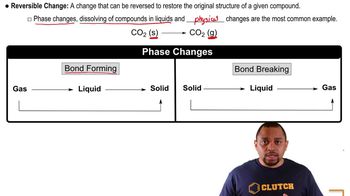
Phase changes refer to the transitions between solid, liquid, and gas states of matter, which are influenced by temperature and pressure. For butane, its melting point (-138.4 °C) indicates that it is a gas at typical outdoor temperatures, while its boiling point (0.5 °C) shows that it can exist as a liquid under pressure in a lighter. Understanding these phase changes is crucial to predicting the behavior of butane in varying temperatures.
Temperature conversion is the process of changing a temperature from one scale to another, such as Celsius to Fahrenheit. In this case, 25 °F converts to approximately -3.9 °C, which is below butane's boiling point. This conversion is essential to determine whether butane will remain in a gaseous state or condense into a liquid at the given outdoor temperature.
Gas behavior under pressure describes how gases can be compressed and how their state can change based on external conditions. In a butane lighter, the gas is stored under pressure, allowing it to remain in liquid form. When the lighter is used, the pressure is released, and the butane vaporizes. Understanding this concept helps explain why a butane lighter may struggle to function in cold temperatures, as the gas may not vaporize effectively.

 3:35 minutes
 Verified step by step guidance
 03:40
03:40