When 1 mol of HCl is added to 1 kg of water, the boiling point increases by 1.0 °C, but when 1 mol of acetic acid, CH₃CO₂H is added to 1 kg of water, the boiling point increases by only 0.5 °C. Explain.
Verified step by step guidance
1
Identify the concept of boiling point elevation, which is a colligative property that depends on the number of solute particles in a solution.
Recognize that HCl is a strong acid and dissociates completely in water to form H⁺ and Cl⁻ ions, resulting in two particles per formula unit.
Understand that acetic acid, CH₃CO₂H, is a weak acid and only partially dissociates in water, producing fewer particles compared to HCl.
Relate the number of particles in solution to the boiling point elevation: more particles result in a greater increase in boiling point.
Conclude that the difference in boiling point elevation is due to the difference in the degree of dissociation of HCl and acetic acid in water.
Verified video answer for a similar problem:
This video solution was recommended by our tutors as helpful for the problem above
Video duration:
5m
Play a video:
0 Comments
Key Concepts
Here are the essential concepts you must grasp in order to answer the question correctly.
Colligative Properties
Colligative properties are physical properties of solutions that depend on the number of solute particles in a given amount of solvent, rather than the identity of the solute. These properties include boiling point elevation, freezing point depression, vapor pressure lowering, and osmotic pressure. The extent of boiling point elevation is directly related to the concentration of solute particles, which explains the differences observed when different solutes are added to water.
Ionization refers to the process by which a solute dissociates into ions when dissolved in a solvent. Strong electrolytes, like HCl, completely ionize in water, producing more particles (H⁺ and Cl⁻ ions) than the original solute. In contrast, acetic acid (CH₃CO₂H) is a weak electrolyte that only partially ionizes, resulting in fewer particles in solution, which leads to a smaller increase in boiling point.
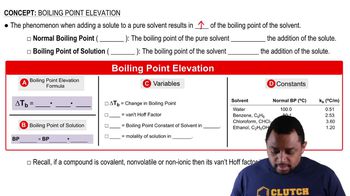
The boiling point elevation can be calculated using the formula ΔT_b = i * K_b * m, where ΔT_b is the change in boiling point, i is the van 't Hoff factor (number of particles the solute breaks into), K_b is the ebullioscopic constant of the solvent, and m is the molality of the solution. For HCl, i equals 2 due to complete ionization, while for acetic acid, i is less than 2, leading to a greater boiling point elevation for HCl compared to acetic acid.

 5:20 minutes
 Verified step by step guidance
 01:27
01:27