 Back
BackAcids and Bases: Properties, Definitions, and Applications
Study Guide - Smart Notes
 Tailored notes based on your materials, expanded with key definitions, examples, and context.
Acids and Bases
Properties of Acids
Acids are a class of compounds with distinct chemical and physical properties. They are commonly encountered in both laboratory and everyday contexts.
Sour taste: Many acids, such as citric acid in lemons, have a characteristic sour flavor.
Ability to dissolve many metals: Acids can react with metals, often producing hydrogen gas.
Ability to neutralize bases: When mixed with bases, acids undergo neutralization reactions to form water and salts.
Change blue litmus paper to red: This is a classic test for acidity.
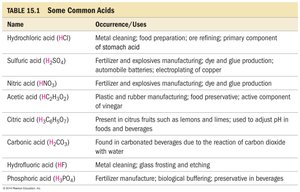
Name | Occurrence/Uses |
|---|---|
Hydrochloric acid (HCl) | Metal cleaning, food preparation, ore refining, stomach acid |
Sulfuric acid (H2SO4) | Fertilizer, explosives, dyes, automobile batteries |
Nitric acid (HNO3) | Fertilizer, explosives, dye, glue production |
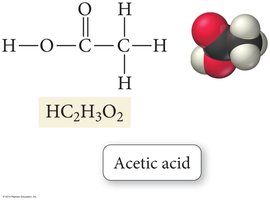
Acetic acid (HC2H3O2) | Plastic, rubber, food preservative, vinegar |
Citric acid (H3C6H5O7) | Citrus fruits, food and beverage pH adjustment |
Carbonic acid (H2CO3) | Carbonated beverages |
Hydrofluoric acid (HF) | Metal cleaning, glass frosting and etching |
Phosphoric acid (H3PO4) | Fertilizer, buffering in beverages |
Properties of Bases
Bases are another important class of compounds with their own characteristic properties.
Bitter taste: Many bases, such as those found in soap, taste bitter.
Alkaloids: Plant products that are alkaline and often poisonous.
Feel slippery: Bases such as soap feel slippery to the touch.
Ability to turn red litmus paper blue: This is a standard test for basicity.
Ability to neutralize acids: Bases react with acids to form water and salts.
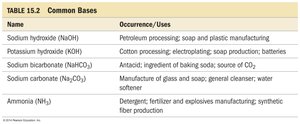
Name | Occurrence/Uses |
|---|---|
Sodium hydroxide (NaOH) | Petroleum processing, soap, plastic manufacturing |
Potassium hydroxide (KOH) | Cotton processing, soap, batteries |
Sodium bicarbonate (NaHCO3) | Antacid, baking soda, CO2 source |
Sodium carbonate (Na2CO3) | Glass, soap, cleanser, water softener |
Ammonia (NH3) | Detergent, fertilizer, explosives, synthetic fiber |
Litmus Tests for Acids and Bases
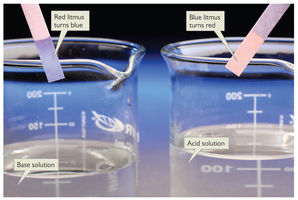
Litmus paper is a simple and effective way to distinguish between acids and bases:
Acids turn blue litmus paper red.
Bases turn red litmus paper blue.
Definitions of Acids and Bases
Arrhenius Definition
The Arrhenius definition is one of the earliest and simplest ways to classify acids and bases:
Acid: Increases the concentration of hydrogen ions (H+) in water.
Base: Increases the concentration of hydroxide ions (OH−) in water.
Example Equations:
Limitations of the Arrhenius Theory
Does not explain the basicity of substances like ammonia (NH3).
Only applies to aqueous solutions.
Hydrogen ions (protons) do not exist freely in water; they form hydronium ions (H3O+).
Brønsted–Lowry Definition
The Brønsted–Lowry theory broadens the concept of acids and bases:
Acid: Proton (H+) donor.
Base: Proton (H+) acceptor.
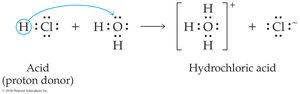
Example:
Here, HCl donates a proton to water, forming hydronium and chloride ions.
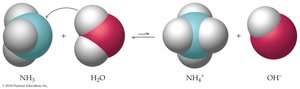
Ammonia as a Brønsted–Lowry base:
Ammonia accepts a proton from water, forming ammonium and hydroxide ions.
Acids, Bases, and Salts
Salts
Salts are ionic compounds composed of cations other than hydrogen and anions other than hydroxide. They are typically formed during the neutralization of acids and bases.
Anhydrides
Acidic anhydrides: Nonmetal oxides that form acids when combined with water (e.g., SO2 + H2O → H2SO3).
Basic anhydrides: Metal oxides that form bases when combined with water (e.g., CaO + H2O → Ca(OH)2).
Strong and Weak Acids and Bases
Strong Acids and Bases
Strong acids and bases ionize completely in water, producing a high concentration of ions.
Strong acids: HCl, HBr, HI, HNO3, H2SO4, HClO3, HClO4
Strong bases: Group 1 and 2 metal hydroxides (e.g., NaOH, KOH, Ca(OH)2)
Weak Acids and Bases
Weak acids and bases only partially ionize in water, resulting in an equilibrium between the ionized and unionized forms.
Neutralization Reactions
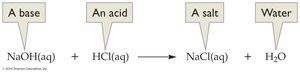
Neutralization is the reaction between an acid and a base to produce water and a salt.
General equation:
Example:
The pH Scale
Definition and Calculation
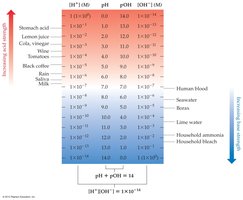
The pH scale is a logarithmic scale used to express the acidity or basicity of a solution. It ranges from 0 (most acidic) to 14 (most basic), with 7 being neutral.
pH Formula:
Acidic: pH < 7
Neutral: pH = 7
Basic: pH > 7
Example Calculation:
For [H3O+] = 1 × 10⁻⁴ M,
Buffers and Conjugate Acid–Base Pairs
Conjugate Acid–Base Pairs
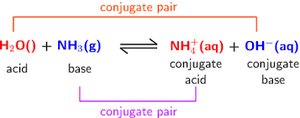
Conjugate acid–base pairs are related by the gain or loss of a single proton (H+).
Example: HCl (acid) and Cl− (conjugate base)
NH3 (base) and NH4+ (conjugate acid)
Buffer Solutions
Buffers are solutions that contain a weak acid and its conjugate base. They resist changes in pH when small amounts of acid or base are added.
Acid Rain
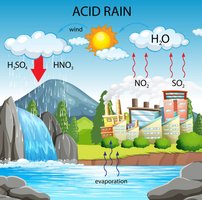
Acid rain is caused by the reaction of nonmetal oxides (such as CO2, SO2, NO, NO2) with water in the atmosphere, forming acidic solutions. Rain with a pH less than 5.6 is considered acid rain.
Antacids: A Basic Remedy
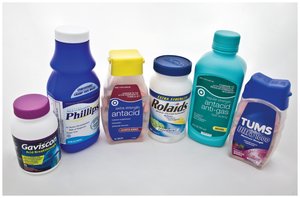
Antacids are basic substances used to neutralize excess stomach acid and relieve symptoms of hyperacidity.
Acids and Bases in Industry and at Home
Acids and bases are widely used in industry and household products. For example, sulfuric acid is used in fertilizer production and car batteries, while hydrochloric acid is used for cleaning and as a rust remover.
