 Back
BackAtoms and Elements: Foundations of Atomic Theory and the Periodic Table
Study Guide - Smart Notes
 Tailored notes based on your materials, expanded with key definitions, examples, and context.
Atoms and Elements
Leucippus’ and Democritus’ Atomic Philosophy
The concept of the atom originated in ancient Greece, where philosophers Leucippus and Democritus first proposed that all matter is composed of small, indivisible, and indestructible particles called atoms. Although their ideas lacked experimental evidence, they laid the groundwork for later scientific inquiry into the nature of matter.
Atoms were thought to be the smallest unit of matter, indivisible and indestructible.
No explanation for chemical or physical behavior was provided.
The theory was philosophical, not based on experimental data.

Laws of Chemical Combination
Law of Definite Proportions (1797)
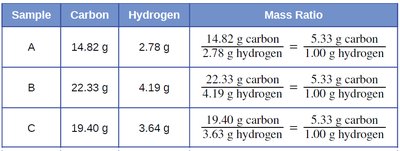
Joseph Proust established that all samples of a pure compound contain the same elements in the same proportions by mass. This law is also known as the law of constant composition.
Regardless of the sample size or source, a compound always contains its component elements in a fixed ratio by mass.
This property is used to distinguish compounds from mixtures.
Sample | Carbon | Hydrogen | Mass Ratio |
|---|---|---|---|
A | 14.82 g | 2.78 g | 5.33 g carbon / 1.00 g hydrogen |
B | 22.33 g | 4.19 g | 5.33 g carbon / 1.00 g hydrogen |
C | 19.40 g | 3.64 g | 5.33 g carbon / 1.00 g hydrogen |
Law of Multiple Proportions (1804)
John Dalton observed that when two elements form more than one compound, the masses of one element that combine with a fixed mass of the other are in ratios of small whole numbers. This law supports the concept of atoms combining in simple, whole-number ratios.
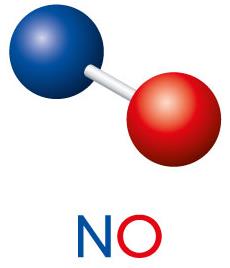
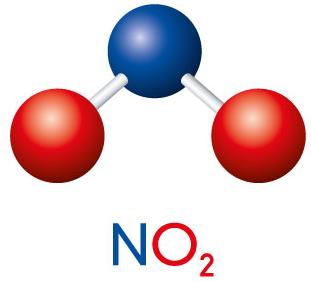
For example, nitrogen and oxygen can form both NO and NO2.
For a fixed mass of nitrogen, the mass of oxygen in NO2 is exactly twice that in NO.
Development of Atomic Theory
John Dalton’s Atomic Theory (1808)
Dalton formulated the first modern atomic theory, which provided a scientific explanation for the laws of chemical combination.
All elements are composed of tiny, indivisible particles called atoms.
Atoms of the same element are identical in mass and properties.
Atoms of different elements can combine in simple whole-number ratios to form compounds.
Chemical reactions involve the rearrangement of atoms; atoms are not created or destroyed in chemical reactions.
Discovery of Subatomic Particles
J.J. Thomson and the Electron (1897)
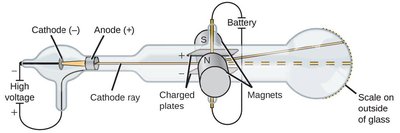
J.J. Thomson discovered the electron using cathode ray tube experiments. He found that cathode rays were negatively charged particles present in all atoms, leading to the conclusion that atoms are divisible and contain subatomic particles.
The cathode ray was deflected by magnetic and electric fields, indicating a negative charge.
The charge-to-mass ratio was the same regardless of the gas or metal used, showing universality of electrons.
Thomson’s Plum Pudding Model (1904)
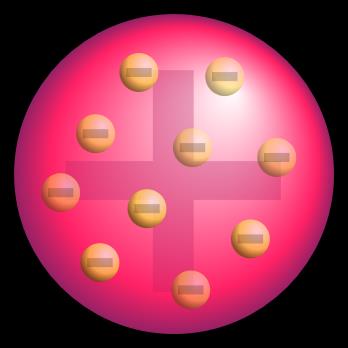
Thomson proposed the "plum pudding" model, where electrons were embedded in a positively charged sphere, like plums in a pudding.
This was the first atomic model to include subatomic structure.
Millikan’s Oil Drop Experiment (1909)
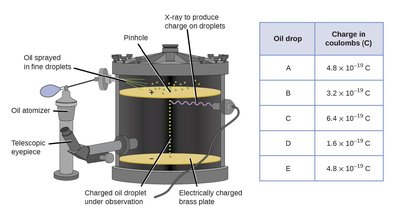
Robert Millikan measured the charge of the electron using the oil drop experiment, confirming that electric charge is quantized and allowing calculation of the electron's mass.
Charges on oil droplets were always multiples of a fundamental value, the charge of a single electron ( C).
Electron mass: g.
Rutherford’s Gold Foil Experiment (1909)
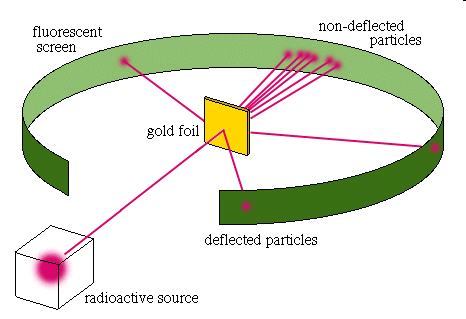
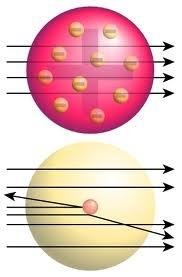
Ernest Rutherford tested the plum pudding model by directing alpha particles at thin gold foil. Most particles passed through, but some were deflected at large angles, indicating a dense, positively charged nucleus.
Most of the atom is empty space.
The nucleus contains most of the atom's mass and all its positive charge.
Rutherford’s Atomic Model (1911)
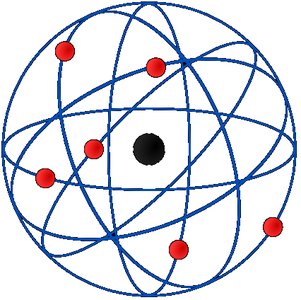
Rutherford proposed that electrons orbit a central nucleus, similar to planets around the sun. This model introduced the concept of a nuclear atom but left questions about electron stability and energy unresolved.
Discovery of the Neutron (1932)
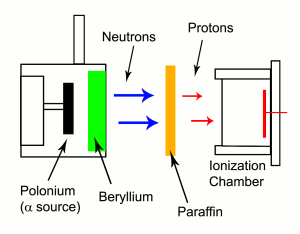
James Chadwick discovered the neutron, a neutral subatomic particle in the nucleus, by bombarding beryllium with alpha particles. Neutrons contribute to atomic mass and nuclear stability.
Neutrons have no charge and a mass similar to protons.
Structure and Properties of the Modern Atom
Subatomic Particles
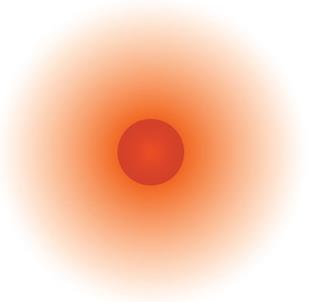
Atoms are composed of three main subatomic particles: protons, neutrons, and electrons. Protons and neutrons reside in the nucleus, while electrons occupy regions of probability called electron clouds.
Protons (p+): Determine the element's identity.
Neutrons (n0): Contribute to atomic mass and stability.
Electrons (e-): Responsible for chemical reactivity.
Atomic Neutrality and Ions
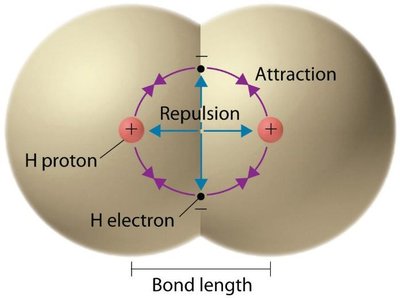
Atoms are electrically neutral when the number of protons equals the number of electrons. Ions are formed when electrons are gained or lost, resulting in a net charge.
Cations: Positively charged ions formed by loss of electrons.
Anions: Negatively charged ions formed by gain of electrons.
The Periodic Table
History and Organization
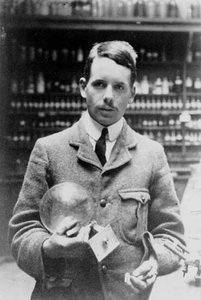
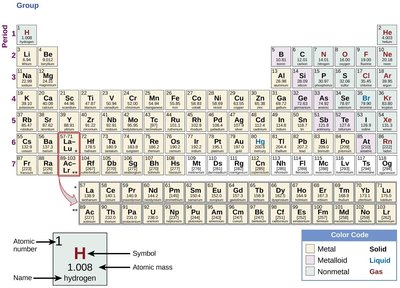
The periodic table organizes elements by increasing atomic number and recurring chemical properties. Dmitri Mendeleev and Lothar Meyer contributed to its development, with Mendeleev predicting undiscovered elements. Henry Moseley later arranged elements by atomic number, leading to the modern periodic law.
Elements are arranged in periods (rows) and groups (columns or families).
Elements in the same group have similar chemical properties.
Periodic Table Group Names and Classifications
Groups (families) have specific names and characteristic properties:
Group I: Alkali metals
Group II: Alkaline earth metals
Group V: Pnictogens
Group VI: Chalcogens
Group VII: Halogens
Group VIII: Noble gases
Elements are classified as metals, nonmetals, or metalloids based on their physical and chemical properties.
Metals: Malleable, ductile, conductive, lustrous; mostly solids.
Nonmetals: Gases or brittle solids; poor conductors.
Metalloids: Properties intermediate between metals and nonmetals; some are semiconductors.
Atomic Number, Mass Number, and Isotopes
Atomic Number (Z)
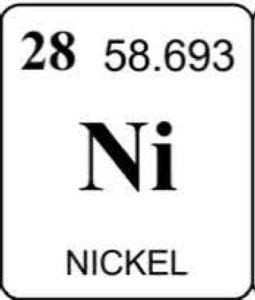
The atomic number is the number of protons in an atom and defines the element. In a neutral atom, it also equals the number of electrons.
Changing the atomic number changes the element's identity.
Mass Number (A) and Isotopes
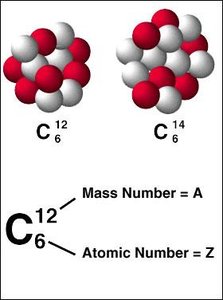
The mass number is the sum of protons and neutrons in the nucleus. Isotopes are atoms of the same element with different numbers of neutrons, resulting in different mass numbers but similar chemical properties.
Mass number:
Isotopes have the same atomic number but different mass numbers.
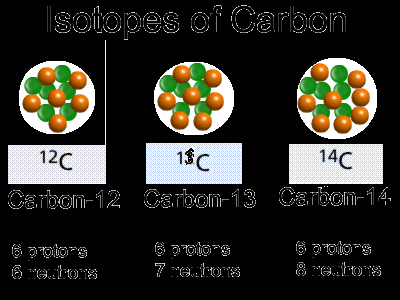
Proton, Neutron, and Electron Counts
To determine the number of subatomic particles in an atom or ion:
Protons: Equal to atomic number (Z).
Neutrons:
Electrons: Equal to protons in a neutral atom; adjust for charge in ions.

Atomic Mass and Average Atomic Mass
Atomic Mass (Relative Atomic Mass)
Atomic mass is measured in unified atomic mass units (u), where 1 u = g. It is based on the mass of protons and neutrons in the nucleus.
1 u is defined as 1/12 the mass of a carbon-12 atom.
Average Atomic Mass
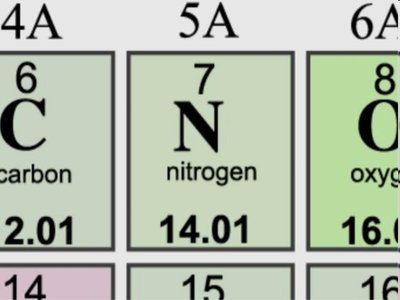
The average atomic mass of an element is the weighted average of the masses of its naturally occurring isotopes, as reported on the periodic table.
Calculated using the formula:
Formula Masses for Compounds
Calculating Formula Mass
The formula mass of a compound is the sum of the atomic masses of all atoms in its chemical formula. This calculation applies to both molecular and ionic compounds.
Example: For XeF4,
Example: For NaCl,
