 Back
BackAtoms and Elements: Structured Study Notes for Introductory Chemistry
Study Guide - Smart Notes
 Tailored notes based on your materials, expanded with key definitions, examples, and context.
Atoms and Elements
Introduction
Atoms are the fundamental building blocks of matter. The properties of atoms determine the properties of all substances. An atom is the smallest identifiable unit of an element, and an element is a substance that cannot be broken down into simpler substances. There are about 91 naturally occurring elements, with additional synthetic elements created by scientists.
The Atomic Theory
The concept of atoms originated with ancient Greek philosophers, but it was John Dalton in 1808 who formalized the atomic theory. Dalton's atomic theory consists of three main points:
Each element is composed of tiny, indestructible particles called atoms.
All atoms of a given element have the same mass and properties that distinguish them from atoms of other elements.
Atoms combine in simple, whole-number ratios to form compounds.
Dalton's theory laid the foundation for modern chemistry by explaining the nature of elements and compounds.
The Nuclear Atom
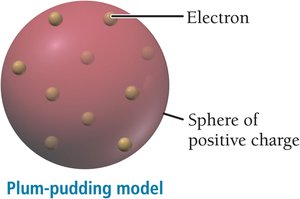
J. J. Thomson discovered the electron, a negatively charged particle much smaller than the atom. He proposed the "plum-pudding model," where electrons are embedded in a sphere of positive charge.
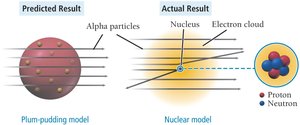
Rutherford's gold foil experiment challenged this model. Alpha particles were directed at a thin sheet of gold foil, and most passed through, but some were deflected, indicating a dense, positively charged nucleus.
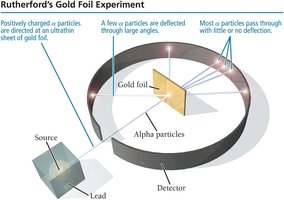
The experiment showed that:
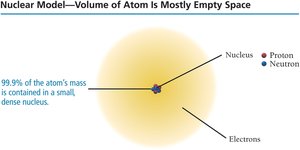
Most of the atom's mass and all its positive charge are in the nucleus.
Most of the atom's volume is empty space, with electrons dispersed outside the nucleus.
The number of electrons equals the number of protons, making the atom electrically neutral.
Protons, Neutrons, and Electrons
Atoms are composed of three main subatomic particles:
Protons: Positively charged particles found in the nucleus.
Neutrons: Electrically neutral particles found in the nucleus.
Electrons: Negatively charged particles located outside the nucleus.
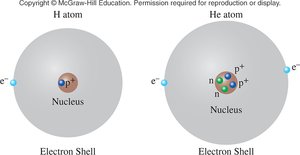
Most of the atom's mass is concentrated in the nucleus.
Electrical Charge
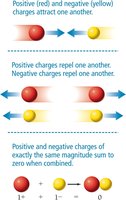
Electrical charge is a fundamental property of protons and electrons. Most matter is charge-neutral because protons and electrons occur together and their charges cancel.
Positive and negative charges attract each other.
Like charges repel each other.
When paired, a proton and an electron are charge-neutral.
Atomic Number, Chemical Symbol, and Elements
The atomic number (Z) is the number of protons in the nucleus and determines the identity of the atom. The periodic table lists each element by atomic number, name, and symbol.
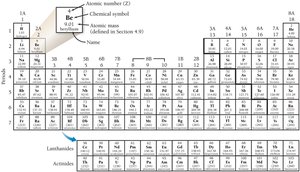
Each element is represented by a unique chemical symbol, often derived from Latin or Greek names (e.g., Pb for lead, Hg for mercury).
The Periodic Law and the Periodic Table
Dmitri Mendeleev organized elements by increasing relative mass, observing recurring patterns in properties. This led to the periodic law: properties of elements recur in a regular pattern when arranged by atomic number.
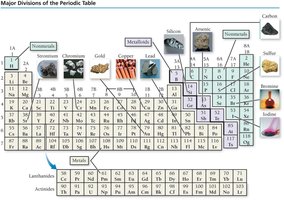
Elements are classified as:
Metals: Usually solid, shiny, malleable, and conductive (e.g., Fe, Mg).
Nonmetals: Can be gas, solid, or liquid; poor conductivity (e.g., O, N).
Metalloids: Semiconductors with mixed properties (e.g., Si, As).
Periods and Groups
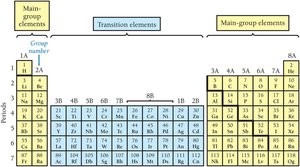
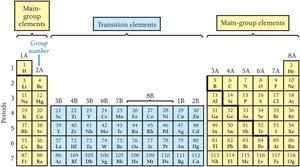
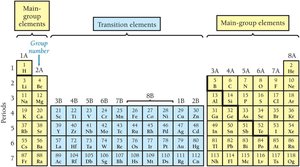
The periodic table is organized into periods (horizontal rows) and groups (vertical columns). Elements in the same group have similar properties.
Main Group Elements and Transition Elements
Main group elements (labeled with A) have predictable properties based on their position. Transition elements (labeled with B) have less predictable properties.
Groups in the Periodic Table
Alkali Metals (Group 1A): Very reactive metals (e.g., Li, Na, K).
Alkaline Earth Metals (Group 2A): Fairly reactive metals (e.g., Be, Mg, Ca).
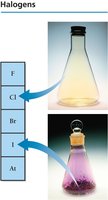
Halogens (Group 7A): Very reactive nonmetals (e.g., F, Cl, Br, I, At).
Noble Gases (Group 8A): Chemically inert gases (e.g., He, Ne, Ar).
Ions: Gaining and Losing Electrons
Atoms can gain or lose electrons to form ions:
Cations: Positive ions formed by losing electrons (e.g., Na+, Ca2+).
Anions: Negative ions formed by gaining electrons (e.g., Cl-, O2-).
The charge of an ion is calculated as:
$\text{Ion charge} = \text{number of protons} - \text{number of electrons}$
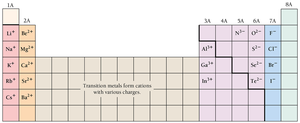
Main-group elements tend to form ions with the same number of valence electrons as the nearest noble gas.
Isotopes
Atoms of the same element can have different numbers of neutrons, resulting in isotopes. Isotopes have the same number of protons but different numbers of neutrons. Each element has a unique percent natural abundance of its isotopes.
Example: Neon has three isotopes—Ne-20, Ne-21, Ne-22—all with 10 protons but different numbers of neutrons.
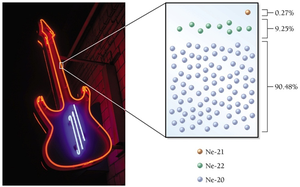
The mass number (A) is the sum of protons and neutrons. Isotopes are symbolized as:
$\text{Element symbol}-\text{mass number}$ (e.g., Ne-20)
Or as:
$\begin{array}{c} \text{mass number} \\ \text{Element symbol} \\ \text{atomic number} \end{array}$
Calculating Atomic Mass as the Weighted Average
The atomic mass listed in the periodic table is the weighted average of the masses of an element's isotopes, based on their natural abundance. The calculation is:
$\text{Atomic mass} = \sum (\text{fractional abundance} \times \text{isotope mass})$
Example: Chlorine has two isotopes—chlorine-35 (75.77%, mass 34.97 amu) and chlorine-37 (24.23%, mass 36.97 amu). The average atomic mass is calculated using their fractional abundances.
Additional info: The study notes above expand on the original content with definitions, examples, and formulas to ensure completeness and academic quality for exam preparation.
