 Back
BackAtoms, Laws of Chemical Combination, and the Periodic Table
Study Guide - Smart Notes
 Tailored notes based on your materials, expanded with key definitions, examples, and context.
Atoms: Historical Development and Modern Understanding
The Greek Concept of Matter
The earliest ideas about the nature of matter originated in ancient Greece. Philosophers such as Aristotle believed that all matter was composed of four fundamental elements: earth, air, fire, and water. This view held that matter was continuous and could be divided infinitely without ever reaching a fundamental particle.
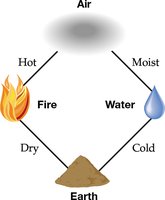
Aristotle's Model: Matter is made of four elements and is continuous, not atomistic.
Limitations: This model could not explain chemical changes or the diversity of substances.
Atomism: Leucippus and Democritus
Leucippus and Democritus introduced the concept of the atom (from the Greek atomos, meaning "cannot be cut"). They proposed that matter is composed of tiny, indivisible particles called atoms, which cannot be further subdivided.
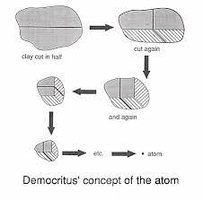
Atomos: The smallest indivisible unit of matter.
Significance: This idea laid the foundation for the modern atomic theory.
Law of Conservation of Mass
Lavoisier's Contribution
Antoine Lavoisier, known as the father of modern chemistry, established the Law of Conservation of Mass. He demonstrated that the total mass of reactants in a chemical reaction equals the total mass of products. This law is fundamental to all chemical processes.
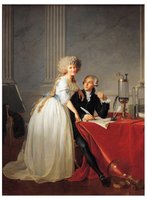
Law of Conservation of Mass: Matter is neither created nor destroyed in a chemical reaction.
Example: Burning a log results in ash and gases; the total mass remains constant if all products are collected.
Dalton's Atomic Theory
John Dalton and the Modern Atomic Model
John Dalton revived the atomic concept in the early 19th century, proposing a scientific atomic theory based on experimental evidence. Dalton's theory consists of four main postulates:
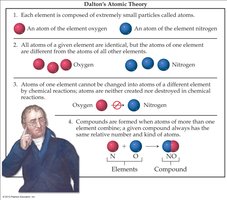
Postulate 1: Each element is composed of extremely small particles called atoms.
Postulate 2: All atoms of a given element are identical in mass and properties, but differ from atoms of other elements.
Postulate 3: Atoms are not created or destroyed in chemical reactions; they are rearranged.
Postulate 4: Compounds are formed when atoms of different elements combine in fixed ratios.
Example: Water (H2O) always contains two hydrogen atoms for every one oxygen atom.
Laws of Chemical Combination
Law of Definite Proportions (Proust's Law)
This law states that a given compound always contains the same proportion of elements by mass, regardless of the sample size or source.
Example: Carbon dioxide (CO2) always has a mass ratio of oxygen to carbon of 2.667:1.
Law of Multiple Proportions (Dalton's Law)
If two elements form more than one compound, the masses of one element that combine with a fixed mass of the other are in ratios of small whole numbers.
Example: CO and CO2 have oxygen-to-carbon mass ratios of 1.333:1 and 2.667:1, respectively, a simple 1:2 ratio.
The Periodic Table
Mendeleev and the Organization of Elements
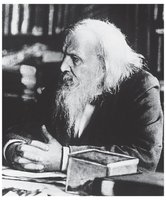
Dmitri Mendeleev arranged elements in order of increasing atomic mass and grouped them by similar chemical properties. He left gaps for undiscovered elements and predicted their properties with remarkable accuracy.
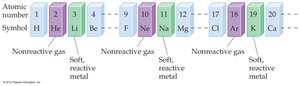
Periodic Law: The properties of elements recur in a regular pattern when arranged by atomic number.
Modern Table: Elements are now arranged by atomic number, not mass.
The Mole Concept
Avogadro's Number and Moles
The mole is the SI unit for amount of substance. One mole contains Avogadro's number of particles (6.022 × 10²³). This allows chemists to count atoms, molecules, or ions by weighing them.
Equality: 1 mole = 6.022 × 10²³ particles
Conversion Factors: Use Avogadro's number to convert between moles and particles.
Example Calculation: How many moles are in 2.50 × 1024 molecules of CO2?
Molar Mass and Conversions
The molar mass is the mass of one mole of a substance, expressed in grams per mole (g/mol). It is numerically equal to the atomic or molecular mass in atomic mass units (amu).
Example: The molar mass of carbon is 12.01 g/mol.
Conversion: To convert between mass and moles, use the formula:
Isotopes
Definition and Properties
Isotopes are atoms of the same element with the same number of protons but different numbers of neutrons. They have identical chemical properties but different masses.
Example: Carbon-12 and Carbon-14 are isotopes of carbon.
Green Chemistry
Principles and Applications
Green Chemistry aims to design chemical products and processes that reduce or eliminate the use and generation of hazardous substances. One example is replacing mercury-containing light bulbs with safer alternatives.
Goal: Minimize environmental impact and improve safety.
