 Back
BackChapter 6: Chemical Composition – Moles, Mass, and Counting Atoms
Study Guide - Smart Notes
 Tailored notes based on your materials, expanded with key definitions, examples, and context.
Chemical Composition and the Mole Concept
Introduction to Chemical Composition
Chemical composition is fundamental to understanding how substances are quantified and related in chemistry. The mole concept allows chemists to count atoms, molecules, or ions by weighing, making it possible to relate mass, number of particles, and chemical formulas.
Information in a Chemical Formula
Calculating the Amount of a Constituent Element in a Compound
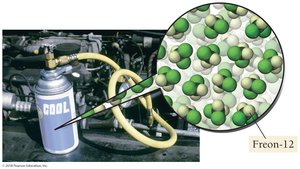
Chemical formulas, atomic masses, and formula masses are used to determine how much of an element is present in a compound. For example, calculating the amount of iron in iron ore or chlorine in a chlorofluorocarbon requires understanding the chemical formula and the mass relationships.
Chemical formula: Indicates the types and numbers of atoms in a compound.
Atomic mass: The mass of a single atom, usually expressed in atomic mass units (amu).
Formula mass: The sum of atomic masses for all atoms in a chemical formula.

Counting by Weighing
Nails by the Pound – Analogy for Counting Atoms
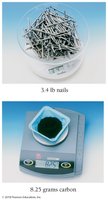
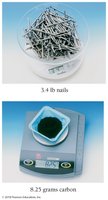
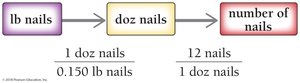
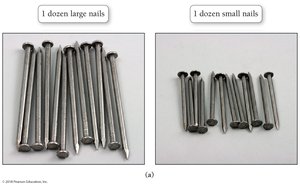
Counting objects by weighing is a practical method used in stores, such as selling nails by the pound. This analogy helps students understand how chemists count atoms in a given mass of an element.
Counting by weighing: Used when individual counting is impractical due to large numbers.
Conversion factors: Relate mass to number of items (e.g., dozen nails).
The Mole: Chemist’s Counting Unit
Definition and Avogadro’s Number
The mole is the chemist’s counting unit, analogous to a dozen but much larger. One mole contains 6.022 × 10²³ units, known as Avogadro’s number.
Mole (mol): 1 mol = 6.022 × 10²³ units
Avogadro’s number: Named after Amadeo Avogadro, it is the number of particles in one mole.
Examples:
1 mole of marbles = 6.022 × 10²³ marbles
1 mole of sand grains = 6.022 × 10²³ sand grains
Objects of Reasonable Size
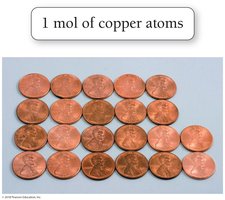
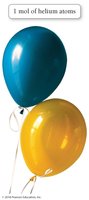
One mole of atoms, ions, or molecules generally makes up objects of reasonable size, such as 22 copper pennies or two large helium balloons.
Converting Moles to Number of Atoms
Example: Helium Atoms
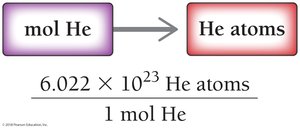
To convert moles to number of atoms, use Avogadro’s number as a conversion factor.
Relationship: 1 mol He = 6.022 × 10²³ He atoms
Solution map: mol He → He atoms
Example: Silver Atoms
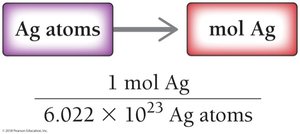
To convert from number of atoms to moles, use the inverse of Avogadro’s number.
Relationship: 1 mol Ag = 6.022 × 10²³ Ag atoms
Solution map: Ag atoms → mol Ag

Molar Mass and Atomic Mass
Definition and Calculation
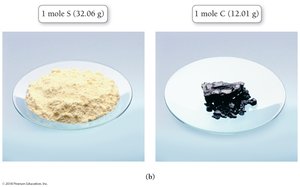
The atomic mass unit (amu) is defined as 1/12th the mass of a carbon-12 atom. The molar mass of an element is the mass of 1 mole of atoms, numerically equal to the atomic mass in grams per mole.
Atomic mass: Mass of a single atom (e.g., copper = 63.55 amu)
Molar mass: Mass of 1 mol of atoms (e.g., copper = 63.55 g/mol)
Examples:
32.07 g sulfur = 1 mol sulfur = 6.022 × 10²³ S atoms
12.01 g carbon = 1 mol carbon = 6.022 × 10²³ C atoms
6.94 g lithium = 1 mol lithium = 6.022 × 10²³ Li atoms
Periodic Table and Atomic Masses
Table of Elements by Atomic Number
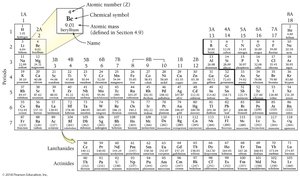
The periodic table lists all known elements according to their atomic numbers, chemical symbols, and atomic masses. It is a key reference for determining molar masses and atomic masses.
Converting Between Grams and Moles
Example: Carbon in Diamond
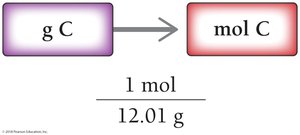
To convert grams to moles, use the molar mass as a conversion factor. For carbon, the molar mass is 12.01 g/mol.
Relationship: 12.01 g C = 1 mol C
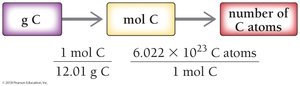
Solution map: g C → mol C

Converting Grams to Moles to Atoms
To find the number of atoms in a given mass, first convert grams to moles, then moles to atoms using Avogadro’s number.
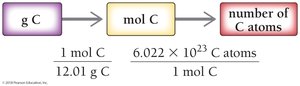
Solution map: g C → mol C → number of C atoms


Example: Aluminum Atoms in a Can
Converting Grams to Atoms
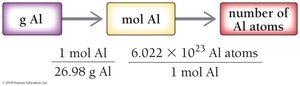
To determine the number of aluminum atoms in a can, convert grams to moles using the molar mass, then moles to atoms using Avogadro’s number.
Relationship: 26.98 g Al = 1 mol Al; 1 mol = 6.022 × 10²³ atoms
Solution map: g Al → mol Al → number of Al atoms

Counting Molecules by the Gram
Molar Mass of Compounds
For compounds, the molar mass is the mass of 1 mol of molecules or formula units. The formula mass is the sum of atomic masses for all atoms in the chemical formula.
Molar mass (compound): Mass of 1 mol of molecules/formula units
Formula mass: Sum of atomic masses in the chemical formula
Converting Between Grams and Moles of a Compound
Example: Water
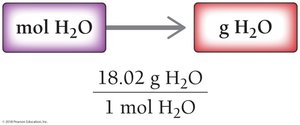
To calculate the mass of a given number of moles of water, use the molar mass of water (18.02 g/mol).
Relationship: H2O molar mass = 2(atomic mass H) + 1(atomic mass O) = 18.02 g/mol
Solution map: mol H2O → g H2O
Converting Between Mass of a Compound and Number of Molecules
Example: Nitrogen Dioxide (NO2)
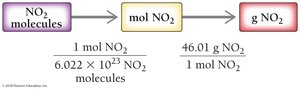
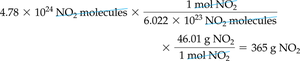
To find the mass of a given number of NO2 molecules, convert molecules to moles using Avogadro’s number, then moles to grams using the molar mass.
Relationship: 6.022 × 10²³ molecules = 1 mol; NO2 molar mass = 46.01 g/mol
Solution map: NO2 molecules → mol NO2 → g NO2
Summary Table: Common Conversions in Chemical Composition
Conversion | Relationship | Example |
|---|---|---|
Grams to Moles | 0.58 g C to mol C | |
Moles to Atoms | 3.5 mol He to He atoms | |
Atoms to Moles | 1.1 × 10²² Ag atoms to mol Ag | |
Moles to Grams (Compound) | 1.75 mol H2O to grams | |
Molecules to Grams (Compound) | 4.78 × 1024 NO2 molecules to grams |
