 Back
BackChapter 6: Chemical Composition – Study Notes for Introductory Chemistry
Study Guide - Smart Notes
 Tailored notes based on your materials, expanded with key definitions, examples, and context.
Chemical Composition
Importance of Sodium in Diet
Sodium is a vital dietary mineral, commonly consumed as sodium chloride (table salt). It plays a key role in regulating body fluids, but excessive intake can lead to high blood pressure. Understanding the chemical composition of sodium chloride helps determine how much sodium is present in the salt we eat.
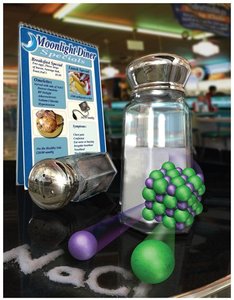
Calculating Sodium Content in Sodium Chloride
The FDA recommends consuming less than 2.3 grams of sodium per day. However, the mass of sodium chloride consumed is not the same as the mass of sodium alone. The chemical formula NaCl indicates a 1:1 ratio of sodium ions to chloride ions, but their masses differ. To determine sodium content, calculations based on chemical composition are required.
Using Chemical Formulas to Calculate Elemental Content
Chemical formulas, combined with atomic or molecular masses, allow us to calculate the amount of a constituent element in a compound. For example, we can determine how much iron is in iron ore or how much chlorine is in a chlorofluorocarbon.

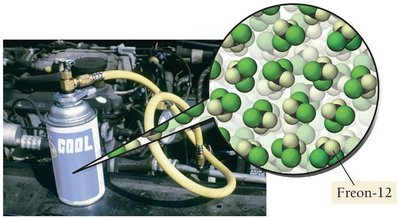
Counting by Weighing: Analogies and Methods
Counting Nails by Weight
Hardware stores often sell nails by the pound, which is easier than counting individual nails. This is analogous to counting atoms in a given mass of an element, since atoms are too small and numerous to count directly.
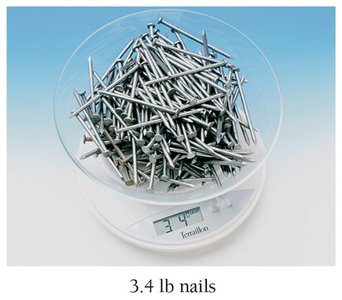
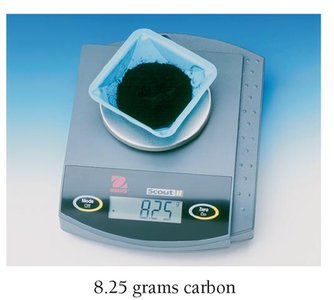
Conversion Process: Nails Example
To determine the number of nails in a given weight, conversion factors are used: weight per dozen nails and number of nails per dozen. The solution map illustrates the stepwise conversion from pounds to dozens to individual nails.

The Mole: Counting Atoms and Molecules
The Concept of the Mole
Atoms are extremely small and numerous, making direct counting impractical. Chemists use the mole (mol) as a counting unit, analogous to a dozen but much larger. One mole equals units, known as Avogadro's number.
Avogadro's Number:
Application: One mole of marbles, sand grains, or atoms contains of those units.
Practical Examples of the Mole
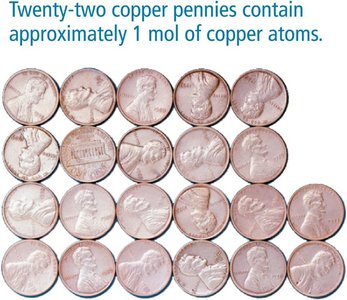
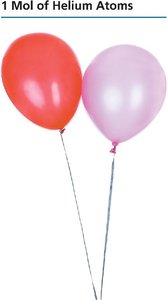
One mole of atoms, ions, or molecules generally makes up objects of reasonable size. For example, twenty-two copper pennies contain about one mole of copper atoms, and two large helium balloons contain approximately one mole of helium atoms.
Definition and Measurement of the Mole
The mole is defined as the number of atoms in exactly 12 grams of pure carbon-12. This establishes a relationship between mass and number of atoms, allowing chemists to count atoms by weighing them.
Conversions: Moles, Atoms, and Mass
Converting Moles to Number of Atoms
To convert moles to the number of atoms, use Avogadro's number as a conversion factor. For example, converting 3.5 mol of helium to atoms:
Formula:
Example:

Converting Number of Atoms to Moles
To convert atoms to moles, divide by Avogadro's number. For example, converting silver atoms to moles:
Formula:
Example:

Variation in Mass: Nails and Atoms
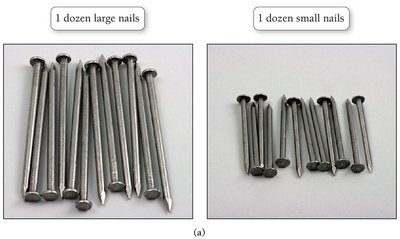
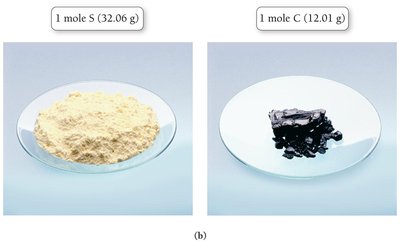
The weight of one dozen nails changes depending on the size of the nails. Similarly, the weight of one mole of atoms changes for different elements.
Molar Mass and Atomic Mass
Definitions
The atomic mass unit (amu) is defined as one-twelfth the mass of a carbon-12 atom. The molar mass of an element is the mass of 1 mole of atoms, numerically equal to the atomic mass in grams.
Example: Copper has an atomic mass of 63.55 amu; 1 mole of copper atoms has a mass of 63.55 grams.
Molar Mass:
Molar Mass for Different Elements
The mass of 1 mole of atoms varies by element:
Sulfur:
Carbon:
Lithium:
Converting Between Grams and Moles
Example: Carbon in a Diamond
To calculate the number of moles in a given mass, use the molar mass as a conversion factor. For example, 0.58 g of carbon:
Formula:
Example:

Converting Between Grams and Number of Atoms
To find the number of atoms in a given mass, convert grams to moles, then moles to atoms using Avogadro's number. For example, 16.2 g of aluminum:
Formula:
Example:

Counting Molecules by the Gram
Molar Mass of Compounds
For elements, molar mass is the mass of 1 mole of atoms. For compounds, it is the mass of 1 mole of molecules or formula units. Ionic compounds are described by formula units rather than molecules.
Converting Between Grams and Moles of a Compound
The molar mass of a compound (grams per mole) is numerically equal to its formula mass in atomic mass units (amu). The formula mass is the sum of atomic masses in the chemical formula.
Example: Water ():

Converting Between Number of Molecules and Mass
To find the mass of a given number of molecules, convert molecules to moles using Avogadro's number, then moles to grams using molar mass.
Example: molecules of
Formula:
Calculation:

Chemical Formulas as Conversion Factors
Using Formulas for Conversion
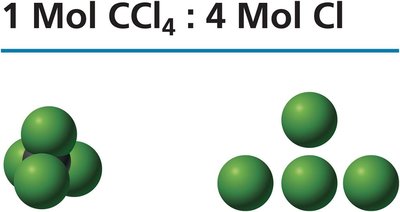
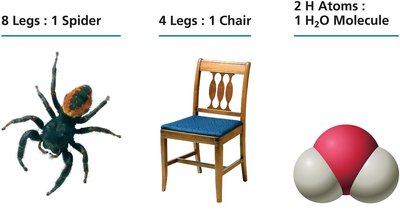
Chemical formulas provide relationships between moles of compounds and moles of constituent elements. For example, contains two oxygen atoms per molecule, so:
molecule


Converting Between Moles of Compound and Moles of Element
To find the number of moles of an element in a compound, use the ratio from the chemical formula. For example, in :
contains 3 moles of O per mole of compound.

Converting Between Grams of Compound and Grams of Element
To find the mass of an element in a compound, convert grams of compound to moles, then moles of compound to moles of element, then moles of element to grams.
Example: Find mass of sodium in 15 g NaCl:
Stepwise:

Review and Learning Objectives
The Mole
The mole is a specific number () used to count atoms or molecules by weighing.
One mole of any element has a mass equal to its atomic mass in grams.
One mole of any compound has a mass equal to its formula mass in grams.
The mass of one mole is called the molar mass.
Chemical Formulas and Composition
Chemical formulas indicate the relative number of each kind of element in a compound.
These numbers are based on atoms or moles.
Molar masses and chemical formulas allow determination of the relative masses of each element in a compound.
The total mass of a compound sample can be related to the masses of its constituent elements.
Empirical and Molecular Formulas
The empirical formula shows the simplest ratio of elements in a compound.
The molecular formula shows the actual number of atoms in a molecule, determined if the molar mass is known.
Learning Objectives
Convert between moles and number of atoms.
Convert between grams and moles.
Convert between grams and number of atoms or molecules.
Convert between grams and moles of a compound.
Convert between mass of a compound and number of molecules.
Convert between moles of a compound and moles of a constituent element.
Convert between grams of a compound and grams of a constituent element.
