 Back
BackChemical Composition and Stoichiometry: Study Notes
Study Guide - Smart Notes
 Tailored notes based on your materials, expanded with key definitions, examples, and context.
Chemical Composition
Formula Masses for Compounds
The formula mass of a compound is the sum of the atomic masses of all atoms present in its chemical formula. This value is essential for understanding the mass relationships in chemical reactions and for calculating molar masses.
Formula mass calculation: Add the atomic masses of each element, multiplied by the number of atoms of that element in the formula.
Example: For XeF4: Xe = 131.293 u, F = 4 × 18.998 u; XeF4 = 131.293 u + 75.992 u = 207.285 u.
Example: For NaCl: Na = 22.989 u, Cl = 35.453 u; NaCl = 22.989 u + 35.453 u = 58.442 u.
Formula mass calculations apply to all compounds and elements.
Key Terms: Formula mass, atomic mass unit (u)
The Mole and Representative Particles
The mole is a fundamental unit in chemistry representing 6.02214076 × 10²³ particles (atoms, molecules, ions, etc.). This number is known as Avogadro's number and allows chemists to relate microscopic particles to macroscopic amounts.
1 mole of any substance contains exactly 6.02214076 × 10²³ representative particles.
Representative particles can be atoms, molecules, ions, or formula units.
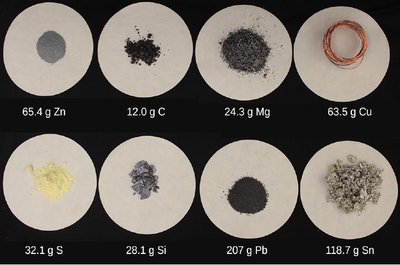
Example: 65.4 g of Zn, 12.0 g of C, 24.3 g of Mg, etc., each represent 1 mole of the respective element.
The Mole and Molar Mass
The molar mass is the mass of one mole of a substance, expressed in grams per mole (g/mol). It is numerically equal to the average atomic mass (in u) of an element or the formula mass of a compound.
1 mole of carbon (C) = 12.011 g
1 mole of hydrogen (H) = 1.00795 g
To find the molar mass of a compound, sum the molar masses of all atoms in the formula.
Example: Molar mass of methane (CH4): C = 12.011 g/mol, H = 4 × 1.00795 g/mol; CH4 = 12.011 g/mol + 4.0318 g/mol = 16.0428 g/mol.
Mole Road Map
The mole road map is a visual tool for converting between mass, moles, number of particles, and volume of gas (at STP). It helps students understand the relationships and conversion factors used in stoichiometry.
Mass → Moles: Divide by molar mass
Moles → Mass: Multiply by molar mass
Moles → Particles: Multiply by Avogadro's number
Particles → Moles: Divide by Avogadro's number
Moles → Volume (gas at STP): Multiply by 22.4 L/mol
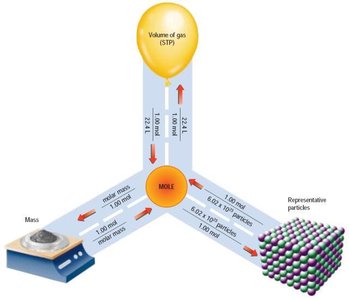
Key Terms: Mole, molar mass, Avogadro's number, STP
Using Dimensional Analysis (DA) to Convert Between Mass Values
Dimensional analysis is a method used to convert between units in chemistry, such as grams, moles, and number of particles. It is essential for solving stoichiometric problems.
Example: Given 8.25 g of potassium hydrogen sulfate, calculate the number of potassium ions, moles of hydrogen sulfate ions, and grams of sulfur.
Example: Given 8.323 × 10²² atoms of hydrogen in ammonium phosphate, calculate the original mass, moles of phosphate, and number of ammonium ions.
Formula:
Composition Stoichiometry
Elemental Analysis
Elemental analysis is used to determine the composition of a compound by measuring the amounts of each element present. This is often done using combustion analysis, which is required for publication in scientific journals.
CHNX testing: Determines the percentage of carbon, hydrogen, nitrogen, and other elements.
JACS (Journal of the American Chemical Society) requires results within 0.4% of calculated values.
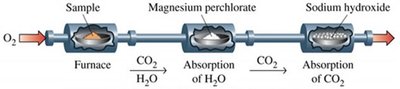
Key Terms: Combustion analysis, elemental analysis
Mass Percent Composition
Mass percent composition is the percentage by mass of each element in a compound. It is calculated by dividing the mass of each element by the total mass of the compound and multiplying by 100%.
Formula:
Example: A 1.912 g sample of calcium chloride contains 0.690 g Ca and 1.222 g Cl. Mass percent Ca = (0.690/1.912) × 100% = 36.08%; Mass percent Cl = (1.222/1.912) × 100% = 63.92%.
Example: Silver(I) chloride contains 75.27% silver. To make 4.8 g of silver plating, calculate the mass of AgCl required:
Empirical Formula and Molecular Formula
The empirical formula is the simplest whole-number ratio of atoms in a compound, while the molecular formula gives the actual number of atoms in a molecule. The molecular formula is always a whole-number multiple of the empirical formula.
Empirical formula: Smallest ratio of atoms (e.g., BH3)
Molecular formula: Actual formula (e.g., B2H6 is a multiple of BH3)
If the multiple is 1, the empirical and molecular formulas are the same.
Key Terms: Empirical formula, molecular formula
Empirical Formula Calculations
To determine the empirical formula, use the mass or percent composition of each element, convert to moles, and find the simplest ratio.
Example: A compound contains 63.52% iron and 36.48% sulfur. Convert each to moles and find the ratio.
Example: A 2.241 g sample of nickel reacts with oxygen to form 2.852 g of metal oxide. Find the empirical formula by calculating moles of Ni and O.
Empirical and Molecular Formula Calculations
Given mass or percent composition and molar mass, calculate both empirical and molecular formulas.
Example: A 0.400 g sample contains 0.141 g K, 0.115 g S, and 0.144 g O. Find the empirical formula.
Example: 54.53% C, 9.15% H, 36.32% O; molar mass = 88.01 g/mol. Find the molecular formula.
Example: Pineapple oil composition: 62.04% C, 10.41% H, 27.55% O; molar mass = 116.16 g/mol. Find empirical and molecular formulas.
Formula:
Convert mass or percent to moles for each element.
Divide each by the smallest number of moles.
Round to nearest whole number to get ratio.
Multiply empirical formula by integer to match molecular mass if needed.
Example: If empirical formula mass is 58 g/mol and molecular mass is 116 g/mol, molecular formula is empirical formula × 2.
