 Back
BackChemical Warfare Agents: Nerve Agents and Incapacitants – Structure, Properties, and Effects
Study Guide - Smart Notes
 Tailored notes based on your materials, expanded with key definitions, examples, and context.
Chemical Warfare Agents
Classification of Chemical Warfare Agents
Chemical warfare agents are substances designed to cause harm or incapacitation through chemical action. They are classified based on their physiological effects and mechanisms of action.
Choking agents: Attack lung tissue, causing pulmonary edema (e.g., chlorine, phosgene).
Blood agents: Inhibit enzymes involved in respiration, similar to carbon monoxide poisoning (e.g., cyanide, cyanogen).
Blister agents (vesicants): Cause severe blistering and tissue damage (e.g., mustards, lewisite).
Nerve agents: Highly toxic compounds that disrupt nervous system function (e.g., sarin, tabun, soman, VX, Novichok).
Incapacitants: Cause temporary physiological or psychological effects (e.g., tear gas, vomiting agents).
Incendiary agents: Designed to start fires or destroy equipment (e.g., white phosphorus, napalm).
Nerve Agents
Overview and Mechanism of Action
Nerve agents are organophosphorus compounds that inhibit acetylcholinesterase (AChE), an enzyme essential for nerve function. Inhibition leads to accumulation of acetylcholine, causing continuous nerve signal transmission, muscle paralysis, and potentially death.
Highly toxic and lethal even in small quantities.
Clear, colorless liquids (may appear yellowish if impure).
High lipid solubility and moderate water solubility.
Classified as weapons of mass destruction by the United Nations.
Therapy and Antidote Administration
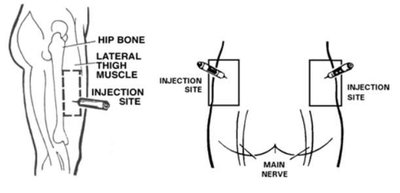
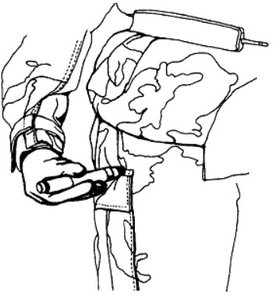
Immediate treatment is critical for nerve agent exposure. The standard therapy involves administration of atropine (blocks acetylcholine receptors) and oximes (reactivate AChE), often delivered via autoinjectors.
Injection site: Lateral thigh muscle is preferred for rapid absorption.
Procedure: Hold the injector firmly in place for at least 10 seconds.
Symptoms and Severity of Exposure
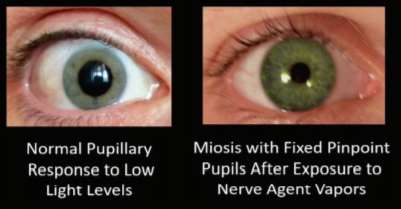
Symptoms progress with exposure time and dose, ranging from mild (miosis, runny nose) to severe (convulsions, paralysis, apnea).
Miosis: Pinpoint pupils are an early sign of exposure.
Other symptoms: Rhinorrhea, dyspnea, nausea, vomiting, loss of consciousness.
The G Series Nerve Agents
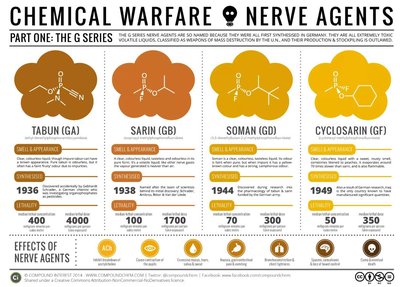
The G series includes Tabun (GA), Sarin (GB), Soman (GD), and Cyclosarin (GF), first synthesized in Germany. These agents are volatile, highly toxic, and have been used as chemical weapons.
Tabun (GA): Fruity, bitter almond odor; synthesized in 1936; antidote is atropine and oximes; decontaminated with bleaching powder.
Sarin (GB): Odorless; synthesized in 1938; highly toxic by skin contact or inhalation; decontaminated with bleaching powder, water, bicarbonate, or sodium hydroxide.
Soman (GD): Fruity, camphor odor; synthesized in 1944; extremely toxic; rapid "aging" of enzyme-substrate complex makes antidote ineffective after 5 minutes.
Cyclosarin (GF): Sweet, musty odor; synthesized in 1949; highly toxic; decontaminated with soap and water, bicarbonate, sodium hydroxide, or bleach.
Physical Properties of G- and V-Series Agents
The table below summarizes the melting point, boiling point, vapor density, and vapor pressure of selected nerve agents.
Agent | Melting Point (°C) | Boiling Point (°C) | Vapor Density (compared to air) | Vapor Pressure (mm Hg at 20°C) |
|---|---|---|---|---|
Tabun | -49 | 246 | 5.6 | 0.036 |
Sarin | -56 | 147 | 4.86 | 2.10 |
Soman | -80 | 167 | 6.3 | 0.27 |
VX | -20 | 300 | 9.2 | 0.00044 |
The V Series Nerve Agents
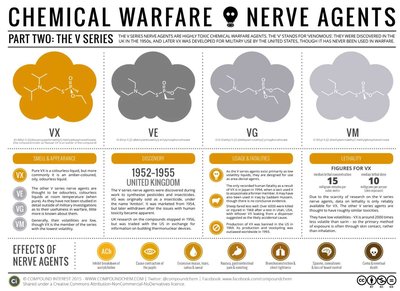
The V series (Venomous agents) are highly toxic, low volatility liquids developed in the UK and US during the 1950s. VX is the most well-known and dangerous of this group.
VX: Odorless, persistent, primarily absorbed through skin; LD50 (skin, 70 kg human) ≈ 10 mg.
Other V agents: VE, VG, VM, and VR (Soviet VX isomer).
Decontamination: Soap and water, bleach, or alkaline solutions.

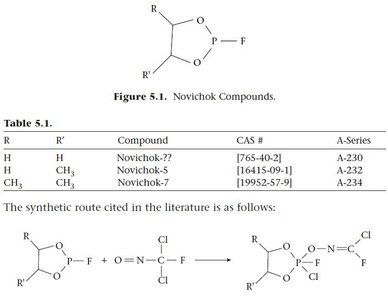
Novichok Agents
Novichok agents are a class of nerve agents developed in the Soviet Union and Russia. They are believed to be more potent than VX and designed to evade chemical weapons treaties.
Binary compounds: Components are mixed to form the active agent just before use.
Very stable and persistent in the environment.
Examples: A-230, A-232, A-234 (exact structures are not publicly confirmed).
Incapacitants
Physical and Psychoincapacitants
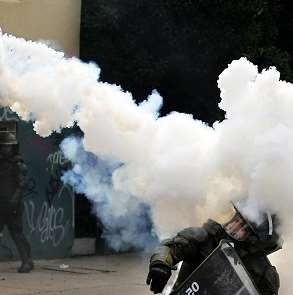
Incapacitants are chemical agents that temporarily reduce the ability to function, either physically or mentally. They are primarily used for riot control or crowd management.
Physical incapacitants: Cause tears and irritation (e.g., tear gas, vomiting agents).
Psychoincapacitants: Affect mental state or perception.
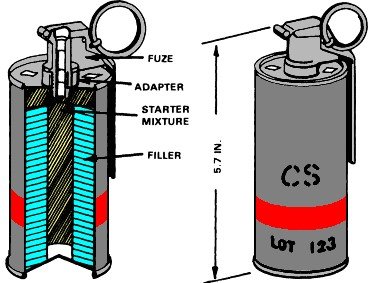
CS gas: The most commonly used tear agent; rapid onset, effects last 5–20 minutes.
Key Chemical and Physical Properties
CS (O-Chlorobenzylidene malononitrile): Developed in the 1950s, used for riot control and military training.
ICt50 (respiratory): 61,000 mg-min/m3 (incapacitates 50% of exposed population).
Summary Table: Types of Chemical Warfare Agents
Type | Effect | Examples |
|---|---|---|
Choking agents | Pulmonary edema | Chlorine, phosgene |
Blood agents | Respiratory enzyme inhibition | Cyanide, cyanogen |
Blister agents | Severe blistering | Mustards, lewisite |
Nerve agents | Nervous system disruption | Sarin, tabun, soman, VX, Novichok |
Incapacitants | Temporary incapacitation | CS, CN, BZ |
Incendiary agents | Fire, destruction | White phosphorus, napalm |
Key Equations and Chemical Reactions
General reaction for nerve agent inhibition of AChE:
Decontamination reaction (example for Tabun):
Example of Novichok synthesis (as cited in literature):
Additional info: The notes above include expanded academic context on the chemical structure, mechanism, and classification of chemical warfare agents, as well as the physical and chemical properties of nerve agents and incapacitants, to ensure completeness and self-contained study material for introductory chemistry students.
