 Back
BackChemistry of Earth: Structure, Minerals, and Materials
Study Guide - Smart Notes
 Tailored notes based on your materials, expanded with key definitions, examples, and context.
Earth’s Structure and Composition
Major Regions of the Earth
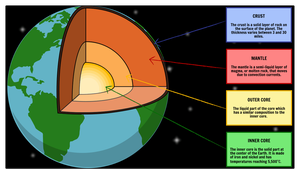
The Earth is composed of several distinct layers, each with unique chemical and physical properties. Understanding these regions is essential for studying the chemistry of Earth's materials.
Core: The innermost region, primarily composed of iron and nickel. It is divided into a solid inner core and a liquid outer core.
Mantle: Located above the core, the mantle consists mainly of silicate minerals and various metals. It is semi-solid and involved in tectonic activity.
Crust (Lithosphere): The outermost shell, composed of solid rock. It is the most accessible and chemically diverse region, containing the majority of Earth's minerals.
Earth’s Spheres
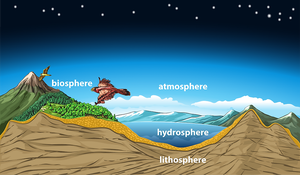
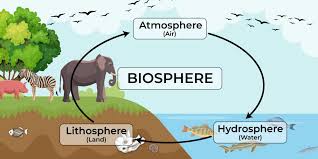
The Earth system is divided into several interacting spheres, each playing a role in the cycling of elements and compounds.
Lithosphere: The rigid outer layer, including the crust and upper mantle.
Hydrosphere: All water found on, under, and over the surface of the planet.
Atmosphere: The layer of gases surrounding Earth.
Biosphere: All living organisms and their interactions with the other spheres.
Elemental Composition of the Earth’s Crust
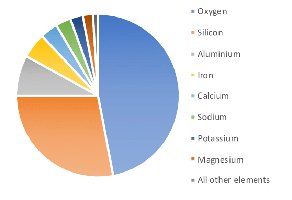
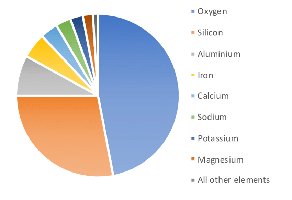
The Earth's crust is composed of a variety of elements, with some being far more abundant than others. The most abundant element is oxygen, followed by silicon, aluminum, and iron. The most abundant metal is aluminum.
Oxygen (O): Most abundant element in the crust.
Aluminum (Al): Most abundant metal in the crust.
Minerals and Ores
Types of Minerals in the Lithosphere
The lithosphere contains both organic and inorganic materials. Inorganic minerals are classified based on their chemical composition:
Silicate minerals: Compounds of metals with silicon and oxygen.
Carbonate minerals: Metals combined with carbon and oxygen.
Oxide minerals: Metals combined with oxygen only.
Sulfide minerals: Metals combined with sulfur only.
Economically Important Nonsilicate Minerals
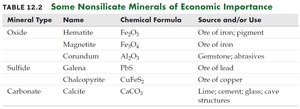
Some minerals are especially important for economic purposes, such as the extraction of metals. The following table summarizes key nonsilicate minerals, their chemical formulas, and uses:
Mineral Type | Name | Chemical Formula | Source and/or Use |
|---|---|---|---|
Oxide | Hematite | Fe2O3 | Ore of iron; pigment |
Oxide | Magnetite | Fe3O4 | Ore of iron |
Oxide | Corundum | Al2O3 | Gemstone; abrasives |
Sulfide | Galena | PbS | Ore of lead |
Sulfide | Chalcopyrite | CuFeS2 | Ore of copper |
Carbonate | Calcite | CaCO3 | Lime; cement; glass; cave structures |
Examples of Ores
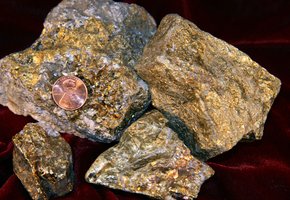
Ore of Copper: Chalcopyrite (CuFeS2)
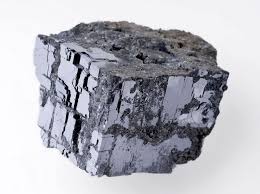
Ore of Lead: Galena (PbS)
Organic and Inorganic Components of the Lithosphere
The lithosphere contains both organic materials (living organisms, their waste, decomposition products, and fossilized remains) and inorganic minerals. Organic materials are rich in carbon, hydrogen, oxygen, and nitrogen.
Silicates and Mineral Structures
Silicate Tetrahedra
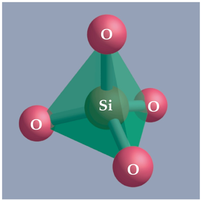
Silicate minerals are based on the tetrahedral SiO4 unit, where a silicon atom is surrounded by four oxygen atoms. These tetrahedra can link together in various ways to form different minerals.
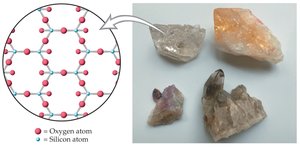
Quartz (SiO2): A macromolecular substance with a 2:1 oxygen to silicon ratio, forming a continuous network of tetrahedra.
Silicate Mineral Types
Many common minerals are classified as silicates due to their structure based on the SiO4 tetrahedron. These include:
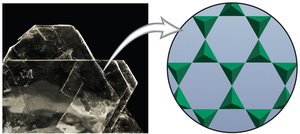
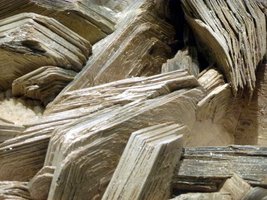
Micas: Composed of SiO4 tetrahedra arranged in two-dimensional sheets.
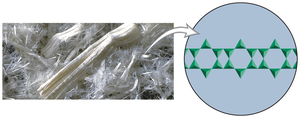
Asbestos: Refers to fibrous silicates, such as chrysotile (a magnesium silicate).
Modified Silicates: Ceramics, Glass, and Cement
Ceramics
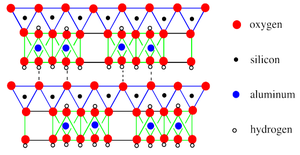
Ceramics are materials made from clays (aluminum silicates) that are shaped and fired to become hard and durable. The structure of clay involves aluminum hydroxide sheets connected by oxygen atoms to both silicon and aluminum atoms.
Glass
Glass is a noncrystalline (amorphous) solid, typically made by heating sand (SiO2), sodium carbonate (Na2CO3), and limestone (CaCO3). The properties of glass can be modified by adding or substituting components. Glass differs from quartz in that glass is amorphous, while quartz is crystalline. Both are composed of silicate.
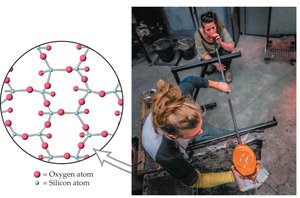
Cement and Concrete
Cement is a complex mixture of calcium and aluminum silicates, produced by heating limestone and clay to high temperatures to form clinker, which is then ground and mixed with gypsum. When mixed with sand, gravel, and water, it forms concrete upon curing.
Metals and Ores
Extraction and Use of Metals
Human history is marked by the ability to extract and use metals from ores. Important metals include copper, tin, iron, and aluminum. Alloys, such as bronze (copper and tin), are mixtures of metals that have enhanced properties.
Bronze: Alloy of copper and about 10% tin.
Iron: Extracted from ores like hematite and magnetite using blast furnaces. The reduction of iron oxide by carbon monoxide produces molten iron.
Aluminum: The most abundant metal in the crust, extracted from bauxite (Al2O3).
Alloy: A mixture of two or more elements, at least one of which is a metal.
Earth’s Dwindling Resources
Resource Availability and Future Prospects
High-grade ores are becoming scarce, leading to increased mining of lower-grade ores at greater economic and environmental cost. The oceans may become an important source of metals in the future.
Population and Resource Use
Global Population Growth
The world population continues to grow rapidly, increasing the demand for Earth's resources. Scientific advances have reduced death rates, but birth rates remain high, leading to projections of 9 billion people by the mid-21st century.
