 Back
BackElectrons in Atoms and the Periodic Table: Study Notes
Study Guide - Smart Notes
 Tailored notes based on your materials, expanded with key definitions, examples, and context.
Electrons in Atoms and the Periodic Table
Light and the Electromagnetic Spectrum
The study of light and its interaction with matter is fundamental to understanding atomic structure. Light behaves both as a wave and as a particle, and its properties are described by wavelength, frequency, and energy.
Electromagnetic Radiation: Light is a form of electromagnetic radiation, which travels at a constant speed in a vacuum: .
Wavelength (\( \lambda \)): The distance between two consecutive peaks of a wave, measured in meters (m).
Frequency (\( \nu \)): The number of cycles (waves) that pass a point per second, measured in hertz (Hz).
Energy of Light: The energy of a photon is given by , where is Planck's constant ().
Relationship:
Visible Spectrum: Light visible to the human eye ranges from approximately 400 nm (violet) to 700 nm (red).
Example: If the wavelength of light is , its frequency is .
Electromagnetic Spectrum
The electromagnetic spectrum encompasses all types of electromagnetic radiation, from gamma rays to radio waves. The energy and frequency increase as the wavelength decreases.
Order (from highest to lowest energy): Gamma rays > X-rays > Ultraviolet > Visible > Infrared > Microwaves > Radio waves
Mnemonic: "Raging Martians Invaded Venus Using X-ray Guns" (Radio, Microwave, Infrared, Visible, Ultraviolet, X-ray, Gamma)
Type | Wavelength (approx.) | Energy |
|---|---|---|
Gamma Rays | < 10 pm | Highest |
X-rays | 10 pm – 10 nm | High |
Ultraviolet | 10 nm – 400 nm | Moderate |
Visible | 400 nm – 700 nm | Moderate |
Infrared | 700 nm – 1 mm | Low |
Microwaves | 1 mm – 1 m | Lower |
Radio Waves | > 1 m | Lowest |
Particle Nature of Light
Light can also behave as a particle, called a photon. The energy of a photon is quantized and depends on its frequency.
Photon: A packet of light energy.
Energy Equation:
Photoelectric Effect: Electrons are ejected from a metal surface when light of sufficient energy strikes it, demonstrating the particle nature of light.
Bohr Model of the Atom
The Bohr model describes electrons as moving in fixed orbits around the nucleus, with quantized energy levels. Electrons can absorb or emit energy to move between these levels.
Energy Levels: Electrons occupy specific energy levels (shells) around the nucleus.
Absorption: When an electron absorbs energy, it moves to a higher energy level.
Emission: When an electron falls to a lower energy level, it emits energy as light.
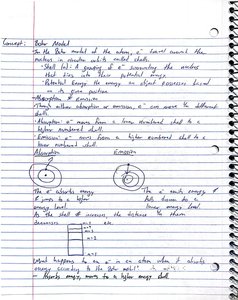
Example: An electron in a hydrogen atom absorbs a photon and moves from to .
Emission Spectrum
When electrons fall from higher to lower energy levels, they emit light at specific wavelengths, producing an emission spectrum unique to each element.
Line Spectrum: Each element has a characteristic set of spectral lines.
Application: Used to identify elements in stars and other substances.
Quantum Mechanical Model
The quantum mechanical model describes electrons as occupying orbitals, which are regions of space where there is a high probability of finding an electron. This model uses quantum numbers to describe the properties of electrons in atoms.
Principal Quantum Number (n): Indicates the main energy level (shell).
Angular Momentum Quantum Number (l): Indicates the shape of the orbital (s, p, d, f).
Magnetic Quantum Number (ml): Indicates the orientation of the orbital.
Spin Quantum Number (ms): Indicates the spin of the electron (+1/2 or -1/2).
Quantum Number | Symbol | Allowed Values | Meaning |
|---|---|---|---|
Principal | n | 1, 2, 3, ... | Shell (energy level) |
Angular Momentum | l | 0 to n-1 | Orbital shape (s, p, d, f) |
Magnetic | m_l | -l to +l | Orbital orientation |
Spin | m_s | +1/2, -1/2 | Electron spin |
Electron Configuration
Electron configuration describes the arrangement of electrons in an atom's orbitals. Electrons fill orbitals in order of increasing energy, following the Aufbau principle, Pauli exclusion principle, and Hund's rule.
Aufbau Principle: Electrons occupy the lowest energy orbitals first.
Pauli Exclusion Principle: No two electrons in an atom can have the same set of four quantum numbers.
Hund's Rule: Electrons fill degenerate orbitals singly before pairing up.
Example: The electron configuration of oxygen (Z=8) is 1s2 2s2 2p4.
Periodic Trends
Periodic trends describe how certain properties of elements change across periods and down groups in the periodic table.
Atomic Radius: Decreases across a period (left to right), increases down a group.
Ionization Energy: Increases across a period, decreases down a group.
Electron Affinity: Generally becomes more negative (increases) across a period.
Electronegativity: Increases across a period, decreases down a group.
Example: Fluorine has the highest electronegativity in the periodic table.
Electron Arrangement and Exceptions
Some elements have electron configurations that differ from the expected order due to increased stability of half-filled and fully-filled subshells. Notable exceptions include chromium and copper.
Chromium (Cr): [Ar] 4s1 3d5 (instead of [Ar] 4s2 3d4)
Copper (Cu): [Ar] 4s1 3d10 (instead of [Ar] 4s2 3d9)
Additional info: These exceptions occur because half-filled and fully-filled d subshells provide extra stability to the atom.
