Back
BackExam 1 Review: Foundations of Chemistry (Chapters 1–4)
Study Guide - Smart Notes
 Tailored notes based on your materials, expanded with key definitions, examples, and context.
Chapter 1: The Chemical World
What Are Chemicals?
Chemicals are substances with a definite composition, found everywhere in our daily lives. Everything we see, touch, or use is made of chemicals, whether natural or synthetic.
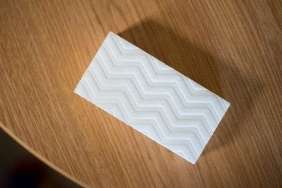
Example: A magic eraser and a wooden table are both made of chemicals, though their compositions differ.
Quantification in Chemistry
Quantification involves assigning numbers to describe properties or amounts of substances. This is essential for scientific accuracy and communication.
Example: Describing a bag of M&M's by counting the number of candies or measuring their mass.

The Scientific Method
The scientific method is a systematic approach to investigating phenomena, acquiring new knowledge, or correcting previous knowledge. It involves several key steps:
Observation: Gathering data about the world.
Hypothesis: Proposing a tentative explanation.
Experimentation: Testing the hypothesis through experiments.
Data Analysis: Interpreting the results.
Conclusion: Drawing conclusions and reporting findings.

Chapter 2: Measurement and Problem Solving
Scientific Notation
Scientific notation expresses very large or small numbers in the form a × 10n, where a is a number between 1 and 10, and n is an integer.
Example 1: 0.0056 =
Example 2: = 5200
Significant Figures (Sig Figs)
Significant figures reflect the precision of a measured or calculated quantity. Rules for counting sig figs:
All nonzero digits are significant.
Zeros between nonzero digits are significant.
Leading zeros are not significant.
Trailing zeros in a decimal number are significant.
Examples:
2070 (3 sig figs)
120.0 (4 sig figs)
0.0064 (2 sig figs)
1.10 × 10⁻² (3 sig figs)
Calculations with Significant Figures
Rules differ for addition/subtraction and multiplication/division:
Addition/Subtraction: Result has the same number of decimal places as the measurement with the fewest decimal places.
Multiplication/Division: Result has the same number of sig figs as the measurement with the fewest sig figs.
Examples:
1.78 + 0.005 = 1.79 (2 decimal places)
2 + 18.5 = 21 (rounded to the nearest whole number)
Unit Conversions
Unit conversions use conversion factors to change from one unit to another. Always set up the calculation so units cancel appropriately.
Example 1: 908 grams to pounds:
Example 2: 157 centimeters to meters:
Example 3: 0.1 hours to seconds:
Metric Units and Prefixes
Metric prefixes indicate multiples or fractions of base units. Common prefixes include:
nano- (n):
micro- (μ):
milli- (m):
centi- (c):
kilo- (k):
Density Calculations
Density (D) is the mass per unit volume of a substance. The formula is:
Example 1: Mass of 1.2 L of alcohol (D = 0.9 g/mL):
Example 2: Volume of 100 g of alcohol:
Chapter 3: Matter and Energy
States of Matter and Forms of Energy
Matter exists in three primary states: solid, liquid, and gas. Energy is the capacity to do work or produce heat, and it exists in several forms:
Kinetic energy: Energy of motion (e.g., a moving bullet).
Potential energy: Stored energy (e.g., a stretched rubber band).
Chemical energy: Stored in chemical bonds (e.g., fireworks).
Electrical energy: Due to movement of electrons (e.g., a defibrillator).
Physical and Chemical Changes and Properties
Physical changes do not alter the chemical composition of a substance, while chemical changes result in new substances.
Physical change: Ice cube melting (solid to liquid, still H2O).
Chemical change: Match burning (new substances formed).
Physical property: Melting point of water.
Chemical property: Flammability.
Classification of Matter
Matter can be classified as pure substances or mixtures:
Pure substances: Elements (e.g., copper) and compounds (e.g., table sugar).
Mixtures: Homogeneous (uniform, e.g., tea) and heterogeneous (non-uniform, e.g., oil and water).

Law of Conservation of Mass
The law of conservation of mass states that mass is neither created nor destroyed in a chemical reaction. The total mass of reactants equals the total mass of products.
Example 1: 4 g hydrogen + x g oxygen = 36 g water → x = 32 g oxygen.
Example 2: 150 g mixture yields 87 g CO2 + y g residue → y = 63 g residue.
Temperature Conversions: Celsius and Kelvin
The Kelvin scale is the SI unit for temperature. The conversion is:
Example: Water freezes at 0°C = 273.15 K.
Absolute zero: 0 K = -273.15°C.
Heat Calculations
Heat (q) is calculated using the formula:
q: heat (Joules)
m: mass (grams)
s: specific heat (J/g·°C)
ΔT: change in temperature (°C)
Example: 487.5 J to heat 25 g copper from 25°C to 75°C:
Chapter 4: Atoms and Elements
Rutherford Gold Foil Experiment
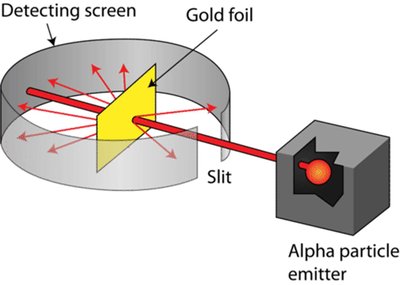
Rutherford's experiment involved firing alpha particles at a thin gold foil. Most particles passed through, but some were deflected, leading to the discovery of the atomic nucleus.
Conclusion: Atoms have a small, dense, positively charged nucleus.
Subatomic Particles and Isotopes
Atoms are composed of protons, neutrons, and electrons:
Protons: Positive charge, found in nucleus.
Neutrons: No charge, found in nucleus.
Electrons: Negative charge, orbit nucleus.
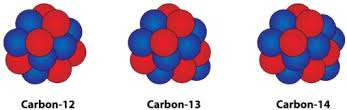
Isotopes are atoms of the same element with different numbers of neutrons.
Ions and Atomic Charge
Ions are atoms or molecules with a net electric charge due to the loss or gain of electrons.
Cations: Positively charged (loss of electrons).
Anions: Negatively charged (gain of electrons).
Opposite charges attract; like charges repel.
The Periodic Table
The periodic table organizes elements by increasing atomic number. Key features include:
Rows: Periods
Columns: Groups or families
Metals: Left and center
Nonmetals: Upper right
Metalloids: Border between metals and nonmetals
Key families: Alkali metals, alkaline earth metals, halogens, noble gases
Average Atomic Mass
The average atomic mass of an element is the weighted average of the masses of its naturally occurring isotopes, based on their natural abundance.
Formula:
Example (Carbon):
Isotope | Mass (amu) | Abundance (%) |
|---|---|---|
Carbon-12 | 12.00 | 98.9 |
Carbon-13 | 13.00 | 1.1 |
Carbon-14 | 14.00 | 0.1 |
Calculation:
amu