 Back
BackFormulae, Equations, and Amount of Substances: Introductory Chemistry Study Notes
Study Guide - Smart Notes
 Tailored notes based on your materials, expanded with key definitions, examples, and context.
Atoms, Elements, Molecules, and Compounds
Definitions and Basic Concepts
Understanding the fundamental building blocks of matter is essential in chemistry. Atoms, elements, molecules, and compounds are the core concepts that describe the composition and structure of substances.
Atom: The smallest unit of an element that retains the properties of that element.
Element: A pure substance consisting of only one type of atom; cannot be broken down by chemical means.
Molecule: Two or more atoms chemically bonded together. Molecules can consist of the same or different elements.
Compound: A substance formed when two or more different elements combine in fixed proportions.
Ion: An atom or group of atoms that has gained or lost electrons, resulting in a charged particle.
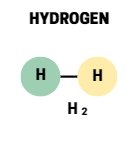
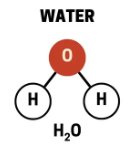
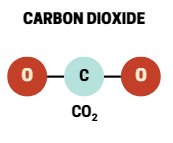
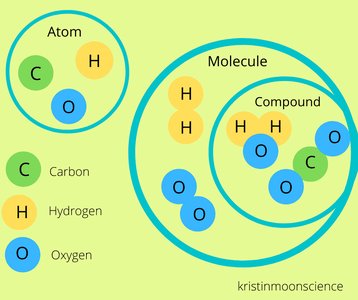
Example: H2 (hydrogen molecule), H2O (water molecule), and CO2 (carbon dioxide molecule) are all molecules, but only H2O and CO2 are compounds because they contain more than one type of element.
Writing and Balancing Chemical Equations
Symbolic Representation of Chemical Reactions
Chemical equations represent the reactants and products in a chemical reaction. Balancing equations ensures the law of conservation of mass is obeyed.
Convert word equations to symbol equations using correct chemical formulas.
Balance the equation so the number of atoms of each element is equal on both sides.
Use state symbols: (s) for solid, (l) for liquid, (g) for gas, (aq) for aqueous solution.
Indicate reaction conditions above or below the arrow if necessary.
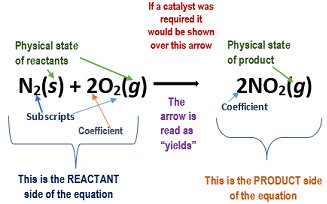
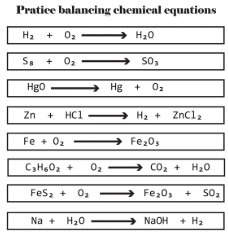
Example: $\mathrm{N_2(s) + 2O_2(g) \rightarrow 2NO_2(g)}$
Ionic and Ionic Half Equations
Ionic equations show only the ions and molecules directly involved in the reaction, omitting spectator ions. Ionic half-equations are used to represent oxidation and reduction processes separately.
Start with the full equation.
Replace ionic compounds with their constituent ions.
Remove spectator ions (those unchanged on both sides).
Reactions of Acids
Typical Reactions and Salt Formation
Acids react with various substances to form salts, water, and sometimes gases. These reactions are important for preparing salts and understanding acid-base chemistry.
Acids with Metals: Produce a salt and hydrogen gas.
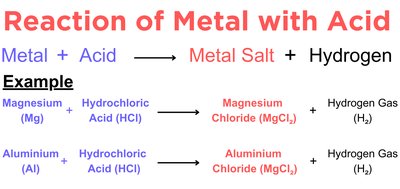
Acids with Metal Oxides and Insoluble Hydroxides: Produce a salt and water.
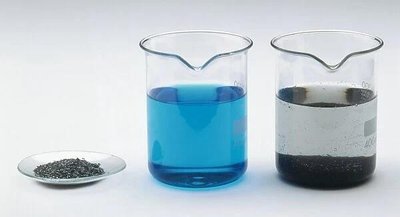
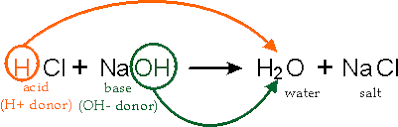
Acids with Alkalis (Soluble Hydroxides): Neutralization reaction producing salt and water.
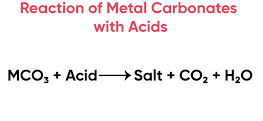
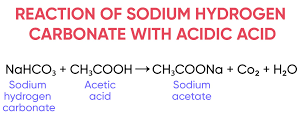
Acids with Carbonates and Hydrogen Carbonates: Produce salt, water, and carbon dioxide gas.
Displacement and Redox Reactions
Types and Examples
Displacement reactions involve one element replacing another in a compound. Redox (reduction-oxidation) reactions involve the transfer of electrons.
OIL RIG: Oxidation Is Loss (of electrons), Reduction Is Gain (of electrons).
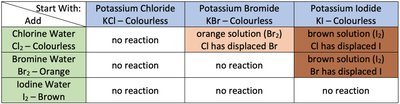
More reactive elements displace less reactive ones from compounds.
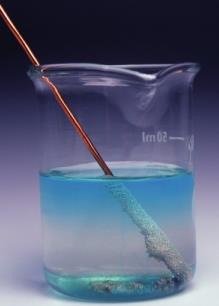
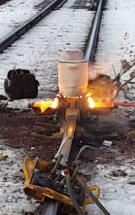
Example: Magnesium displaces copper from copper(II) sulfate, being oxidized itself.
Halogen displacement: More reactive halogen displaces a less reactive halogen from its compound.
Precipitation Reactions and Chemical Tests
Formation of Insoluble Products
Precipitation reactions occur when two solutions combine to form an insoluble solid (precipitate). These reactions are used in qualitative analysis to test for specific ions.
Test for Carbon Dioxide: Turns limewater milky due to formation of calcium carbonate.
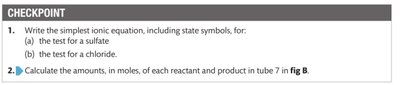
Test for Sulfates: Addition of barium chloride to a solution containing sulfate ions forms a white precipitate of barium sulfate.
Test for Halides: Addition of silver nitrate to a solution containing halide ions forms a precipitate (color depends on halide).
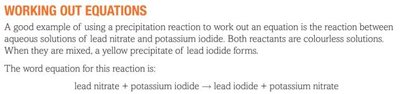
Example: Mixing lead nitrate and potassium iodide forms a yellow precipitate of lead iodide.
Amount of Substance and Moles
Relative Masses and the Mole Concept
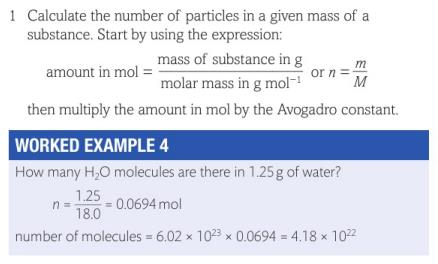
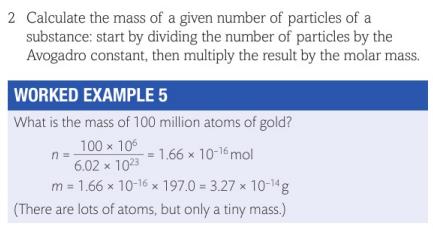
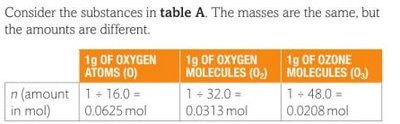
The mole is a fundamental unit in chemistry for counting particles. Relative atomic mass (Ar), relative molecular mass (Mr), and molar mass (M) are used to relate mass to the number of particles.
Relative Atomic Mass (Ar): Weighted average mass of an atom compared to 1/12 of a carbon-12 atom.
Relative Molecular/Formula Mass (Mr): Sum of relative atomic masses in a molecule or formula unit.
Molar Mass (M): Mass of one mole of a substance (g/mol).
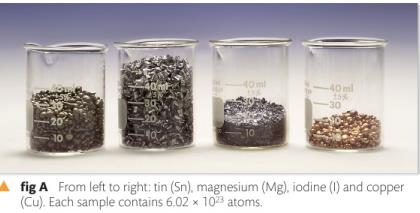
Avogadro's Constant (L): $6.02 \times 10^{23}$ particles per mole.
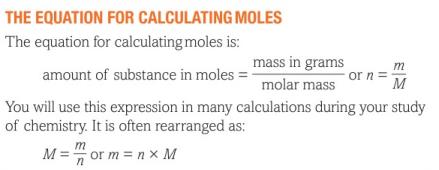
Key Equations:
$n = \frac{m}{M}$
Number of particles = moles $\times$ Avogadro's constant
Calculations Involving Moles and Masses
Reacting Masses, Yield, and Atom Economy
Stoichiometry allows calculation of the amounts of reactants and products in chemical reactions. Yield and atom economy are important for evaluating reaction efficiency.
Theoretical Yield: Maximum possible mass of product, assuming complete reaction.
Actual Yield: Mass of product actually obtained.
Percentage Yield: $\frac{\text{Actual Yield}}{\text{Theoretical Yield}} \times 100\%$
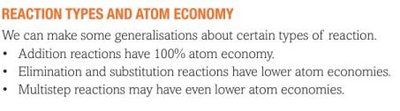
Atom Economy: $\frac{\text{Molar mass of desired product}}{\text{Sum of molar masses of all products}} \times 100\%$
Empirical and Molecular Formulae
Determining Chemical Formulas
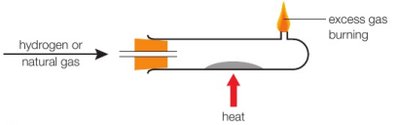
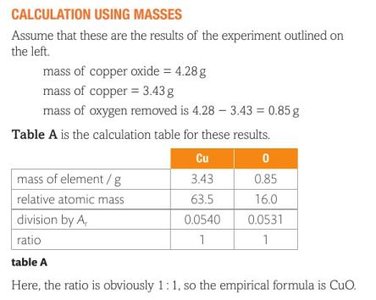
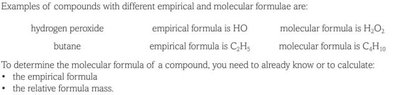
The empirical formula gives the simplest whole-number ratio of elements in a compound, while the molecular formula gives the actual number of atoms of each element in a molecule.
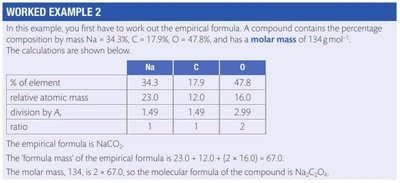
To find the empirical formula: Convert masses to moles, divide by the smallest number, and write the ratio.
To find the molecular formula: Divide the molar mass by the empirical formula mass and multiply the subscripts accordingly.
The Ideal Gas Equation and Molecular Volume
Gas Laws and Calculations
The ideal gas equation relates the pressure, volume, temperature, and amount of gas. Molar volume is the volume occupied by one mole of gas at room temperature and pressure (r.t.p.).
Ideal Gas Equation: $pV = nRT$
At r.t.p. (25°C, 1 atm), 1 mole of gas occupies 24 dm3 or 24,000 cm3.
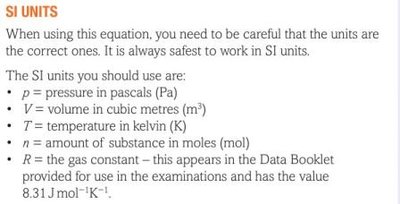
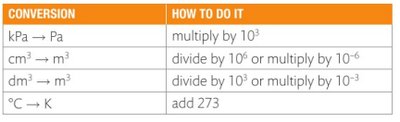
SI units: p (Pa), V (m3), T (K), n (mol), R = 8.31 J mol-1 K-1
Key Steps for Calculations:
Calculate moles using given data.
Use the chemical equation to find moles of the substance of interest.
Convert moles to required quantity (mass or volume).
Concentration of Solutions
Definitions and Calculations
Concentration expresses the amount of solute dissolved in a given volume of solvent. It can be expressed in mass concentration, molar concentration, or parts per million (ppm).
Mass Concentration (g/dm3): $\frac{\text{mass of solute (g)}}{\text{volume of solution (dm}^3)}$
Molar Concentration (mol/dm3): $\frac{\text{amount of solute (mol)}}{\text{volume of solution (dm}^3)}$
PPM (Parts per Million): 1 ppm = 1 g in 1,000,000 g or 1 cm3 in 1,000,000 cm3
Additional info: These notes cover the foundational concepts of introductory chemistry, including atomic structure, chemical equations, reactions, stoichiometry, and solution chemistry, as outlined in standard college-level curricula.
