 Back
BackGases, Liquids, and Solids: States of Matter and Their Properties
Study Guide - Smart Notes
 Tailored notes based on your materials, expanded with key definitions, examples, and context.
Gases, Liquids, and Solids
Introduction to States of Matter
The physical state of matter—gas, liquid, or solid—is determined by the balance between the kinetic energy of particles and the intermolecular attractive forces between them. Kinetic energy keeps particles moving and disordered, while intermolecular forces tend to hold them together.
Kinetic Energy: Increases with temperature, causing more molecular motion and disorder.
Intermolecular Forces: Hold particles together, counteracting kinetic energy.
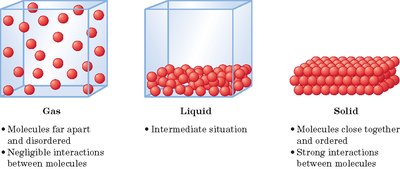
Physical States of Matter
The three main states of matter differ in the arrangement and movement of their particles:
Gas: No definite shape or volume; particles are far apart and move freely.
Liquid: Definite volume but no definite shape; particles are closer together but can move past each other.
Solid: Definite shape and volume; particles are closely packed in an ordered arrangement.
Gas Pressure and Measurement
Gas Pressure
Gas pressure is the force exerted by gas molecules colliding with the walls of their container. It is measured as force per unit area.
Atmospheric Pressure: Measured with a barometer.
Confined Gas Pressure: Measured with a manometer.
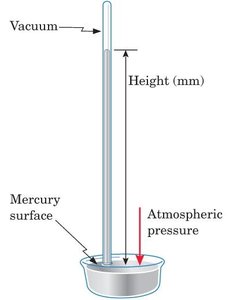
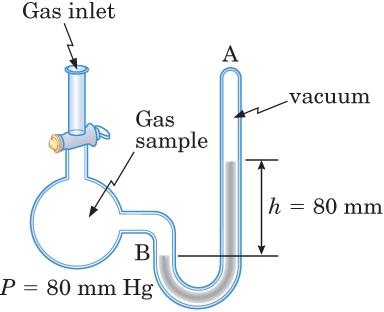
Units of Pressure
Common units for measuring pressure include:
Millimeters of mercury (mm Hg)
Atmospheres (atm)
Torr
Pascals (Pa)
Inches of mercury (in. Hg)
Bars
Conversion: 1 atm = 760 mm Hg = 760 torr = 101,325 Pa = 29.92 in. Hg = 1.01325 bars
Gas Laws
Boyle’s Law
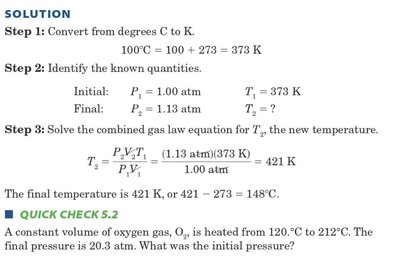
For a fixed mass of gas at constant temperature, the volume is inversely proportional to the pressure.
Equation:
Application: Breathing involves changes in lung volume and pressure, following Boyle’s law.
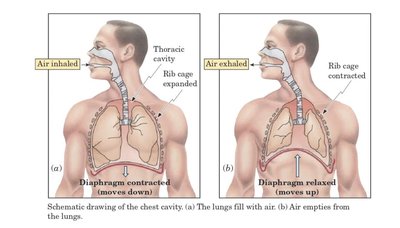
Charles’s Law
For a fixed amount of gas at constant pressure, the volume is directly proportional to the temperature (in kelvins).
Equation: or
Note: Temperatures must be in kelvins for calculations.


Gay-Lussac’s Law
For a fixed mass of gas at constant volume, the pressure is directly proportional to the temperature (in kelvins).
Equation: or


Summary Table of Gas Laws
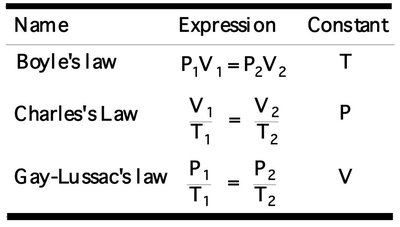
Name | Expression | Constant |
|---|---|---|
Boyle’s law | T | |
Charles’s Law | P | |
Gay-Lussac’s law | V |
Combined Gas Law
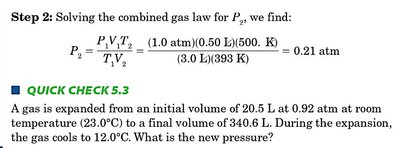
The combined gas law merges Boyle’s, Charles’s, and Gay-Lussac’s laws into one equation:
Equation: or


Avogadro’s Law
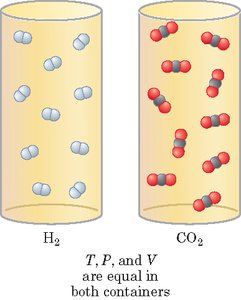
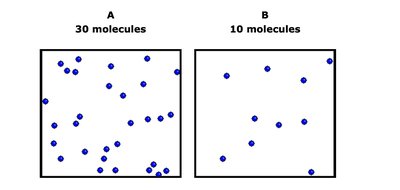
Avogadro’s law states that equal volumes of gases at the same temperature and pressure contain the same number of molecules, regardless of the gas identity.
Standard Temperature and Pressure (STP): 0°C (273 K) and 1 atm.
Molar Volume at STP: 1 mole of any gas occupies 22.4 L.
The Ideal Gas Law
Ideal Gas Law
The ideal gas law relates pressure, volume, temperature, and the number of moles of a gas:
Equation:
Variables: P = pressure (atm), V = volume (L), n = moles, R = 0.0821 L·atm/mol·K, T = temperature (K)
Dalton’s Law of Partial Pressures
Dalton’s Law
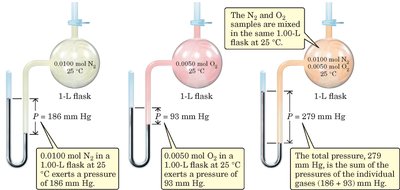
The total pressure of a mixture of gases is the sum of the partial pressures of each individual gas:
Equation:
The partial pressure is the pressure a gas would exert if it were alone in the container.
Kinetic Molecular Theory of Gases
Assumptions of Kinetic Molecular Theory (KMT)
The KMT explains the behavior of ideal gases based on the following assumptions:
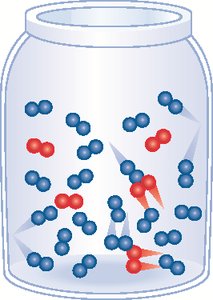
Gas particles are in constant, random motion.
The average kinetic energy is proportional to temperature (K).
Collisions are elastic (no energy lost).
Gas particles have negligible volume.
No attractive forces between particles.
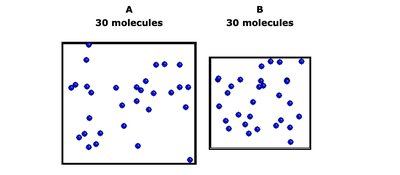
Pressure results from collisions with container walls.
Ideal vs. Real Gases
Ideal Gases: Follow all KMT assumptions perfectly.
Real Gases: Deviate from ideal behavior at high pressures and low temperatures due to intermolecular forces and finite molecular volume.
Intermolecular Forces
Types of Intermolecular Forces
Intermolecular forces are electrostatic attractions between molecules and determine the physical properties of substances.
Attractive Force | Example | Typical Energy (kcal/mol) |
|---|---|---|
Hydrogen bonding | H2O | 2–10 |
Dipole–dipole interaction | CH3COCH3 | 1–6 |
London dispersion forces | Ne | 0.01–2.0 |
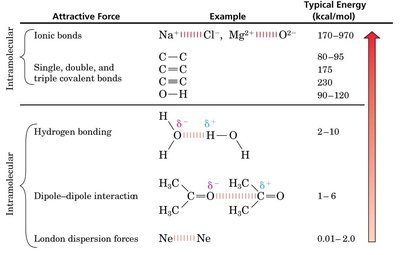
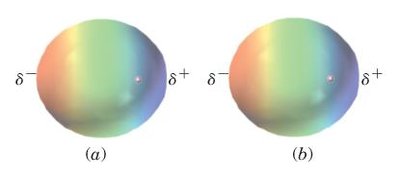
London Dispersion Forces
These are weak, temporary attractions caused by momentary shifts in electron density, present in all atoms and molecules. Their strength increases with molecular size and mass.
Dipole–Dipole Interactions
These occur between polar molecules, where the positive end of one molecule is attracted to the negative end of another.
Hydrogen Bonds
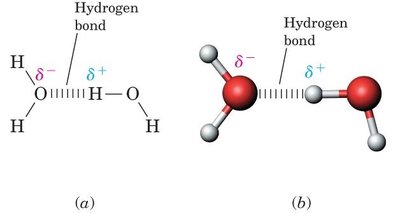
A strong type of dipole–dipole interaction, hydrogen bonds occur when hydrogen is bonded to highly electronegative atoms (O, N, or F) and is attracted to a lone pair on another electronegative atom.
Liquids
Properties of Liquids
High density compared to gases
Low compressibility
Fluidity due to random arrangement of molecules
Surface Tension
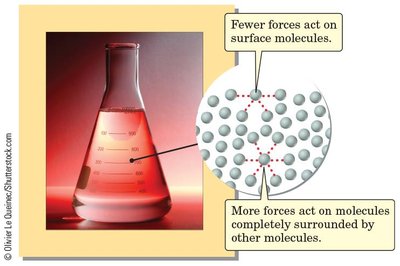
Surface tension is the elastic "skin" on the surface of a liquid caused by uneven intermolecular attractions. It is higher in liquids with strong intermolecular forces, such as water.

Evaporation and Condensation
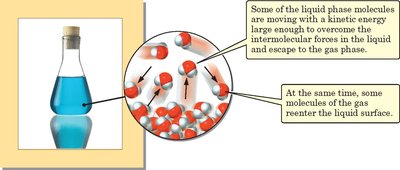
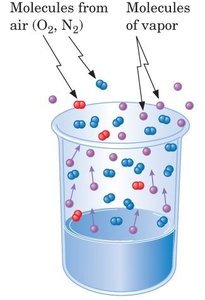
Evaporation occurs when molecules at the surface of a liquid gain enough kinetic energy to escape into the gas phase. In a closed container, equilibrium is reached when the rate of evaporation equals the rate of condensation.
Vapor Pressure and Boiling Point
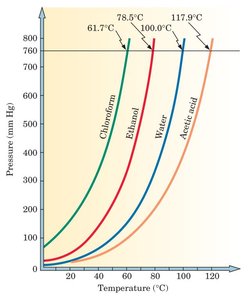
The vapor pressure of a liquid is the pressure exerted by its vapor when in equilibrium with the liquid. The boiling point is the temperature at which vapor pressure equals atmospheric pressure.
Boiling Point and Its Factors
Intermolecular Forces: Stronger forces lead to higher boiling points.
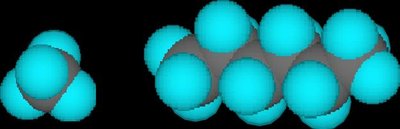
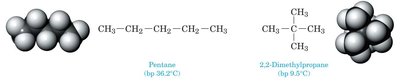
Molecular Size and Shape: Larger surface area and mass increase boiling point due to stronger London forces.
Solids
Formation and Types of Solids
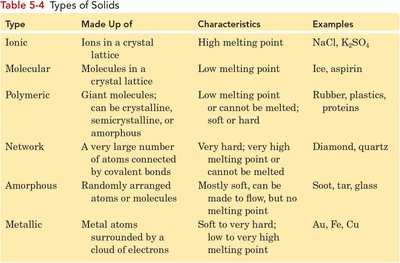
Solids form when intermolecular forces overcome kinetic energy, resulting in fixed positions for particles. Types of solids include ionic, molecular, polymeric, network, amorphous, and metallic solids.
Type | Made Up of | Characteristics | Examples |
|---|---|---|---|
Ionic | Ions in a crystal lattice | High melting point | NaCl, K2SO4 |
Molecular | Molecules in a crystal lattice | Low melting point | Ice, aspirin |
Polymeric | Giant molecules | Low melting point or cannot be melted; soft or hard | Rubber, plastics, proteins |
Network | Atoms connected by covalent bonds | Very hard; very high melting point or cannot be melted | Diamond, quartz |
Amorphous | Randomly arranged atoms or molecules | Mostly soft, can be made to flow, but no melting point | Soot, tar, glass |
Metallic | Metal atoms surrounded by a cloud of electrons | Soft to very hard; low to very high melting point | Au, Fe, Cu |
Phase Changes and Diagrams
Phase Changes
Phase changes are transitions between solid, liquid, and gas states. Common changes include melting, freezing, vaporization, condensation, sublimation, and deposition.
Phase Diagram of Water
A phase diagram shows the state of a substance as a function of temperature and pressure. The triple point is where all three phases coexist. The critical point marks the formation of a supercritical fluid, which has properties of both gases and liquids.
Energy Changes in Phase Transitions
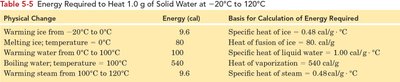
Physical Change | Energy (cal) | Basis for Calculation |
|---|---|---|
Warming ice from –20°C to 0°C | 9.6 | Specific heat of ice = 0.48 cal/g·°C |
Melting ice; temperature = 0°C | 80 | Heat of fusion of ice = 80 cal/g |
Warming water from 0°C to 100°C | 100 | Specific heat of liquid water = 1.00 cal/g·°C |
Boiling water; temperature = 100°C | 540 | Heat of vaporization = 540 cal/g |
Warming steam from 100°C to 120°C | 9.6 | Specific heat of steam = 0.48 cal/g·°C |
Additional info: This guide covers the essential concepts of gases, liquids, and solids, including their properties, the laws governing their behavior, and the transitions between states. It is suitable for introductory college chemistry students preparing for exams.
