 Back
BackIntro to Chemistry Exam 2 Study Guidance
Study Guide - Smart Notes
 Tailored notes based on your materials, expanded with key definitions, examples, and context.
Q1. What element combines to form compounds with the greatest number of different oxidation numbers?
Background
Topic: Oxidation States
This question tests your understanding of how elements can have multiple oxidation states, which is important for predicting compound formation and chemical reactivity.
Key Terms:
Oxidation number: The charge an atom would have if electrons were assigned according to certain rules.
Transition metals: Elements that often have multiple possible oxidation states.
Step-by-Step Guidance
Recall which elements are known for having a wide range of oxidation states. Transition metals are a good place to start.
Think about common examples: Iron (Fe) can be +2 or +3, but some elements like manganese (Mn) or vanadium (V) have even more.
Review the periodic table and consider which element is famous for forming compounds with many different oxidation numbers.
Try solving on your own before revealing the answer!
Q2. Which among the following elements does NOT exist as a diatomic molecule in nature?
Background
Topic: Diatomic Molecules
This question tests your knowledge of the elements that naturally exist as diatomic molecules (e.g., O2, N2).
Key Terms:
Diatomic molecule: A molecule consisting of two atoms, often of the same element.
Step-by-Step Guidance
Recall the mnemonic "BrINClHOF" for the seven diatomic elements: Bromine, Iodine, Nitrogen, Chlorine, Hydrogen, Oxygen, Fluorine.
Compare the answer choices to this list to identify which one is not diatomic in its natural state.
Try solving on your own before revealing the answer!
Q3. What is the correct Lewis structure for the compound V2O5?
Background
Topic: Lewis Structures
This question tests your ability to draw Lewis structures for compounds, showing how atoms are bonded and where lone pairs are located.
Key Terms:
Lewis structure: A diagram showing the bonding between atoms and the lone pairs of electrons in a molecule.
Step-by-Step Guidance
Count the total number of valence electrons for all atoms in V2O5.
Arrange the atoms with vanadium (V) as the central atoms and oxygen (O) around them.
Distribute electrons to satisfy the octet rule for oxygen and as much as possible for vanadium.
Try solving on your own before revealing the answer!
Q4. How many atoms are in 1.50 moles of Fe?
Background
Topic: Mole Concept and Avogadro's Number
This question tests your ability to use Avogadro's number to convert between moles and number of atoms.
Key Formula:
Step-by-Step Guidance
Identify the number of moles given (1.50 mol).
Multiply the number of moles by Avogadro's number ( atoms/mol).
Try solving on your own before revealing the answer!
Q5. How many moles of Cs are in 1.48 × 1025 Cs atoms?
Background
Topic: Mole Concept and Avogadro's Number
This question tests your ability to convert from number of atoms to moles using Avogadro's number.
Key Formula:
Step-by-Step Guidance
Write down the number of atoms given (1.48 × 1025).
Divide this number by Avogadro's number ( atoms/mol).
Try solving on your own before revealing the answer!
Q6. How many moles are in 17.5 g of Na?
Background
Topic: Moles and Molar Mass
This question tests your ability to convert from grams to moles using the molar mass of sodium (Na).
Key Formula:
Step-by-Step Guidance
Find the molar mass of sodium (Na) from the periodic table (approximately 22.99 g/mol).
Divide the given mass (17.5 g) by the molar mass.
Try solving on your own before revealing the answer!
Q7. What is the molar mass of Al2(SO4)3?
Background
Topic: Molar Mass Calculation
This question tests your ability to calculate the molar mass of a compound by summing the atomic masses of all atoms in the formula.
Key Formula:
Step-by-Step Guidance
List the number of each type of atom in Al2(SO4)3: 2 Al, 3 S, 12 O.
Multiply the number of each atom by its atomic mass (Al: ~27.0, S: ~32.1, O: ~16.0).
Add the total masses together to get the molar mass.
Try solving on your own before revealing the answer!
Q8. What is the percent by mass of hydrogen in water?
Background
Topic: Percent Composition
This question tests your ability to calculate the percent by mass of an element in a compound.
Key Formula:
Step-by-Step Guidance
Calculate the mass of hydrogen in one mole of H2O (2 × 1.01 g).
Calculate the molar mass of H2O (2 × 1.01 + 16.00).
Divide the mass of hydrogen by the molar mass and multiply by 100%.
Try solving on your own before revealing the answer!
Q9. Which of the following compounds has the greatest percent by mass of oxygen?
Background
Topic: Percent Composition
This question tests your ability to compare the percent by mass of oxygen in different compounds.
Key Steps:
For each compound, calculate the total mass of oxygen atoms.
Calculate the molar mass of the compound.
Divide the mass of oxygen by the molar mass and multiply by 100% for each compound.
Try solving on your own before revealing the answer!
Q10. What is the empirical formula for a compound with the molecular formula C6H12O6?
Background
Topic: Empirical and Molecular Formulas
This question tests your ability to determine the simplest whole-number ratio of atoms in a compound.
Key Steps:
Identify the subscripts in the molecular formula (C:6, H:12, O:6).
Divide each subscript by the greatest common factor to get the simplest ratio.
Try solving on your own before revealing the answer!
Q11. What are the coefficients for the following reaction when it is properly balanced?
Background
Topic: Balancing Chemical Equations
This question tests your ability to balance chemical equations by ensuring the same number of each atom on both sides.
Key Steps:
Write out the number of each atom on both sides of the equation.
Adjust coefficients to balance one element at a time, starting with the most complex molecule.
Try solving on your own before revealing the answer!
Q12. Which of the following compounds is SOLUBLE?
Background
Topic: Solubility Rules
This question tests your ability to apply solubility rules to predict whether a compound will dissolve in water.
Key Terms:
Soluble: A compound that dissolves in water to a significant extent.
Step-by-Step Guidance
Refer to the solubility rules reference sheet provided.
Check if the compound contains ions that are generally soluble or if there are exceptions.
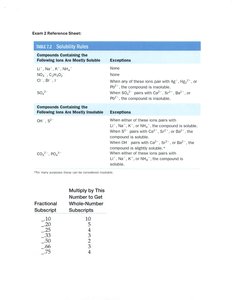
Try solving on your own before revealing the answer!
Q13. What type of reaction is the generic equation A + B → AB?
Background
Topic: Types of Chemical Reactions
This question tests your ability to classify reactions (e.g., synthesis, decomposition, single replacement, double replacement, combustion).
Key Terms:
Synthesis reaction: Two or more substances combine to form a single product.
Step-by-Step Guidance
Identify the number of reactants and products.
Recall the definition of a synthesis reaction.
Try solving on your own before revealing the answer!
Q14. Which of the following is a strong acid?
Background
Topic: Acids and Bases
This question tests your knowledge of strong acids, which completely dissociate in water.
Key Terms:
Strong acid: An acid that ionizes completely in aqueous solution.
Step-by-Step Guidance
Recall the list of common strong acids (e.g., HCl, HNO3, H2SO4).
Compare the answer choices to this list.
Try solving on your own before revealing the answer!
Q15. Complete the double displacement reaction, provide product phases, and balance the reaction.
Background
Topic: Double Displacement Reactions
This question tests your ability to predict products of a double displacement reaction, assign phases, and balance the equation.
Key Steps:
Identify the cations and anions in the reactants and swap them to form the products.
Use solubility rules to determine the phases (solid, aqueous, etc.).
Balance the equation by adjusting coefficients.
Try solving on your own before revealing the answer!
Q16. Balance the following equation:
Background
Topic: Balancing Chemical Equations
This question tests your ability to balance chemical equations by ensuring the same number of each atom on both sides.
Key Steps:
List the number of each atom on both sides of the equation.
Adjust coefficients to balance one element at a time.
Try solving on your own before revealing the answer!
Q17. Complete the table (IUPAC names are accepted) and no partial credit given. Spelling counts.
Background
Topic: Nomenclature
This question tests your ability to write chemical formulas from names and vice versa, using IUPAC rules.
Key Steps:
For each name, write the correct chemical formula using the periodic table and valence rules.
For each formula, write the correct IUPAC name, ensuring correct spelling and format.
Try solving on your own before revealing the answer!
Q18. Acetic acid is known chemically by the name acetic acid. Determine the empirical formula of acetic acid if it is composed of 40.10% carbon, 6.58% hydrogen, and 53.32% oxygen by mass.
Background
Topic: Empirical Formula Determination
This question tests your ability to determine the simplest whole-number ratio of atoms in a compound from percent composition data.
Key Steps:
Assume a 100 g sample so the percentages become grams.
Convert grams of each element to moles using their atomic masses.
Divide each mole value by the smallest number of moles to get the simplest ratio.
Try solving on your own before revealing the answer!
