 Back
BackIntro to Chemistry: States of Matter, Solids & Liquids Study Guide
Study Guide - Smart Notes
 Tailored notes based on your materials, expanded with key definitions, examples, and context.
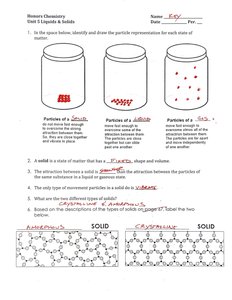
Q1. Draw and describe the particle representation for each state of matter (solid, liquid, gas).
Background
Topic: States of Matter
This question tests your understanding of how particles are arranged and behave in solids, liquids, and gases.
Key Terms:
Solid: Particles are closely packed in a fixed, orderly arrangement.
Liquid: Particles are close together but can move past each other.
Gas: Particles are far apart and move freely.
Step-by-Step Guidance
For a solid, draw particles packed closely together in a regular pattern.
For a liquid, draw particles close together but not in a fixed pattern; they should appear to flow past each other.
For a gas, draw particles spaced far apart, moving randomly throughout the container.
Try solving on your own before revealing the answer!
Q2. What is a solid?
Background
Topic: Properties of Solids
This question checks your understanding of the basic properties of solids, including their shape and volume.
Key Terms:
Fixed shape: Solids do not change shape easily.
Fixed volume: Solids have a definite volume.
Step-by-Step Guidance
Recall that solids maintain their shape and volume regardless of the container.
Think about how the particles in a solid are arranged and how this affects their properties.
Try solving on your own before revealing the answer!
Q3. What is the difference between a solid and a liquid?
Background
Topic: States of Matter Comparison
This question tests your ability to compare the arrangement and movement of particles in solids and liquids.
Key Terms:
Solid: Fixed shape and volume, particles vibrate in place.
Liquid: Takes the shape of its container, fixed volume, particles move past each other.
Step-by-Step Guidance
Describe how the particles in a solid are arranged compared to those in a liquid.
Explain how the movement of particles differs between the two states.
Try solving on your own before revealing the answer!
Q4. What is the attraction between the particles of matter in a solid compared to a liquid or gas?
Background
Topic: Intermolecular Forces
This question is about the strength of the forces holding particles together in different states of matter.
Key Terms:
Intermolecular forces: The forces of attraction between particles.
Solid: Strongest forces.
Liquid: Moderate forces.
Gas: Weakest forces.
Step-by-Step Guidance
Recall that solids have the strongest intermolecular forces, keeping particles in fixed positions.
Compare this to liquids and gases, where the forces are weaker, allowing more movement.
Try solving on your own before revealing the answer!
Q5. What are the two types of government solids?
Background
Topic: Types of Solids
This question asks you to identify the two main categories of solids based on particle arrangement.
Key Terms:
Crystalline solid: Particles arranged in a regular, repeating pattern.
Amorphous solid: Particles arranged randomly, without a set pattern.
Step-by-Step Guidance
Review the definitions of crystalline and amorphous solids.
Look at diagrams or examples to distinguish between the two types.
Try solving on your own before revealing the answer!
Q6. Label the two types of solids in the diagrams provided.
Background
Topic: Visual Identification of Solids
This question tests your ability to recognize and label diagrams of amorphous and crystalline solids.
Key Terms:
Amorphous: No regular pattern.
Crystalline: Regular, repeating pattern.
Step-by-Step Guidance
Examine the arrangement of particles in each diagram.
Label the diagram with a regular pattern as 'crystalline' and the one with a random arrangement as 'amorphous.'
Try solving on your own before revealing the answer!
Q7. What is a liquid?
Background
Topic: Properties of Liquids
This question checks your understanding of the basic properties of liquids, including their shape and volume.
Key Terms:
Fixed volume: Liquids have a definite volume.
Shape: Liquids take the shape of their container.
Step-by-Step Guidance
Recall that liquids do not have a fixed shape but do have a fixed volume.
Think about how the particles in a liquid move compared to solids and gases.
Try solving on your own before revealing the answer!
Q8. How do the particles in a liquid behave?
Background
Topic: Particle Motion in Liquids
This question is about the movement and arrangement of particles in the liquid state.
Key Terms:
Vibrate: Particles move around each other but remain close together.
Step-by-Step Guidance
Describe how liquid particles are not fixed in place but can slide past one another.
Compare this movement to the more rigid structure of solids.
Try solving on your own before revealing the answer!
Q9. What is surface tension?
Background
Topic: Properties of Liquids
This question tests your understanding of surface tension and its molecular basis.
Key Terms:
Surface tension: The force that acts on the surface of a liquid and tends to minimize the area of the surface.
Step-by-Step Guidance
Think about how molecules at the surface of a liquid experience different forces than those inside the liquid.
Relate this to the tendency of liquids to form droplets.
Try solving on your own before revealing the answer!
Q10. What is viscosity?
Background
Topic: Properties of Liquids
This question is about the resistance of a liquid to flow.
Key Terms:
Viscosity: A measure of a liquid's resistance to flow.
Step-by-Step Guidance
Consider how easily different liquids (like water and honey) flow.
Relate this to the strength of intermolecular forces in the liquid.
Try solving on your own before revealing the answer!
Q11. What happens to the energy of a solid as it melts?
Background
Topic: Phase Changes
This question tests your understanding of energy changes during the melting process.
Key Terms:
Melting: The process of a solid turning into a liquid.
Energy: Absorbed by the solid to overcome intermolecular forces.
Step-by-Step Guidance
Recall that melting requires energy input to break the forces holding particles in place.
Think about how this energy affects particle movement.
Try solving on your own before revealing the answer!
Q12. What is the difference between melting and freezing?
Background
Topic: Phase Changes
This question asks you to compare the processes of melting (solid to liquid) and freezing (liquid to solid).
Key Terms:
Melting: Solid to liquid, energy absorbed.
Freezing: Liquid to solid, energy released.
Step-by-Step Guidance
Describe what happens to the particles and energy during each process.
Compare the direction of energy flow in melting and freezing.
Try solving on your own before revealing the answer!
Q13. What is the melting point?
Background
Topic: Phase Changes
This question is about the temperature at which a solid turns into a liquid.
Key Terms:
Melting point: The temperature at which a solid becomes a liquid.
Step-by-Step Guidance
Recall the definition of melting point and how it is determined for a substance.
Think about how the melting point can vary between different substances.
Try solving on your own before revealing the answer!
Q14. Explain the difference between melting and boiling at the atomic level.
Background
Topic: Atomic-Level Changes During Phase Transitions
This question asks you to describe what happens to particles during melting (solid to liquid) and boiling (liquid to gas).
Key Terms:
Melting: Particles gain enough energy to move past each other but remain close.
Boiling: Particles gain enough energy to break free from each other and spread out.
Step-by-Step Guidance
Describe the energy changes and particle movement during melting.
Explain how boiling requires even more energy, allowing particles to escape into the gas phase.
Try solving on your own before revealing the answer!
Q15. Why does a substance with strong intermolecular forces have a higher melting point?
Background
Topic: Intermolecular Forces and Melting Point
This question tests your understanding of how the strength of intermolecular forces affects the melting point of a substance.
Key Terms:
Intermolecular forces: Forces between molecules.
Melting point: Temperature at which a solid becomes a liquid.
Step-by-Step Guidance
Recall that stronger intermolecular forces require more energy to overcome.
Relate this to the temperature needed to melt the substance.
Try solving on your own before revealing the answer!
