 Back
BackIntroduction to Chemistry: Foundations, Measurement, and Matter
Study Guide - Smart Notes
 Tailored notes based on your materials, expanded with key definitions, examples, and context.
Chapter 1: The Chemical World
Science and Technology
Science is a systematic approach to understanding natural phenomena through observation and experimentation. Technology refers to the practical application of scientific knowledge, often predating formal science. Chemistry is the branch of science focused on the behavior and transformation of matter.
Science: Seeks explanations for natural events using the scientific method.
Technology: Applies scientific discoveries for practical uses.
Chemistry: Studies matter, its properties, and changes.
Characteristics of science include being testable, reproducible, explanatory, predictive, and tentative. However, science is limited to observable phenomena and processes where variables can be controlled.
The Scientific Method
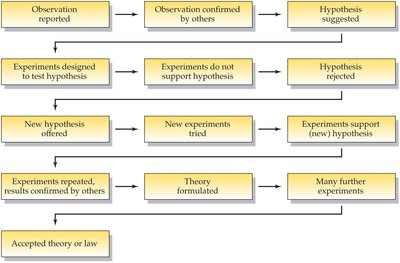
The scientific method is a logical, systematic approach to solving scientific questions. It involves making observations, forming hypotheses, conducting experiments, and developing theories or laws based on evidence.
Hypothesis: A testable explanation for observations.
Scientific Law: A summary of observed phenomena (e.g., law of conservation of mass).
Theory: A well-tested explanation for a broad range of observations.
Scientific Model: A tangible or visual representation of invisible processes.
Science & Technology – Risks and Benefits
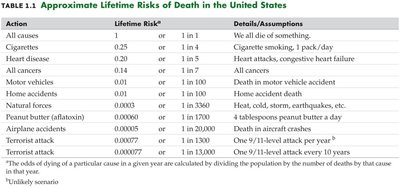
Risk-benefit analysis is used to evaluate the desirability of technological advances. The desirability quotient (DQ) is calculated as:
Action | Lifetime Risk | Details/Assumptions |
|---|---|---|
All causes | 1.0 or 1 in 1 | We all die of something. |
Cigarettes | 0.25 or 1 in 4 | Cigarette smoking, 1 pack/day |
Heart disease | 0.20 or 1 in 5 | Heart attacks, congestive heart failure |
All cancers | 0.14 or 1 in 7 | All cancers |
Motor vehicles | 0.01 or 1 in 100 | Death in motor vehicle accident |
Home accidents | 0.01 or 1 in 100 | Home accident death |
Natural forces | 0.0003 or 1 in 3,300 | Heat, cold, storm, earthquakes, etc. |
Peanut butter (aflatoxin) | 0.00003 or 1 in 33,000 | 4 tablespoons peanut butter a day |
Airplane accidents | 0.00002 or 1 in 50,000 | Death in aircraft crashes |
Terrorist attack | 0.000007 or 1 in 130,000 | One 9/11-level attack per year |
Terrorist attack | 0.000001 or 1 in 1,300,000 | One 9/11-level attack every 10 years |
Green and Sustainable Chemistry
Green chemistry focuses on designing products and processes that minimize environmental impact by preventing pollution at its source. Sustainable chemistry aims to meet current needs without compromising future generations' ability to meet theirs.
Studying Chemistry – Macro to Micro
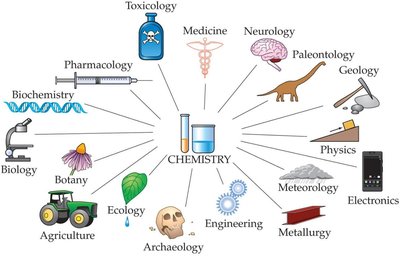
Chemistry connects the macroscopic world (what we see and measure) to the microscopic world (atoms and molecules). Everything we do involves chemistry, from biological processes to industrial applications.
Chapter 3: Matter and Energy
What is Matter?
Matter is anything that has mass and occupies space. Chemistry studies the properties, composition, and changes of matter.
Mass: The amount of matter in an object (measured in kilograms or grams).
Weight: The force of gravity acting on an object's mass (varies with location).
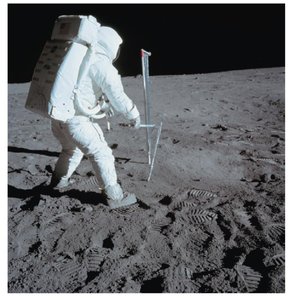
For example, a bowling ball with a mass of 8.00 kg weighs 17.64 pounds on Earth but only 2.91 pounds on the Moon due to the difference in gravitational force.
Classification of Matter
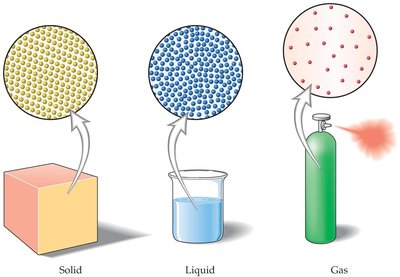
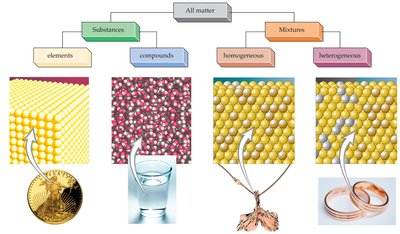
Matter can be classified by its physical state and composition. The three common states are solid, liquid, and gas. Matter can also be classified as a pure substance (element or compound) or a mixture (homogeneous or heterogeneous).
Solid: Definite shape and volume.
Liquid: Definite volume, takes the shape of its container.
Gas: No definite shape or volume, fills its container.
Properties of Matter
Physical Properties
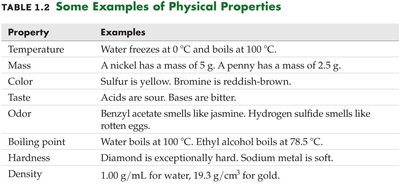
Physical properties can be observed or measured without changing the substance's identity. Examples include temperature, mass, color, taste, odor, boiling point, hardness, and density.
Property | Examples |
|---|---|
Temperature | Water freezes at 0°C and boils at 100°C. |
Mass | A nickel has a mass of 5 g. |
Color | Sulfur is yellow. |
Taste | Acids are sour. |
Odor | Benzyl acetate smells like jasmine. |
Boiling point | Water boils at 100°C. |
Hardness | Diamond is exceptionally hard. |
Density | 1.00 g/mL for water, 19.3 g/cm³ for gold. |
Chemical Properties
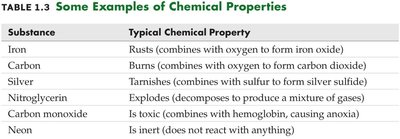
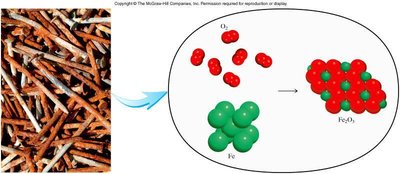
Chemical properties describe a substance's ability to undergo chemical changes, forming new substances. Examples include rusting, burning, tarnishing, exploding, toxicity, and inertness.
Substance | Typical Chemical Property |
|---|---|
Iron | Rusts (combines with oxygen to form iron oxide) |
Carbon | Burns (combines with oxygen to form carbon dioxide) |
Silver | Tarnishes (combines with sulfur to form silver sulfide) |
Nitroglycerin | Explodes (decomposes to produce a mixture of gases) |
Carbon monoxide | Is toxic (combines with hemoglobin, causing anoxia) |
Neon | Is inert (does not react with anything) |
Chapter 2: Measurement and Problem Solving
Measuring Matter – Base Units
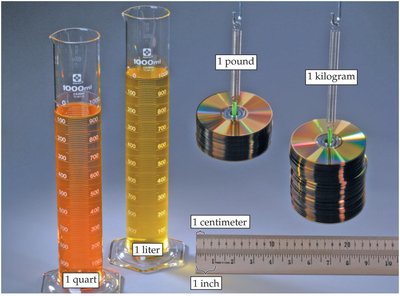
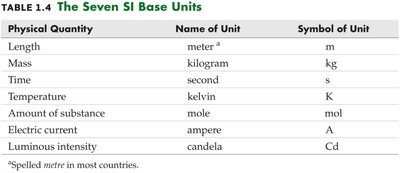
Scientific measurements use the International System of Units (SI). The seven base units are meter (m), kilogram (kg), second (s), kelvin (K), mole (mol), ampere (A), and candela (Cd).
Physical Quantity | Name of Unit | Symbol of Unit |
|---|---|---|
Length | meter | m |
Mass | kilogram | kg |
Time | second | s |
Temperature | kelvin | K |
Amount of substance | mole | mol |
Electric current | ampere | A |
Luminous intensity | candela | Cd |
Making Measurements – Precision and Significant Figures
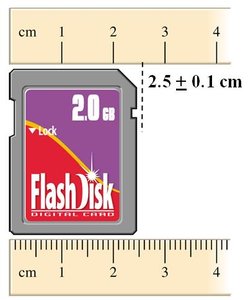
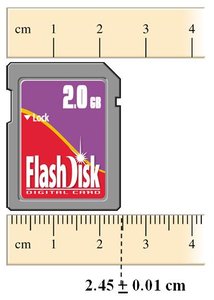
Measurements should be recorded with the correct number of decimal places, reflecting the precision of the measuring instrument. The uncertainty in a measurement is indicated by the last digit.
Example: 2.5 ± 0.1 cm (less precise)
Example: 2.45 ± 0.01 cm (more precise)
SI Prefixes and Unit Conversions
SI prefixes are used to express multiples or fractions of base units. For example, kilo- means 1,000 times the base unit. Unit conversions use conversion factors to change from one unit to another.
Example calculation: To convert 3.6 × 10⁵ m to kilometers:
Density
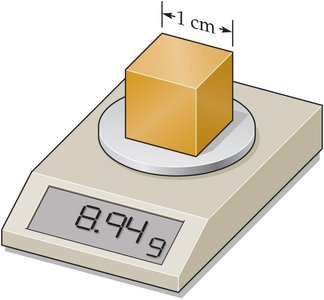
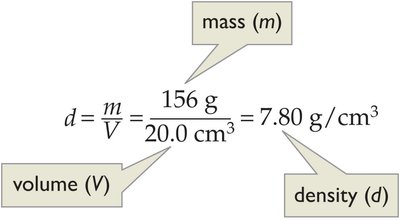
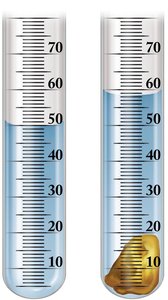
Density is the amount of matter in a given volume. It is calculated as mass divided by volume:
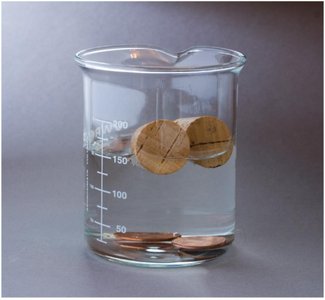
Typical units are g/cm³ or g/mL. More dense substances sink in less dense substances.
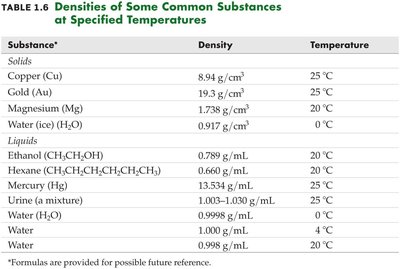
Substance | Density | Temperature |
|---|---|---|
Copper (Cu) | 8.94 g/cm³ | 25°C |
Gold (Au) | 19.3 g/cm³ | 20°C |
Magnesium (Mg) | 1.738 g/cm³ | 20°C |
Water (ice) | 0.917 g/cm³ | 0°C |
Ethanol | 0.789 g/mL | 20°C |
Hexane | 0.660 g/mL | 20°C |
Mercury | 13.534 g/mL | 20°C |
Water (H2O) | 1.000 g/mL | 4°C |
Water (H2O) | 0.998 g/mL | 20°C |
Chapter 3: Matter and Energy (continued)
Heat vs Temperature
Heat is the total energy transferred due to temperature difference, while temperature is a measure of the average kinetic energy of particles in a substance. Heat depends on both the temperature and the amount of substance, while temperature is independent of the amount.

Temperature Scales and Conversions
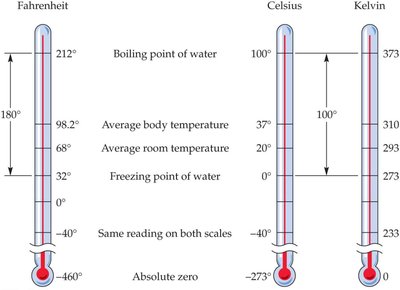
The three main temperature scales are Celsius (°C), Kelvin (K), and Fahrenheit (°F). The Kelvin scale is the SI unit for temperature and starts at absolute zero.
Celsius to Kelvin:
Fahrenheit to Celsius:
Celsius to Fahrenheit:
Example: Liquid nitrogen boils at 77 K. What is this temperature in Celsius?
Summary
Chemistry is the study of matter, its properties, and changes.
The scientific method is central to scientific inquiry.
Matter is classified by state and composition; properties are physical or chemical.
Measurements in chemistry use SI units and require precision.
Density, heat, and temperature are key concepts for understanding matter and energy.
