 Back
BackMeasurement and Problem Solving in Chemistry
Study Guide - Smart Notes
 Tailored notes based on your materials, expanded with key definitions, examples, and context.
Measurement and Problem Solving
Importance of Measurement in Chemistry
Measurement is fundamental to chemistry, as it allows scientists to quantify observations and communicate results. The importance of how something is measured depends on the context—whether performing everyday tasks or conducting precise scientific experiments. Units and precision are controlled by the experimenter, while accuracy depends on the method and instrument used.
Precision refers to the reproducibility of measurements.
Accuracy refers to how close a measurement is to the true value.
Proper Representation of Measurements
Every measurement consists of three components: magnitude (the number), a standard of comparison (the unit), and an estimation (the uncertainty). Analog instruments require estimation one decimal place beyond what is readable, while digital instruments use the last toggling digit as the estimate.
Magnitude: Scientific Notation
Purpose and Structure
Scientific notation is used to express very large or very small numbers efficiently. It consists of a coefficient (between 1 and 9.99) and a power of ten, which adjusts the magnitude.
Example: m
The exponent sign indicates the direction to move the decimal: right for positive, left for negative.
Examples:
Standard of Comparison: SI Base Units
SI Base Units
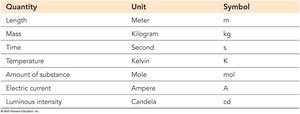
The International System of Units (SI) provides standard units for scientific measurements. Each physical quantity has a corresponding base unit and symbol.
Quantity | Unit | Symbol |
|---|---|---|
Length | Meter | m |
Mass | Kilogram | kg |
Time | Second | s |
Temperature | Kelvin | K |
Amount of substance | Mole | mol |
Electric current | Ampere | A |
Luminous intensity | Candela | cd |
SI Prefixes and Scale
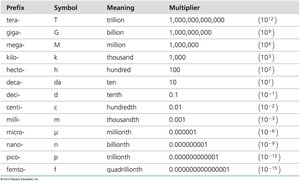
Prefixes are used to indicate multiples or fractions of base units, making it easier to express very large or small quantities.
Prefix | Symbol | Meaning | Multiplier |
|---|---|---|---|
tera- | T | trillion | 1,000,000,000,000 (1012) |
giga- | G | billion | 1,000,000,000 (109) |
mega- | M | million | 1,000,000 (106) |
kilo- | k | thousand | 1,000 (103) |
centi- | c | hundredth | 0.01 (10-2) |
milli- | m | thousandth | 0.001 (10-3) |
micro- | μ | millionth | 0.000001 (10-6) |
nano- | n | billionth | 0.000000001 (10-9) |
pico- | p | trillionth | 0.000000000001 (10-12) |
Scale of the Universe
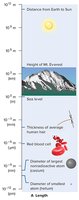
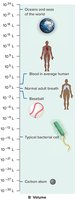
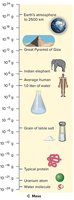
SI units and prefixes allow us to describe quantities across a vast range of scales, from the size of atoms to astronomical distances.
Length: From the diameter of an atom to the distance from Earth to the Sun.
Volume: From the volume of a carbon atom to the oceans of the world.
Mass: From the mass of a hydrogen atom to the Earth's atmosphere.
Precision and Accuracy
Definitions and Differences
Precision and accuracy are critical concepts in measurement. Precision refers to the consistency of repeated measurements, while accuracy refers to how close a measurement is to the true value.
High precision, high accuracy: Measurements are close to each other and to the true value.
High precision, low accuracy: Measurements are close to each other but not to the true value.
Low precision, high accuracy: Measurements are spread out but average to the true value.
Low precision, low accuracy: Measurements are spread out and far from the true value.

Estimation and Error in Measurement
Types of Error
Random error: Fluctuations due to limitations in measurement precision; affects every measurement.
Systematic error: Consistent, repeatable error due to faulty equipment or experimental design.
"Human error" is a vague term; always specify whether error is random or systematic.
Dimensional Analysis
Unit Conversion and Problem Solving
Dimensional analysis is a method for converting between units using conversion factors. Units in the numerator cancel with those in the denominator, and vice versa. Multiply all numerators together and divide by the product of all denominators.
Example: Converting 3.30 cm to miles:
The Mole in Dimensional Analysis
The mole (mol) is a counting unit in chemistry, representing entities (Avogadro's number). It is used to count atoms, molecules, and other particles.
1 mole of atoms = atoms
1 dozen = 12 items (analogy)
Significant Figures
Preserving Precision
Significant figures (sig figs) indicate the precision of a measurement. They include all measured digits plus one estimated digit. The rules for determining significant figures are:
All non-zero digits are significant.
Zeros between non-zero digits are significant.
Trailing zeros to the right of the decimal are significant.
Trailing zeros in a whole number with a decimal are significant.
Leading zeros are not significant.
Trailing zeros in a whole number without a decimal are not significant.
In scientific notation, only the coefficient is significant.
Exact numbers (e.g., counted items) have infinite significant figures.
Rounding: If the digit to be dropped is 5 or greater, round up; if less than 5, leave unchanged.
Significant Figures in Calculations
Addition/Subtraction: The result should have the same number of decimal places as the measurement with the fewest decimal places.
Multiplication/Division: The result should have the same number of significant figures as the measurement with the fewest significant figures.
Do not round until the final step of the calculation.
Density
Definition and Units
Density is a physical property defined as mass per unit volume. It is commonly expressed in grams per cubic centimeter (g/cm3) or kilograms per liter (kg/L).
1 lb = 453.592 g
1 mL = 1 cm3
