 Back
BackMetric and SI Units: Prefixes, Equalities, and Measurement in Chemistry
Study Guide - Smart Notes
 Tailored notes based on your materials, expanded with key definitions, examples, and context.
2.5 The Basic Units of Measurement
Introduction to Measurement in Chemistry
Measurement is fundamental to chemistry, as it allows scientists to quantify observations and communicate results precisely. The metric and SI (International System of Units) systems are universally used in science for consistency and clarity. Understanding how to use prefixes and convert between units is essential for accurate measurement and data interpretation.
Prefixes in the Metric and SI Systems
Definition and Purpose of Prefixes
Prefixes are used in the metric and SI systems to indicate multiples or fractions of base units by factors of ten. This system simplifies the expression of very large or very small quantities by attaching a prefix to the unit name.
Example: 1 kilometer (km) = 1000 meters (m); 1 millimeter (mm) = 0.001 meters (m).
Replacing the prefix with its numerical value gives the equality: 1 km = 1000 m, 1 mm = 0.001 m.
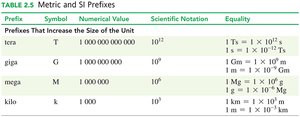
Metric and SI Prefixes That Increase the Size of the Unit
Some prefixes represent values greater than the base unit. The table below summarizes the most common prefixes that increase unit size:
Prefix | Symbol | Numerical Value | Scientific Notation | Equality |
|---|---|---|---|---|
tera | T | 1,000,000,000,000 | 1 Ts = s | |
giga | G | 1,000,000,000 | 1 Gm = m | |
mega | M | 1,000,000 | 1 Mg = g | |
kilo | k | 1,000 | 1 km = m |
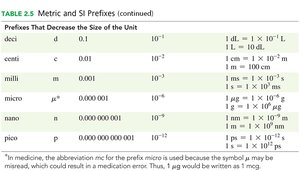
Metric and SI Prefixes That Decrease the Size of the Unit
Other prefixes represent values smaller than the base unit. The table below summarizes the most common prefixes that decrease unit size:
Prefix | Symbol | Numerical Value | Scientific Notation | Equality |
|---|---|---|---|---|
deci | d | 0.1 | 1 dL = L | |
centi | c | 0.01 | 1 cm = m | |
milli | m | 0.001 | 1 ms = s | |
micro | μ* | 0.000001 | 1 μg = g | |
nano | n | 0.000000001 | 1 ns = s | |
pico | p | 0.000000000001 | 1 ps = s |
Additional info: In medicine, "mc" is sometimes used for micro to avoid confusion with the Greek letter μ.
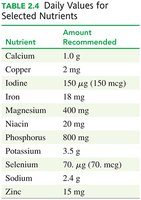
Daily Values for Selected Nutrients
The U.S. Food and Drug Administration (FDA) uses metric prefixes to express recommended daily values for nutrients. Understanding these prefixes helps interpret nutritional information on food labels.
Nutrient | Amount Recommended |
|---|---|
Calcium | 1.0 g |
Copper | 2 mg |
Iodine | 150 μg (150 mcg) |
Iron | 18 mg |
Magnesium | 400 mg |
Niacin | 20 mg |
Phosphorus | 800 mg |
Potassium | 3.5 g |
Selenium | 70 μg (70 mcg) |
Sodium | 2.4 g |
Zinc | 15 mg |
Equalities and Unit Conversions
Understanding Equalities
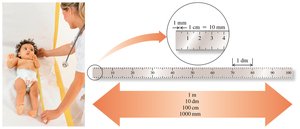
An equality shows the relationship between two units that measure the same quantity. These relationships are essential for converting between units in calculations.
1 m = 100 cm = cm
1 m = 1000 mm = mm
1 cm = 10 mm = mm
Volume Equalities and the Cubic Centimeter
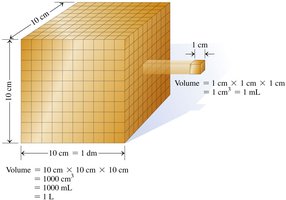
Volume is often measured in liters (L) and its subunits. The cubic centimeter (cm3 or cc) is a common unit of volume, especially in health sciences. It is defined as the volume of a cube with sides of 1 cm.
1 L = 10 dL = dL
1 L = 1000 mL = mL
1 dL = 100 mL = mL
1 cm3 = 1 cc = 1 mL
Measuring Mass: Equalities
Mass Units and Their Relationships
Mass is commonly measured in grams (g) and its multiples or submultiples. Equalities between these units are used in laboratory and medical settings.
1 kg = 1000 g = g
1 g = 1000 mg = mg
1 g = 100 cg = cg
1 mg = 1000 μg (mcg) = μg (mcg)
Practice Problems and Solutions
Prefix and Unit Identification
1000 m = 1 km (kilo)
1 × 10⁻⁶ g = 1 μg (micro)
0.1 L = 1 dL (deci)
Comparing Units
mm or cm: 1 cm is larger than 1 mm.
kilogram or centigram: 1 kilogram is larger than 1 centigram.
dL or μL: 1 dL is larger than 1 μL.
mcg or mg: 1 mg is larger than 1 mcg.
Completing Equalities
1000 m = 1 km
0.01 m = 1 cm
1 kg = 1000 g
1 cL = 0.01 L
Applications in Health and Science
Measurement in Medical Practice
Accurate measurement is critical in health sciences, such as when an ophthalmologist uses a retinal camera to photograph the retina, requiring precise units for length and volume.

Summary Table: Common Metric Equalities
Length | Volume | Mass |
|---|---|---|
1 m = 100 cm = 1000 mm | 1 L = 1000 mL = 1000 cm3 | 1 kg = 1000 g = 1,000,000 mg |
Additional info: Mastery of metric prefixes and unit conversions is foundational for success in chemistry and related sciences.
