 Back
BackMolecules and Compounds: Structure, Bonding, and Nomenclature
Study Guide - Smart Notes
 Tailored notes based on your materials, expanded with key definitions, examples, and context.
Molecules and Compounds
Element Groupings
The periodic table organizes elements into groups based on their electron configurations and chemical properties. The main group elements (s and p blocks) include the most common elements involved in chemical bonding, while transition metals (d block) and the lanthanides and actinides (f block) have unique bonding characteristics.
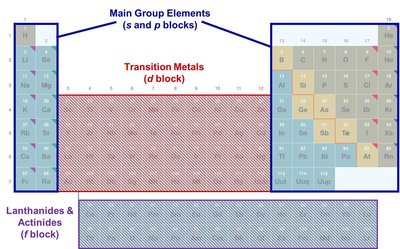
Main Group Elements: Groups 1, 2, and 13-18; these elements typically form predictable ions and compounds.
Transition Metals: Groups 3-12; these elements can form multiple oxidation states and complex ions.
Lanthanides & Actinides: The f-block elements, often involved in specialized chemistry.
Periodic Trends and Chemical Bonding
Periodic trends influence how elements gain or lose electrons to achieve stable electron configurations, often resembling those of noble gases. Main group elements follow predictable patterns in forming ions:
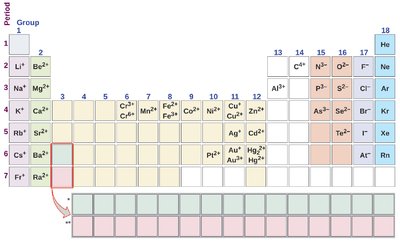
Groups I-IV lose electrons to achieve the electron count of the closest prior noble gas.
Groups V-VII gain electrons to achieve the electron count of the closest subsequent noble gas.
Transition metals lose electrons, but the number lost varies depending on the chemical environment.
For cations in Groups III & IV after the transition metals, subtract 10 electrons to find the correct noble gas configuration.
Chemical Bonding
Why Do Electrons Form Bonds?
Atoms form chemical bonds to lower their potential energy, resulting in more stable arrangements. The two primary types of bonds are ionic and covalent.
Ionic and Covalent Bonding
Ionic bonds result from the transfer of electrons from one atom to another, creating oppositely charged ions that attract each other. Covalent bonds involve the sharing of electrons between atoms, forming molecules.
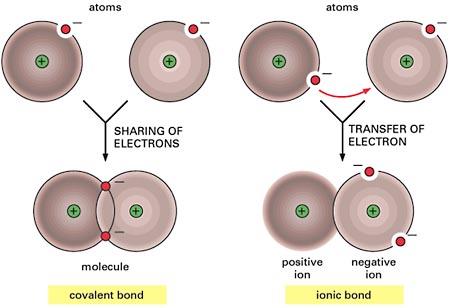
Ionic Bond: Electrostatic attraction between cations and anions; forms crystalline solids.
Covalent Bond: Atoms share electrons; forms discrete molecules.
Bonding and Electronegativity
Electronegativity (EN) is the ability of an atom to attract electrons in a chemical bond. EN increases across a period and decreases down a group. The difference in EN between atoms determines the type of bond formed.
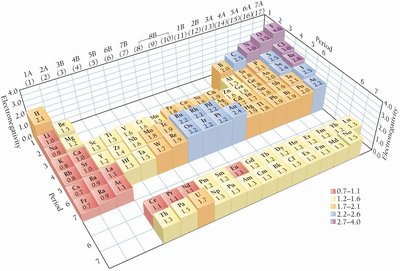
Across a period: EN increases.
Down a group: EN decreases.
Bond Polarity – Ionic or Covalent?
Bond polarity refers to the unequal distribution of electron density in a bond. The difference in electronegativity between two atoms determines whether a bond is pure covalent, polar covalent, or ionic.
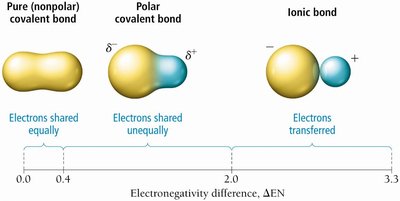
Electronegativity Difference (ΔEN) | Type of Bond |
|---|---|
≤ 0.4 | Pure covalent |
0.4 – 2.0 | Polar covalent |
≥ 2.0 | Ionic |
Ionic compounds contain fully separated charges (+ or -).
Covalent compounds contain partial charges (δ+ or δ-).
Example: NaCl is ionic (ΔEN > 2.0), HCl is polar covalent (ΔEN ≈ 0.9), Cl2 is pure covalent (ΔEN = 0).
Properties of Ionic and Covalent Compounds
Covalent vs. Ionic Bond Properties
Ionic Compounds: High melting and boiling points, hard and brittle, conductive in solution or molten state, crystalline solids.
Covalent Compounds: Lower melting and boiling points, softer, often gases or liquids at room temperature, poor conductors.
Ionic Bonding and Crystal Structure
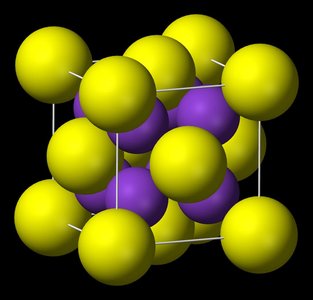
Ionic compounds are composed of cations and anions arranged in a three-dimensional lattice. The simplest ratio of ions that results in electrical neutrality is called the formula unit.
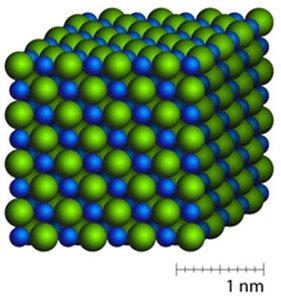
Crystalline order lowers the energy of the system.
Electrostatic repulsion between like charges contributes to brittleness.
Example: NaCl (sodium chloride) forms a cubic lattice.
Polyatomic Ions
Polyatomic ions are groups of covalently bonded atoms that carry a net charge. They can bond with other ions to form ionic compounds and are treated as single entities when balancing charges.
Examples: (CO3)2-, (NO3)-, (NH4)+
When writing formulas, use parentheses if more than one polyatomic ion is needed (e.g., Ca(NO3)2).
Nomenclature of Compounds
Nomenclature for Ionic Compounds
Monatomic Ions: Cation name is the same as the element; anion name ends in "-ide" (e.g., O2- is oxide).
Transition Metals: Use Roman numerals to indicate oxidation state (e.g., Fe2+ is iron(II)).
Polyatomic Ions: Memorize names; no systematic naming rule.
Binary Ionic Compounds: Name cation first, then anion (e.g., BaCl2 is barium chloride).
All formula units must be electrically neutral.
Nomenclature for Molecular Compounds
Molecular compounds (formed from main group elements) use a prefix system to indicate the number of each atom present. The less electronegative element is named first, followed by the more electronegative element with an "-ide" ending.
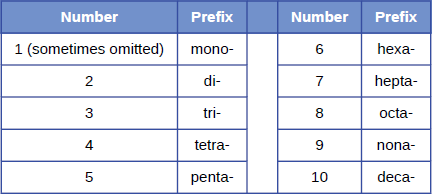
Prefixes: mono-, di-, tri-, tetra-, penta-, hexa-, hepta-, octa-, nona-, deca-
Example: CO2 is carbon dioxide; N2O4 is dinitrogen tetroxide.
When two vowels are adjacent, the final vowel of the prefix is often dropped (e.g., monoxide, not monooxide).
Nomenclature for Arrhenius Acids
Arrhenius acids are compounds that release H+ ions in aqueous solution. Acid names are based on the anion present:
"-ide" anion: hydro-...-ic acid (e.g., HCl(aq) is hydrochloric acid)
"-ate" anion: ...-ic acid (e.g., H2CO3(aq) is carbonic acid)
"-ite" anion: ...-ous acid (e.g., HNO2(aq) is nitrous acid)
Summary Table: Greek Prefixes for Molecular Compounds
Number | Prefix | Number | Prefix |
|---|---|---|---|
1 (sometimes omitted) | mono- | 6 | hexa- |
2 | di- | 7 | hepta- |
3 | tri- | 8 | octa- |
4 | tetra- | 9 | nona- |
5 | penta- | 10 | deca- |
