 Back
BackStates of Matter and Gas Properties: Introductory Chemistry Study Guide
Study Guide - Smart Notes
 Tailored notes based on your materials, expanded with key definitions, examples, and context.
States of Matter
Overview of States of Matter
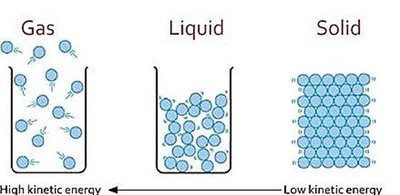
The three primary states of matter—solid, liquid, and gas—are distinguished by the arrangement and motion of their particles. Understanding these differences is fundamental to chemistry, as it explains how substances behave under various conditions.
Solid: Particles are closely packed in a regular pattern and vibrate in place.
Liquid: Particles are close together but arranged randomly, allowing them to move around each other.
Gas: Particles are far apart and move quickly in all directions.
Kinetic Energy: Gases have the highest kinetic energy, followed by liquids, then solids.
Example: Water exists as ice (solid), liquid water, and water vapor (gas).
Kinetic Theory and the Model for Gases
Kinetic Molecular Theory (KMT) of Gases
The kinetic molecular theory explains the behavior of gases based on the motion of their particles. It provides a model for understanding gas properties and their interactions.
Assumptions:
Gas particles are very small, hard spheres with negligible volume.
No attractive forces exist between gas particles.
Particles move in constant, random motion and travel in straight lines until they collide.
Collisions are perfectly elastic (no kinetic energy is lost).
Elastic Collision: A collision in which the total kinetic energy before and after remains the same.
Limitations: Real gases deviate from this model due to particle shape, attractive forces, and energy loss during collisions.
Motion of Gas Particles
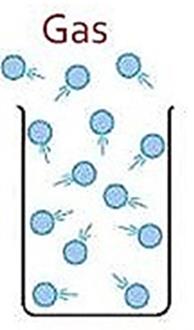
Gas particles move rapidly and randomly, colliding with each other and the container walls. Their speed increases with temperature, and collisions are elastic.
Speed: Increases with temperature.
Collisions: Occur frequently and are elastic.
Direction: Random, straight-line movement between collisions.
Types of Gases at Standard Temperature and Pressure (STP)
Classification of Gases
Gases can be classified based on their molecular structure. At STP (0°C, 1 atm), gases may be monatomic, diatomic, or compounds.
Monatomic: Consist of single atoms (e.g., He, Ne, Ar).
Diatomic: Consist of two atoms bonded together (e.g., O2, N2, H2).
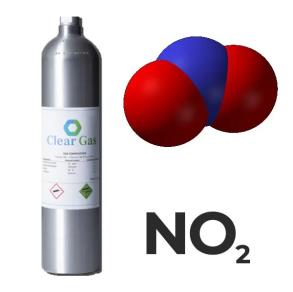
Compounds: Consist of different atoms bonded together (e.g., CO2, NO2).
Gas Pressure
Definition and Cause of Gas Pressure
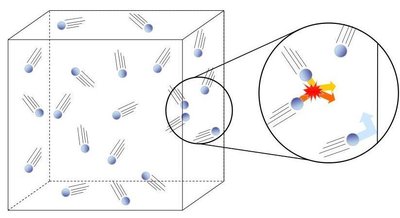
Gas pressure is the result of collisions between gas particles and the walls of their container. The frequency and force of these collisions determine the pressure.
More collisions: Higher pressure.
Fewer collisions: Lower pressure.
Factors Affecting Gas Pressure
Three main factors affect gas pressure: temperature, volume, and the number of gas particles.
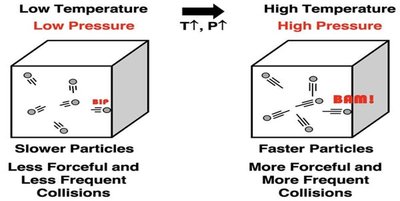
Temperature: Higher temperature increases particle speed and collision frequency, raising pressure.
Volume: Decreasing volume increases collision frequency, raising pressure (inverse relationship).
Amount of Gas: More particles result in more collisions and higher pressure.
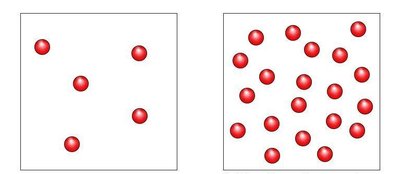
Effect of Number of Particles on Gas Pressure
Doubling the number of gas particles doubles the number of collisions, thus doubling the pressure.
Example: Increasing particles from 8 to 16 increases pressure from 100 kPa to 200 kPa.
Effect of Volume on Gas Pressure
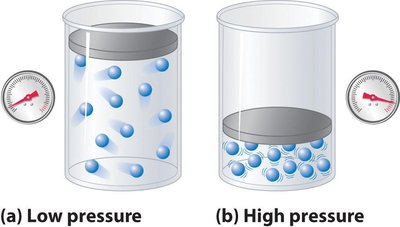
At constant temperature and particle number, decreasing the volume increases pressure, while increasing volume decreases pressure. This is an inverse relationship.
Smaller volume: Particles are closer, more collisions, higher pressure.
Larger volume: Particles are farther apart, fewer collisions, lower pressure.
Example: Halving the volume doubles the pressure.
Effect of Temperature on Gas Pressure
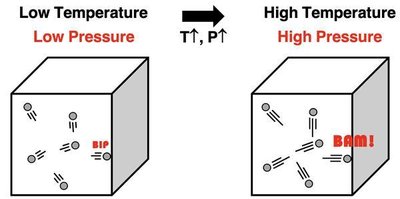
Increasing the temperature of a gas (at constant volume) increases the pressure, as particles move faster and collide more frequently and forcefully.
Key Relationship: Doubling Kelvin temperature doubles pressure; halving temperature halves pressure.
Example: Heating a gas in a closed container increases its pressure.
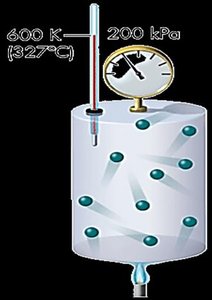
Units of Pressure and Conversion
Common Units of Pressure
Pressure is measured in several units, each used in different contexts.
Pascal (Pa): SI unit of pressure.
Millimeters of Mercury (mm Hg): Used in blood pressure and weather reports.
Atmosphere (atm): Standard atmospheric pressure at sea level, used in chemistry.
Conversion: 1 atm = 760 mm Hg = 101.3 kPa

Pressure Conversion Examples
Converting between units is essential for comparing and calculating gas properties.
Example 1: 450 kPa to atm:
Example 2: 450 kPa to mm Hg:
Example 3: 5.3 atm to mm Hg:
Example 4: 2.86 atm to mm Hg:
Example 5: 33.7 kPa to atm:
Particle Motion in Solids, Liquids, and Gases
Types of Molecular Motion
Molecules exhibit three types of motion: translation, rotation, and vibration. The extent of these motions depends on the state of matter.
Translation: Movement from one place to another.
Rotation: Spinning around an axis.
Vibration: Back-and-forth motion around a fixed position.
Comparison of Particle Motion by State
State | Arrangement | Movement | Types of Motion |
|---|---|---|---|
Solid | Close together, regular pattern | Vibrate in place | Vibration only |
Liquid | Close together, random arrangement | Move around each other | Vibration, Rotation, Translation (limited) |
Gas | Far apart, random arrangement | Move quickly in all directions | Vibration, Rotation, Translation |
Liquids and Intermolecular Forces
Definition of Fluids
Fluids are substances that can flow and take the shape of their container. Both liquids and gases are considered fluids.
Liquids: Particles are close together and flow past each other; have fixed volume.
Gases: Particles are far apart and move freely; have no fixed volume.
Aspect | Liquids | Gases |
|---|---|---|
Particle Arrangement | Close together | Far apart |
Particle Movement | Flow and slide past each other | Move freely and quickly |
Shape | Take shape of container | Take shape of container |
Volume | Fixed volume | No fixed volume |
Types of Solids & Attractive Forces
Classification of Solids
Solids are classified based on the nature of their particles and the forces holding them together.
Type of Solid | Particles | Type of Force | Properties | Examples |
|---|---|---|---|---|
Molecular | Molecules | Weak intermolecular forces | Soft, low melting point | Ice, sugar, CO2 |
Ionic | Ions | Strong ionic bonds | Hard, high melting point | NaCl, CaCl2, MgO |
Metallic | Metal atoms | Metallic bonds | Conduct electricity, malleable | Fe, Cu |
Covalent Network | Atoms | Strong covalent bonds | Very hard, very high melting point | Diamond, SiO2 |
Crystal Structure
Crystalline Solids and Crystal Lattice
Most solids are crystalline, meaning their particles are arranged in an orderly, repeating three-dimensional pattern called a crystal lattice.
Unit Cell: The smallest repeating part of the crystal lattice.
Crystal Systems: Seven types, including cubic, tetragonal, orthorhombic, monoclinic, triclinic, hexagonal, and rhombohedral.
Cubic Unit Cells: Simple cubic (SC), body-centered cubic (BCC), face-centered cubic (FCC).
Amorphous Solids
Not all solids are crystalline. Amorphous solids have particles arranged randomly, lack a definite geometric shape, and melt over a range of temperatures.
Aspect | Crystalline Solid | Amorphous Solid |
|---|---|---|
Particle arrangement | Regular, repeating pattern | Random, no pattern |
Shape | Clear, regular shape | No fixed shape |
Melting behavior | Sharp melting point | Melts gradually |
Structure | Long-range order | No long-range order |
Breaking pattern | Clean, regular | Irregular, uneven |
Examples | Salt, Diamond, Quartz | Glass, Plastic, Rubber |
