 Back
BackStudy Guide: Gases, Liquids, Solids, and Intermolecular Forces
Study Guide - Smart Notes
 Tailored notes based on your materials, expanded with key definitions, examples, and context.
States of Matter
Classification and Properties
The three primary states of matter—solid, liquid, and gas—differ in their physical properties and behavior. Understanding these differences is fundamental to chemistry.
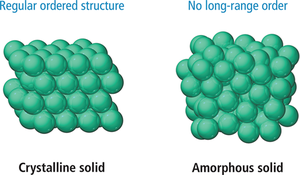
Solid: Retains its shape, does not expand to fill a container, virtually incompressible, does not flow, diffusion is very slow. Can be crystalline (long-range order) or amorphous (no long-range order).
Liquid: Assumes the shape of its container, does not expand to fill a container, virtually incompressible, flows readily, diffusion is slower than in a gas.
Gas: Assumes both the volume and shape of its container, expands to fill a container, is compressible, flows readily, diffuses readily.
Physical Changes and Phase Transitions
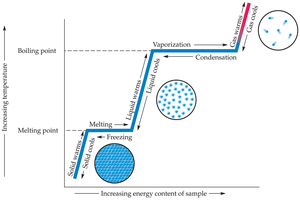
Physical changes involve transitions between states of matter, driven by energy changes.
Melting point: Temperature at which a solid becomes a liquid.
Vaporization: Process by which a liquid becomes a gas.
Boiling point: Temperature at which liquid particles escape to become gas.
Condensation: Gas becomes a liquid.
Freezing: Liquid becomes a solid (occurs at the freezing/melting point).
Sublimation: Solid changes directly to gas.
Intermolecular Forces and States of Matter
Intramolecular vs Intermolecular Forces
Forces within molecules (intramolecular) and between molecules (intermolecular) determine chemical and physical properties.
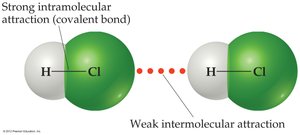
Intramolecular forces: Exist within molecules; include ionic, covalent, and metallic bonds. Influence chemical properties.
Intermolecular forces: Exist between molecules/atoms; influence physical properties and state (gas, liquid, solid).
Types of Intermolecular Forces
London Dispersion Forces: Present in all molecules, arise from instantaneous and induced dipoles. Stronger in larger, more polarizable molecules.
Dipole-Dipole Interactions: Occur between polar molecules; strength increases with molecular polarity.
Hydrogen Bonding: Strongest dipole-dipole interaction; occurs when H is bonded to N, O, or F.
Ion-Dipole Interactions: Occur between ions and polar molecules, important in solutions.
Dissolution and Electrolytes
Dissociation of Ionic Solids
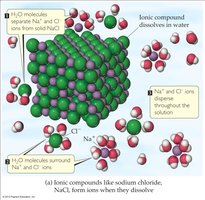
Ionic compounds dissolve in water through dissociation, where the solvent separates and solvates individual ions.
Dissociation: Process by which ionic solids dissolve, forming free ions in solution.
Ionic compounds: Generally have high melting and boiling points due to strong ionic bonds.
Electrolytes and Nonelectrolytes
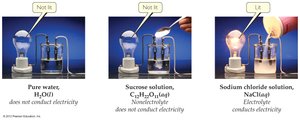
Electrolytes dissociate into ions in solution and conduct electricity, while nonelectrolytes do not.
Electrolyte: Substance that dissociates into ions in water; conducts electricity.
Nonelectrolyte: Dissolves but does not dissociate; does not conduct electricity.
Strong electrolyte: Dissociates completely; conducts electricity well.
Weak electrolyte: Dissociates partially; conducts electricity poorly.
Properties of Gases
General Properties
Gases are compressible, expand to fill containers, and form homogeneous mixtures. Their behavior is described by four parameters: pressure, volume, temperature, and amount.
Pressure (P): Force exerted by gas on container walls.
Volume (V): Space occupied by the gas.
Temperature (T): Average kinetic energy of gas particles (measured in Kelvin).
Moles (n): Number of gas particles.
Kinetic-Molecular Theory (KMT)
KMT explains gas behavior based on particle motion and energy.
Particles are negligibly small and far apart.
Continuous random motion; collisions are elastic.
Negligible attractive/repulsive forces between particles.
Average kinetic energy is proportional to temperature.
Gas Laws
Boyle’s Law
Boyle’s Law describes the inverse relationship between pressure and volume at constant temperature and moles.
Equation:
If volume decreases, pressure increases, and vice versa.
Charles’s Law
Charles’s Law states that the volume of a gas at constant pressure is directly proportional to its absolute temperature.
Equation:
Use Kelvin for temperature in calculations.
Gay-Lussac’s Law
Gay-Lussac’s Law relates pressure and temperature at constant volume and moles.
Equation:
Combined Gas Law
The combined gas law incorporates Boyle’s, Charles’s, and Gay-Lussac’s laws for situations where pressure, volume, and temperature all change (n constant).
Equation:
Avogadro’s Law
Avogadro’s Law states that the volume of a gas at constant temperature and pressure is directly proportional to the number of moles.
Equation:
At STP, one mole of any gas occupies 22.4 L.
Ideal Gas Law
The ideal gas law combines all previous gas laws into a single equation.
Equation:
R is the gas constant (0.0821 L·atm/mol·K).
Density of Gases
The density of a gas can be calculated using the ideal gas law and molar mass.
Equation:
Where D is density, P is pressure, M is molar mass, R is gas constant, T is temperature.
Summary Table: Intermolecular Forces
Type | Strength | Examples |
|---|---|---|
London Dispersion | Weakest | All molecules, especially nonpolar |
Dipole-Dipole | Intermediate | Polar molecules |
Hydrogen Bonding | Strongest (among dipoles) | H bonded to N, O, F |
Ion-Dipole | Very strong | Ions in polar solvents |
Solutions and Solubility
Definitions
Solution: Homogeneous mixture of two or more pure substances.
Solute: The dissolved substance.
Solvent: The major component.
"Like dissolves like": Solutions form most readily when solute and solvent have similar intermolecular forces.
Ionic Substances in Water
Ionic substances dissolve in water through ion–dipole interactions.
Solubility depends on the similarity of intermolecular forces between solute and solvent.
Key Equations (Summary)
Boyle’s Law:
Charles’s Law:
Gay-Lussac’s Law:
Combined Gas Law:
Avogadro’s Law:
Ideal Gas Law:
Gas Density:
