 Back
BackStudy Guide: Periodic Table, Chemical Nomenclature, Reactions, and Mole Concept
Study Guide - Smart Notes
 Tailored notes based on your materials, expanded with key definitions, examples, and context.
Chapter 5: The Periodic Table
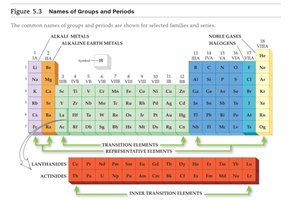
Classification of Elements by Period and Group
The periodic table organizes elements by periods (rows) and groups (columns), which helps predict their properties and behaviors. Elements in the same group share similar chemical properties due to their valence electron configuration.
Periods: Horizontal rows; elements in the same period have the same number of electron shells.
Groups: Vertical columns; elements in the same group have similar chemical properties.
Families: Groups often have common names, such as alkali metals, alkaline earth metals, halogens, and noble gases.
Trends in Metallic Character
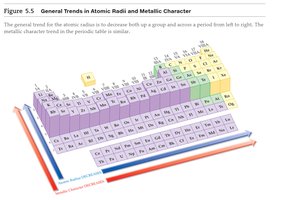
Metallic character increases down a group and decreases across a period from left to right. Metals tend to lose electrons easily, forming cations.
Metallic character: The tendency of an element to exhibit properties of metals, such as conductivity and malleability.
Trend: Increases down a group, decreases across a period.
Trends in Atomic Size
Atomic radius increases down a group and decreases across a period. This is due to the addition of electron shells and increased nuclear charge.
Atomic radius: The distance from the nucleus to the outermost electron shell.
Trend: Increases down a group, decreases across a period.
Periodic Table Blocks and Sublevels
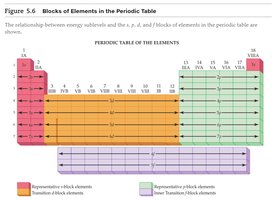
The periodic table is divided into blocks based on the highest energy sublevel being filled: s, p, d, and f blocks. This division helps predict electron configurations and chemical behavior.
s-block: Groups 1 and 2, plus helium.
p-block: Groups 13-18.
d-block: Transition metals, groups 3-12.
f-block: Lanthanides and actinides.
Trends in Ionization Energy
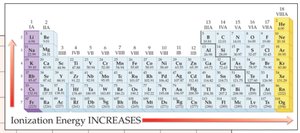
Ionization energy is the energy required to remove an electron from an atom. It increases across a period and decreases down a group.
Highest ionization energy: Noble gases (group 18).
Lowest ionization energy: Alkali metals (group 1).
Valence Electrons and Electron Dot Formulas
Valence electrons are the outermost electrons involved in chemical bonding. Electron dot formulas (Lewis structures) represent valence electrons as dots around the element symbol.
Representative elements: Groups 1, 2, and 13-18.
Valence electrons: Equal to the group number for representative elements.
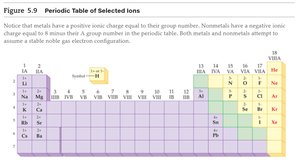
Periodic Table of Selected Ions
Metals form positive ions (cations) with charges equal to their group number. Nonmetals form negative ions (anions) with charges equal to 8 minus their group number.
Chapter 6: Language of Chemistry
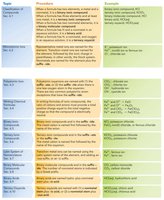
Classification of Compounds
Chemical compounds are classified based on their composition:
Binary ionic compounds: Composed of two elements, a metal and a nonmetal.
Ternary ionic compounds: Contain three or more elements, usually including a polyatomic ion.
Binary molecular (covalent) compounds: Composed of two nonmetals.
Classification of Acids
Binary acids: Contain hydrogen and one other element.
Ternary acids (oxyacids): Contain hydrogen, oxygen, and another element.
Classification of Ions
Monatomic cations: Single atom with a positive charge (e.g., Na+).
Polyatomic cations: Multiple atoms with a positive charge (e.g., NH4+).
Polyatomic anions: Multiple atoms with a negative charge (e.g., SO42-).
Systematic Names and Formulas
Systematic naming follows IUPAC rules for clarity and consistency. The name reflects the composition and charge of the compound or ion.
Chapter 7: Chemical Reactions
Evidence of a Chemical Reaction
Four main observations indicate a chemical reaction:
Formation of a gas
Formation of a precipitate
Color change
Temperature change
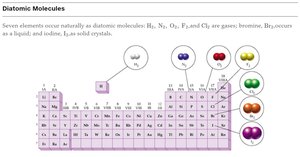
Diatomic Molecules
Seven elements naturally occur as diatomic molecules: H2, N2, O2, F2, Cl2, Br2, I2.
Types of Chemical Reactions
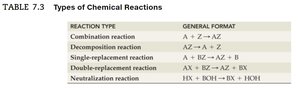
Chemical reactions are classified into five main types:
Reaction Type | General Format |
|---|---|
Combination | |
Decomposition | |
Single-replacement | |
Double-replacement | |
Neutralization |
Combination Reactions
Metal + oxygen (g) → metal oxide
Nonmetal + oxygen (g) → nonmetal oxide
Metal + nonmetal → ionic compound

Decomposition Reactions
Metal hydrogen carbonate → metal carbonate + water + carbon dioxide (g)
Metal carbonate → metal oxide + carbon dioxide (g)
Oxygen-containing compound → substance + oxygen (g)

Single-Replacement Reactions
Metal + salt1 (aq) → metal2 + salt2 (aq)
Metal + acid (aq) → salt (aq) + hydrogen (g)
Metal + water → metal hydroxide (aq) + hydrogen (g)

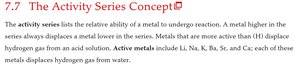
The Activity Series Concept
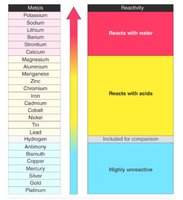
The activity series ranks metals by their ability to undergo reactions. A metal higher in the series displaces a metal lower in the series. Highly active metals can displace hydrogen from water or acid.
Active metals: Li, Na, K, Ba, Sr, Ca
Metals above hydrogen displace hydrogen from acids.
Metals above certain thresholds displace hydrogen from water.
Double-Replacement Reactions
Double-replacement reactions occur when two ionic compounds exchange ions, often resulting in the formation of a precipitate.
General format:
Occurs if one product is insoluble in water.
Solubility Rules for Ionic Compounds
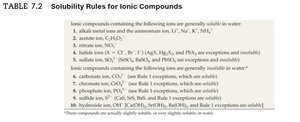
Solubility rules help predict whether an ionic compound will dissolve in water or form a precipitate.
Rule | Description |
|---|---|
1 | Alkali metal ions and ammonium ion are always soluble. |
2 | Nitrate, acetate, and most chloride, bromide, and iodide salts are soluble (exceptions: Ag+, Pb2+, Hg22+). |
3 | Sulfate salts are generally soluble (exceptions: BaSO4, PbSO4, CaSO4). |
4 | Carbonates, phosphates, sulfides, and hydroxides are generally insoluble (exceptions: alkali metals and ammonium). |
Chapter 8: The Mole Concept
Avogadro's Number and the Mole
The mole is a fundamental unit in chemistry representing particles (atoms, molecules, or ions). Avogadro's number allows conversion between particles and moles.
Avogadro's number:
1 mole: Contains Avogadro's number of particles.
Calculating Moles, Mass, and Particles
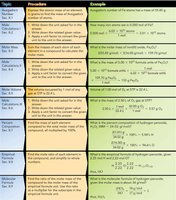
Use the periodic table to determine molar mass and convert between mass, moles, and number of particles.
Molar mass: Mass of 1 mole of a substance (g/mol).
Conversions:
Particles to moles:
Moles to mass:
Molar Volume of Gases at STP
At standard temperature and pressure (STP), 1 mole of any gas occupies 22.4 L.
Molar volume: at STP
Density of gas:
Percent Composition and Empirical/Molecular Formulas
Percent composition is calculated from the chemical formula. Empirical formula is the simplest ratio of elements; molecular formula is the actual number of atoms in a molecule.
Percent composition:
Empirical formula: Simplest whole-number ratio.
Molecular formula: Multiple of empirical formula based on molar mass.
