 Back
BackThe Scientific Method in Chemistry: Principles and Applications
Study Guide - Smart Notes
 Tailored notes based on your materials, expanded with key definitions, examples, and context.
The Chemical World
The Scientific Method
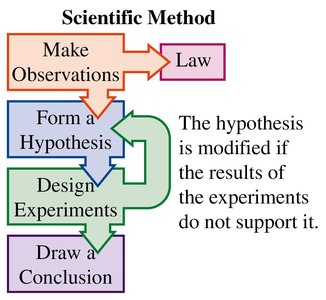
The scientific method is a systematic approach used by scientists to investigate natural phenomena, develop explanations, and build knowledge. It is foundational to all scientific disciplines, including chemistry, and ensures that conclusions are based on evidence and logical reasoning.
Observation: The process begins with making careful observations about nature or a specific event. Observations are factual and measurable.
Hypothesis: A hypothesis is a proposed explanation for the observations. It must be testable and falsifiable.
Experiment: Experiments are designed to test the hypothesis. They involve manipulating variables and collecting data to determine if the hypothesis is supported.
Conclusion: After analyzing the experimental results, a conclusion is drawn. The hypothesis may be accepted, rejected, or modified based on the evidence.
Law: If repeated experiments consistently support a hypothesis, it may become a scientific law, describing a fundamental principle of nature.
Theory: A theory is a well-substantiated explanation of some aspect of the natural world, based on a body of evidence and multiple tested hypotheses.
Key Points:
The scientific method is iterative; hypotheses may be revised if experiments do not support them.
Scientific laws describe what happens, while theories explain why it happens.
Example: Consider a scenario involving a malfunctioning blender:
Observation: The blender does not work when plugged in.
Hypothesis: The blender motor is broken.
Experiment: Plug the blender into a different outlet to test if the issue is with the outlet or the blender.
Conclusion: If the blender still does not work, the hypothesis that the motor is broken may be supported, or further hypotheses may be proposed (e.g., the plug has malfunctioned).
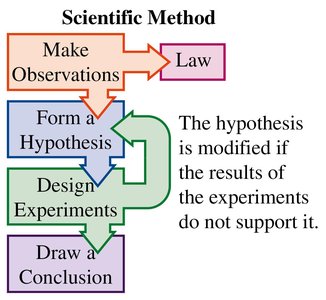
Additional info: The scientific method is not a rigid sequence but a flexible framework. Scientists may revisit earlier steps as new data emerges, ensuring that scientific knowledge evolves and improves over time.
