 Back
BackUnderstanding the Parts of an Elemental (Isotopic) Symbol
Study Guide - Smart Notes
 Tailored notes based on your materials, expanded with key definitions, examples, and context.
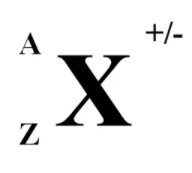
Q1. Identify the parts of the elemental symbol (what is represented by A, X, Z, and +/-)?
Background
Topic: Atomic Structure and Isotopic Notation
This question tests your understanding of how to interpret the standard notation for isotopes, which is used to represent different forms of elements based on their atomic structure.
Key Terms and Formulas
A (Mass Number): The total number of protons and neutrons in the nucleus of an atom.
Z (Atomic Number): The number of protons in the nucleus, which determines the element's identity.
X (Elemental Symbol): The one- or two-letter symbol representing the element (e.g., H for hydrogen, He for helium).
+/− (Charge): Indicates the ion's charge. If the number of protons equals the number of electrons, there is no charge. If there are more protons, the ion is positive (cation); if more electrons, negative (anion).
Step-by-Step Guidance
Start by identifying the position of each symbol in the notation: A is in the upper left, Z is in the lower left, X is the central symbol, and +/- is in the upper right.
Recall that the mass number (A) is the sum of protons and neutrons:
The atomic number (Z) is the number of protons, which defines the element:
The charge (+/-) is determined by the difference between the number of protons and electrons:
Try identifying each part and its meaning before checking the answer!
Final Answer:
A: Mass number (protons + neutrons)
Z: Atomic number (number of protons)
X: Elemental symbol
+/−: Charge (difference between protons and electrons)
This notation helps chemists quickly identify isotopes and ions of elements.
