 Back
BackAggregate Demand and Aggregate Supply: Economic Fluctuations and the AD-AS Model
Study Guide - Smart Notes
 Tailored notes based on your materials, expanded with key definitions, examples, and context.
Aggregate Demand and Aggregate Supply
Introduction to Economic Fluctuations
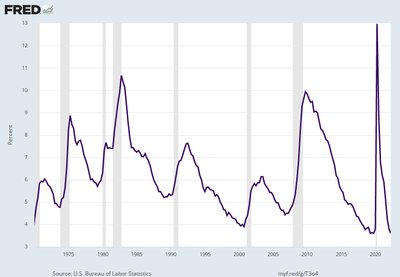
Economic fluctuations, also known as business cycles, refer to the short-run variations in real GDP and other macroeconomic variables around their long-run trends. These fluctuations are a central focus of macroeconomics because they affect employment, income, and overall economic well-being.
Recessions: Periods of falling real incomes and rising unemployment.
Depressions: Severe recessions, which are rare.
Key Characteristics: Fluctuations are irregular and unpredictable; most macroeconomic quantities fluctuate together; as output falls, unemployment rises.
The Classical Dichotomy and Short-Run Fluctuations
The classical dichotomy separates economic variables into real (quantities, relative prices) and nominal (measured in money terms) groups. Classical theory assumes monetary neutrality: changes in the money supply affect nominal but not real variables. This holds in the long run, but not in the short run, where changes in nominal variables can affect real variables such as output and unemployment.
The Aggregate Demand (AD) and Aggregate Supply (AS) Model
Model Overview
The AD-AS model is the primary tool for analyzing short-run economic fluctuations. It determines the equilibrium price level and output (real GDP) in the economy.
Aggregate Demand (AD): Shows the quantity of all goods and services demanded at each price level.
Aggregate Supply (AS): Shows the total quantity of goods and services firms produce and sell at each price level.
The Aggregate Demand Curve
The AD curve slopes downward, indicating that as the price level falls, the quantity of goods and services demanded increases. The AD curve is represented by the equation:
C: Consumption
I: Investment
G: Government Purchases
NX: Net Exports
Why the AD Curve Slopes Downward
The Wealth Effect (P and C): A lower price level increases the real value of money, making consumers wealthier and increasing consumption.
The Interest-Rate Effect (P and I): A lower price level reduces the demand for money, lowers interest rates, and stimulates investment spending.
The Exchange-Rate Effect (P and NX): A lower price level leads to lower interest rates, causing the domestic currency to depreciate and increasing net exports.
Shifts in the AD Curve
Any event that changes C, I, G, or NX (other than a change in the price level) will shift the AD curve.
Increase in AD: Stock market boom, increased government spending, rise in exports, tax cuts.
Decrease in AD: Stock market crash, decreased investment, reduced government spending, appreciation of the domestic currency.
The Aggregate Supply Curve
Long-Run Aggregate Supply (LRAS)
The LRAS curve is vertical, indicating that in the long run, the quantity of goods and services supplied depends on the economy’s resources and technology, not on the price level. The natural rate of output () is determined by labor, capital, natural resources, and technology.
Shifts in LRAS: Changes in labor (e.g., immigration), capital (physical or human), natural resources, or technological knowledge.
Short-Run Aggregate Supply (SRAS)
The SRAS curve is upward sloping: over periods of 1–2 years, an increase in the price level increases the quantity of goods and services supplied. The slope of SRAS is explained by three theories:
Sticky-Wage Theory: Nominal wages are slow to adjust due to contracts and social norms. If the price level rises above expectations, real wages fall, making production more profitable and increasing output.
Sticky-Price Theory: Some prices are slow to adjust due to menu costs. Firms with sticky prices see increased demand when the overall price level rises, leading to higher output.
Misperceptions Theory: Firms may misinterpret changes in the overall price level as changes in relative prices, leading them to adjust output.
All three theories imply:
Y: Quantity of output supplied
Y_N: Natural rate of output
P: Actual price level
P_E: Expected price level
a: Parameter measuring responsiveness
Shifts in the SRAS Curve
Everything that shifts LRAS also shifts SRAS.
Changes in expected price level () shift SRAS: if rises, SRAS shifts left; if $ P_E $ falls, SRAS shifts right.
Using the AD-AS Model to Analyze Economic Fluctuations
Four Steps for Analysis
Determine whether the event shifts AD or AS.
Determine the direction of the shift (left or right).
Use the AD–AS diagram to see how the shift changes output (Y) and the price level (P) in the short run.
Use the diagram to see how the economy moves from the new short-run equilibrium to the new long-run equilibrium.
Historical Examples
The Great Depression (1929–1933): Large leftward shift in AD due to falling money supply and stock prices; output and prices fell, unemployment rose sharply.
World War II Boom (1939–1944): Large rightward shift in AD due to increased government spending; output and prices rose, unemployment fell.
The Great Recession (2008–2009): Contractionary shift in AD, sharp fall in real GDP and employment, housing market collapse, and financial crisis.
The Covid Recession (2020): Simultaneous leftward shifts in AD and AS due to pandemic-related shutdowns; sharp reduction in production and employment, followed by large fiscal and monetary policy responses.
Policy Responses to Economic Fluctuations
Monetary Policy: Central bank actions such as lowering interest rates or quantitative easing to stimulate AD.
Fiscal Policy: Government spending increases or tax cuts to boost AD (e.g., CARES Act during Covid-19).
Summary Table: Effects of Shifts in AD and AS
Shock | Short-Run Effect | Long-Run Adjustment |
|---|---|---|
AD shifts left | Y and P fall, unemployment rises | SRAS shifts right, Y returns to YN, P lower |
AD shifts right | Y and P rise, unemployment falls | SRAS shifts left, Y returns to YN, P higher |
SRAS shifts left (e.g., oil shock) | Y falls, P rises (stagflation) | SRAS shifts right as wages/prices adjust, Y and P return to initial levels |
Key Takeaways
Short-run economic fluctuations are irregular and unpredictable.
The AD-AS model explains how output and prices adjust to balance aggregate demand and supply.
Policy responses can mitigate the effects of economic shocks but may have long-term consequences (e.g., inflation).
