 Back
BackAggregate Expenditure and Output in the Short Run: Study Notes
Study Guide - Smart Notes
 Tailored notes based on your materials, expanded with key definitions, examples, and context.
Aggregate Expenditure and Output in the Short Run
Introduction
This chapter explores the aggregate expenditure model, a foundational concept in macroeconomics that explains how total spending in the economy determines output and income in the short run. The model is essential for understanding fluctuations in real GDP and the business cycle.
The Aggregate Expenditure Model
Definition and Purpose
Aggregate expenditure model: A macroeconomic model focusing on the short-run relationship between total spending (aggregate expenditure) and real GDP, assuming a constant price level.
The model determines the short-run equilibrium level of output in the economy.
Components of Aggregate Expenditure
Consumption (C): Household spending on goods and services.
Planned Investment (I): Firm spending on capital goods and household spending on new homes (excludes unplanned inventory changes).
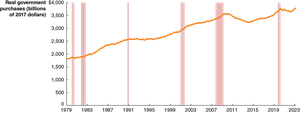
Government Purchases (G): Government spending on goods and services at all levels.
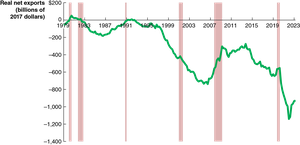
Net Exports (NX): Exports minus imports.
Aggregate Expenditure (AE): The sum of the above components:
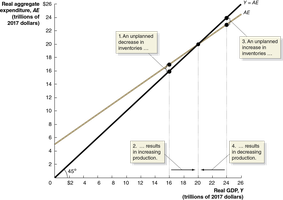
Planned vs. Actual Investment
Planned investment excludes unplanned changes in inventories, while actual investment includes them.
Macroeconomic equilibrium occurs when planned investment equals actual investment (no unplanned inventory changes).
Determinants of Aggregate Expenditure Components
Consumption
Largest component of aggregate expenditure.
Determinants include:
Current disposable income
Household wealth
Expected future income
Price level
Interest rate
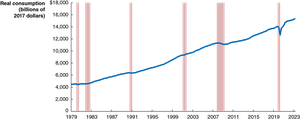
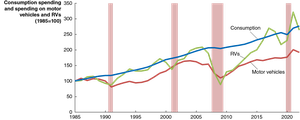
Volatility of Durable Goods Consumption
Spending on durable goods (e.g., cars, RVs) is more volatile than overall consumption due to postponable purchases, substitutes, and sensitivity to interest rates.
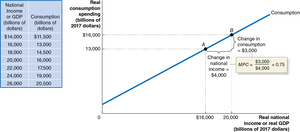
The Consumption Function and Marginal Propensity to Consume (MPC)
Consumption function: Relationship between consumption and disposable income.
Marginal propensity to consume (MPC): The change in consumption from a change in disposable income.
Formula:

Marginal Propensity to Save (MPS)
Marginal propensity to save (MPS): The change in saving from a change in disposable income.
Relationship:
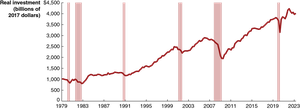
Planned Investment
More volatile than consumption.
Determinants include:
Expectations of future profitability
Interest rate
Taxes
Cash flow
Government Purchases
Includes all levels of government spending on goods and services (excludes transfer payments).
Net Exports
Typically negative for the U.S. in recent decades.
Determinants include:
Relative price levels
Relative growth rates
Exchange rates
Macroeconomic Equilibrium
Graphical Representation: The 45-Degree Line Diagram
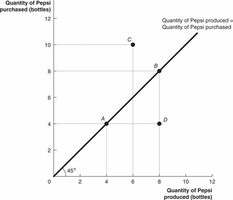
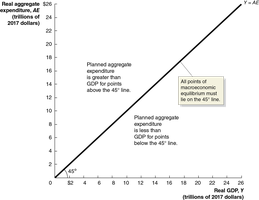
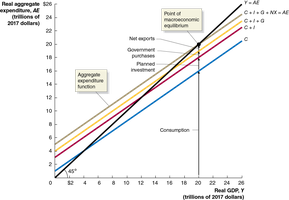
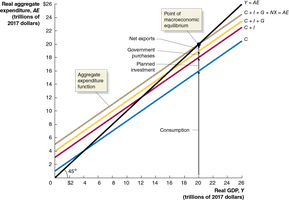
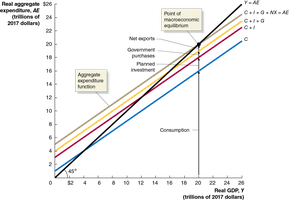
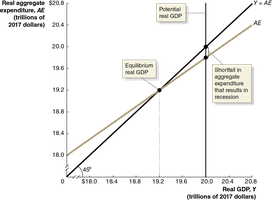
Equilibrium occurs where aggregate expenditure equals real GDP.
The 45-degree line shows all points where output equals spending.
Finding Equilibrium
Equilibrium is found where the aggregate expenditure function intersects the 45-degree line.
At this point, there are no unplanned changes in inventories.
Recessionary Gaps
If equilibrium occurs below potential GDP, the economy experiences a recessionary gap (unemployment above the natural rate).
The Multiplier Effect
Definition and Mechanism
Multiplier effect: A small change in autonomous expenditure leads to a larger change in equilibrium real GDP.
Occurs because each round of spending induces further rounds of consumption.
Formula:
Calculation Example
If , then .
A $200 billion increase in equilibrium GDP.
Reverse Multiplier
The multiplier works in reverse: decreases in autonomous expenditure cause larger decreases in GDP (e.g., during the Great Depression).
Limitations
Real-world factors (imports, taxes, inflation, interest rates) reduce the actual size of the multiplier compared to the simple model.
The Paradox of Thrift
In the short run, increased saving can reduce consumption, lowering incomes and potentially causing a recession.
Known as the paradox of thrift: what is beneficial for individuals (saving) can be harmful for the economy in the short run.
The Aggregate Demand Curve
Relationship to Aggregate Expenditure
The aggregate demand (AD) curve shows the inverse relationship between the price level and the quantity of real GDP demanded.
As the price level rises, aggregate expenditure falls due to:
Decreased real wealth (reducing consumption)
Reduced net exports (as U.S. goods become relatively more expensive)
Higher interest rates (reducing investment)
Appendix: The Algebra of Macroeconomic Equilibrium
Aggregate Expenditure Equations
Consumption function:
Planned investment:
Government purchases:
Net exports:
Equilibrium condition:
Solving for Equilibrium Output
Substitute the first four equations into the equilibrium condition and solve for :
Summary Table: Key Concepts
Concept | Definition |
|---|---|
Aggregate Expenditure (AE) | Total spending in the economy: |
Marginal Propensity to Consume (MPC) | Fraction of additional income spent on consumption |
Multiplier | Effect of a change in autonomous expenditure on equilibrium GDP: |
Macroeconomic Equilibrium | Occurs when AE = Real GDP |
Aggregate Demand Curve | Shows relationship between price level and real GDP demanded |
