 Back
BackCanadian Macroeconomic Outlook: GDP, Trade, Investment, and Policy (2025-2026)
Study Guide - Smart Notes
 Tailored notes based on your materials, expanded with key definitions, examples, and context.
Canadian Macroeconomic Performance and Outlook
Recent GDP Trends and Trade Impacts
Canada's economy has experienced a significant contraction, primarily due to the U.S. trade war and declining exports. The sharp drop in exports, especially to the U.S., has led to a projected GDP growth of only 1.1% in 2025, which is below the economy's potential. Structural issues, such as weak business investment and stagnant productivity, further contribute to the subdued outlook for 2026.
GDP Growth: Real GDP fell by 1.6% annualized in Q2 2025, marking the largest contraction since the COVID-19 recession.
Exports: U.S. tariffs on Canadian goods caused a slump in U.S.-bound exports. Efforts to diversify trade increased exports to non-U.S. countries, but not enough to offset losses.
Business Investment: Declining investment in machinery, equipment, and intellectual property further weakened the economy.
Consumption and Government Spending: Both showed temporary increases, but are expected to soften due to labour market weakness and a declining household savings rate.
Inventory Accumulation: Contributed to GDP growth, but signals weak future production.
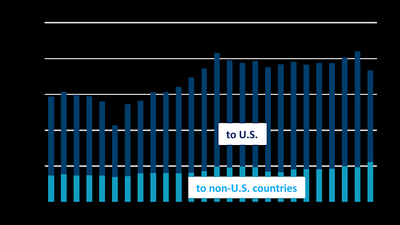
Figure 1: Higher exports to non-U.S. countries did not compensate for the slump in U.S.-bound exports.
Structural Challenges: Productivity and Investment
Canada's low potential GDP is a result of stagnant productivity and slow population growth. Productivity growth has averaged only 0.6% per year since 2002, much lower than previous decades. This is largely due to weak private sector investment, which has fallen to just 5.5% of GDP in the first half of 2025.
Potential GDP: Represents the economy's "speed limit"—the maximum sustainable output.
Labour Productivity: Defined as output per hour worked. Weak investment leads to slow productivity growth.
Business Investment: Key driver of productivity. Investment in machinery, equipment, and intellectual property is essential for economic growth.
Foreign Capital: Attracting foreign investment is challenging due to U.S. tax incentives and a weak Canadian dollar.
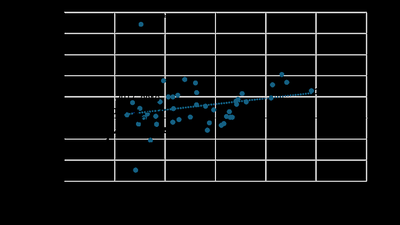
Figure 3: Positive relationship between productivity and investment share of GDP.
Policy Responses and Long-Term Prospects
The federal government is planning increased expenditures on infrastructure and defense, aiming to boost economic potential and attract investment. However, these measures will take time to impact growth. In the short term, monetary policy by the Bank of Canada is expected to provide relief, with the overnight rate likely falling below the neutral range of 2.25-3.25%.
Infrastructure Investment: Modernizing infrastructure can attract foreign capital and improve productivity.
Monetary Policy: Lowering the policy rate can stimulate borrowing and spending, but long-term bond yields may remain elevated due to external factors.
Exchange Rate: A weaker Canadian dollar affects investment and the cost of imported goods.
Forecasts of Key Economic Variables
The following table summarizes forecasts for GDP growth, inflation, policy rates, bond yields, and exchange rates for 2024-2026.
Variable | 2024 | 2025 | 2026 | Annual Average |
|---|---|---|---|---|
GDP growth (quarter-over-quarter % change, annualized) | Q1-Q4 | Q1-Q4 | Q1-Q4 | 2024-2026 |
Inflation (year-over-year % change, quarterly averages) | Q1-Q4 | Q1-Q4 | Q1-Q4 | 2024-2026 |
Key policy rate (% end of period) | Q1-Q4 | Q1-Q4 | Q1-Q4 | 2024-2026 |
Government of Canada key bond rates (% end of period) | Q1-Q4 | Q1-Q4 | Q1-Q4 | 2024-2026 |
Exchange rate (end of period) | Q1-Q4 | Q1-Q4 | Q1-Q4 | 2024-2026 |
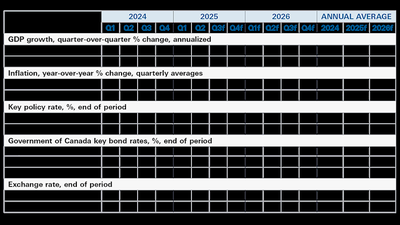
Summary table: Forecasts for GDP growth, inflation, policy rates, bond yields, and exchange rates.
Key Macroeconomic Concepts and Formulas
Gross Domestic Product (GDP): The total value of goods and services produced within a country in a given period.
GDP Growth Rate Formula:
Inflation Rate Formula:
Labour Productivity Formula:
Potential GDP: The maximum output an economy can produce without causing inflation.
Aggregate Demand and Supply: Key determinants of overall economic activity, influenced by trade, investment, and policy.
Example: Impact of Trade Diversification
When exports to the U.S. decline due to tariffs, increasing exports to other countries can partially offset losses. However, if the increase is insufficient, overall GDP growth remains subdued. This highlights the importance of trade diversification and structural reforms to boost economic resilience.
Summary
Canada faces a period of low GDP growth due to both cyclical and structural challenges. Policy measures targeting investment and infrastructure are crucial for raising economic potential, but immediate relief depends on monetary policy. Understanding the interplay between trade, investment, productivity, and policy is essential for analyzing macroeconomic performance.
